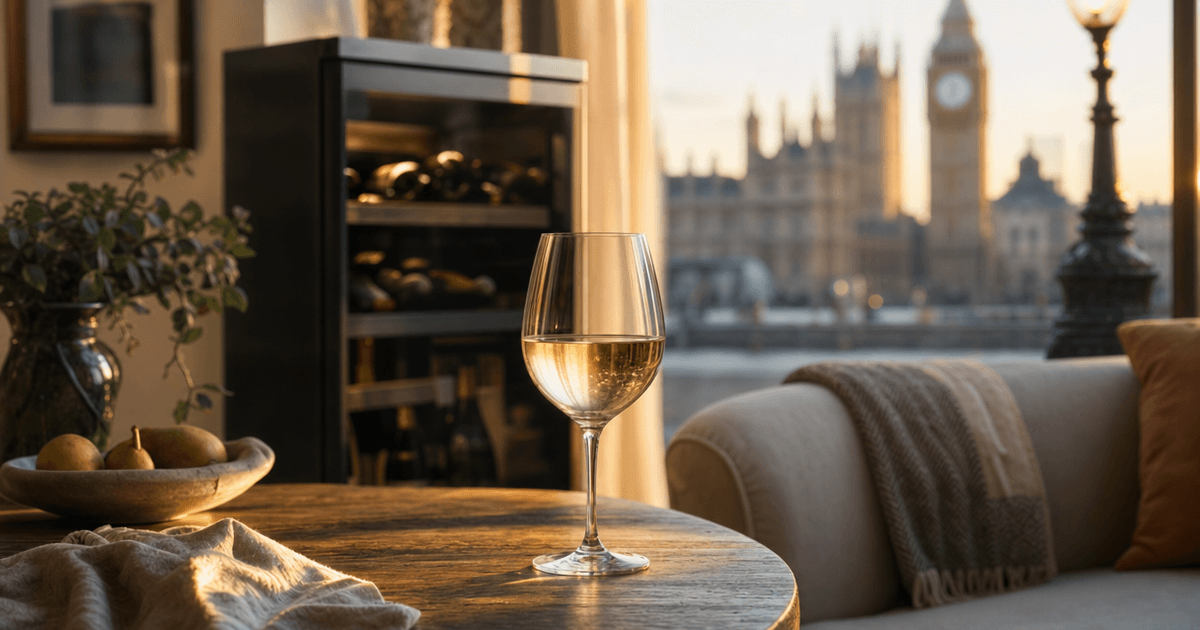
Your central heating is quietly mistreating every red in the house. “Serve at room temperature” was advice written for rooms that no longer exist, and following it in a modern British sitting room is the commonest way the serving temperature for red wine goes wrong — the bottle tastes “off,” you blame the wine, and it was never the wine’s fault at all. Serving temperature is simply how warm or cold the wine is the moment it hits your glass; it has nothing to do with how the bottle was stored beforehand. Better still, temperature is the one upgrade in wine that costs nothing — just a fridge and a little patience. By the end of this you’ll know exactly what to do with whatever’s open tonight — red, white, fizz or rosé — without needing a wine fridge to manage it. Get the temperature right and the fruit, acidity and tannin all show in proportion; get it wrong and you either mute the whole thing or let the alcohol shout over everything else.
What is the ideal temperature for a red wine?
Forget the idea of one magic number for “red wine” — the right temperature swings hugely by style. Serve a light, juicy red like Beaujolais Gamay or a young Loire Cabernet Franc too warm and it turns flabby; these want a cool 10-13°C. Step up to a medium-bodied bottle — Pinot Noir, a mid-weight Chianti — and 14-16°C lets the fruit and acidity balance properly. Big, tannic reds are the outliers: a young Bordeaux blend, a Barolo, a ripe Rioja Reserva all need real warmth, 16-18°C, before their fruit opens up and the tannins stop biting. Zoom out and the trade’s rough consensus spans 15-20°C for reds overall — the lighter the wine, the cooler it wants to be; the more structured, the more warmth it can take.
Here’s the mechanism behind that central-heating problem from the top of the page — “room temperature” is an inherited phrase from houses that ran a good five degrees cooler than ours do now. Push a tannic red past 20°C and the alcohol starts to evaporate so eagerly it unbalances the wine, pushing heat to the front and burying the fruit. Drop any red below about 8°C and most of the aroma simply won’t lift off the glass at all — you’ll be drinking something that smells of very little. Young carbonic-maceration reds, the light, juicy nouveau style, actually prefer the cooler end too, around 14-16°C, which is one reason they taste flat when served too warm.
If you’re serving a red Burgundy specifically, the maths shifts again with vintage and appellation — worth reading how to serve red Burgundy: temperature, glass and the decanting question before you open anything from the Côte de Nuits.
If that cool 10-13°C band for lighter reds is news to you, it’s also the cheapest experiment in this piece: pick up a bottle of Beaujolais, give it half an hour in the fridge, and see which side of the argument you land on.
What is the 20/20 rule for wine?
No wine fridge? No problem — just remember the twenty-minute trick. Reds fresh from the rack should chill in the fridge for about twenty minutes before you serve them, while whites straight from the fridge need roughly twenty minutes on the counter to shrug off the worst of the cold. This won’t land you on an exact number on the thermometer, but it’s a reliable fix for the two classic slip-ups: reds poured too warm and whites poured so cold they taste of nothing at all.
The reason it works at all is that most British living rooms sit around 20-21°C once the heating’s on, which is already above where a red wine’s serving temperature ideally sits, even for the full-bodied kind. Twenty minutes in the fridge brings a full-bodied red down towards that 16-18°C window nicely. But if what you’ve opened is a lighter style — something you’re after chilling closer to 10-13°C — twenty minutes probably isn’t enough; give it closer to thirty-five or forty. The rule is a starting point, not a stopwatch you should trust blindly.
One thing not to do: speed the process up on a radiator. Wine doesn’t warm evenly that way, and it tends to dull the character rather than restore it — better to be patient and let a cold bottle come up gradually in the room, or pour it into a glass and let your hands (and the room) do the work.

Every bottle in the house: the cheat-sheet
Reds get most of the attention, but the same logic runs right through the rack. Here’s the shape of it, style by style:
| Style | Serving temperature | Note |
|---|---|---|
| Sparkling wine | 8-10°C | Colder if it’s simple, a touch warmer for vintage styles |
| Rosé | 8-11°C | Treat like a light white |
| Fresh, light white | 10-13°C | Sauvignon Blanc, Muscadet, most Pinot Grigio |
| Complex, oaked white | 12-16°C | White Burgundy, barrel-aged Rioja Blanco |
| Light-bodied red | 10-13°C | Beaujolais, young Loire reds — yes, a little fridge time helps |
| Medium-bodied red | 14-16°C | Pinot Noir, Chianti, most Grenache blends |
| Full-bodied, tannic red | 16-18°C | Bordeaux blends, Barolo, Rioja Reserva |
| Dry fortified (fino-style) | 8-14°C | Serve cool, closer to a crisp white |
| Sweet fortified | around 18°C | Vintage Port and similar |
Sweet, flabby or lower-quality whites benefit from serving cold too — chilling hides a multitude of small sins, which is exactly why cheap fizz and supermarket rosé get served icy. A genuinely good complex white doesn’t need the disguise, so give it a little more warmth and let it show what it can actually do.
There’s a buying rule hiding in that table, too. If your flat runs warm all year, shop for the fridge-friendly rows — a Beaujolais or a young Loire red will repay you far more readily than a big Barolo you can’t keep cool. And if tonight’s bottle will sit out warming while you talk, pick the most forgiving target: a full-bodied red at 16-18°C is only a couple of degrees off where the room will take it anyway.
How to actually get there without a wine fridge
The fridge cools wine at roughly 2°C every ten minutes, and warms it back up at about the same rate once you take it out — useful maths for working backwards from a dinner time. An ice bucket with water and ice, not just ice on its own, chills a bottle faster than the fridge if you’re pressed for time; the water makes contact with more of the glass than ice alone ever manages.
Decanting has a side effect worth knowing: pouring a wine from bottle into decanter, or decanter into glass, warms it slightly on the way through, and cupping the glass in your hand warms it further still. That’s fine for a wine that needs coaxing open — less fine if you’ve just got it to the right temperature and then sit there warming it back out of range over twenty minutes of conversation. If you’re opening something old and worth the ceremony, our piece on how do you serve an aged Barolo? Decanting, glasses and timing goes into exactly when that warming works for you rather than against you.
Glassware plays its part too. A wide-bowled glass exposes more surface area to the air, which both releases aroma faster and lets the wine warm up in your hand more quickly than a narrower glass would. Not every glass in the cupboard needs replacing to fix this — see glassware that matters (and glassware that doesn’t) for where it’s worth spending money and where it genuinely isn’t.
For the wider picture — matching a bottle to the right occasion at home, not just the right serving temperature — our pillar piece on bringing the vineyard home: drinking well in the city is worth a browse too. Stock the rack with the thermometer in mind — a couple of fridge-happy light reds alongside the big ones — and every bottle in the house ends up with a job it can actually do.
Questions customers ask us
Does “room temperature” mean the same thing as serving temperature for red wine? Not really. The phrase dates from an era of cooler European houses, often closer to 15-16°C — most modern British rooms run at 20-21°C or warmer, which pushes even a full-bodied red past its ideal window.
Can I put red wine in the freezer to speed things up? You can, briefly, if you’re watching the clock — just don’t forget it’s in there. A few minutes is fine; twenty is a wine that’s gone from underchilled to overshot.
Does temperature affect how a wine ages in the bottle, not just how it’s served? Yes, though that’s a different question to serving — storage around 10-15°C lets a wine mature gradually; much warmer and it can taste cooked or jammy well before its time.
What wine is best for GERD? That’s a medical question, not one I’m placed to answer — your GP or pharmacist is the right person to ask. What I can do is point you towards softer, rounder, lower-tannin styles if that’s the general direction you’re after; tell me what you usually enjoy and I’ll steer from there.
The merchant’s last word
I’ve poured plenty of good bottles at the wrong temperature over the years, usually because the room got hot and nobody noticed. It’s not a technicality — it’s the difference between a wine tasting like itself and tasting like something apologising for itself. Get the temperature roughly right and everything else about the bottle gets easier. If you fancy something worth putting a thermometer to, come and browse the Red cellar — and tell me how warm your sitting room runs; I’ll pick with that in mind.



