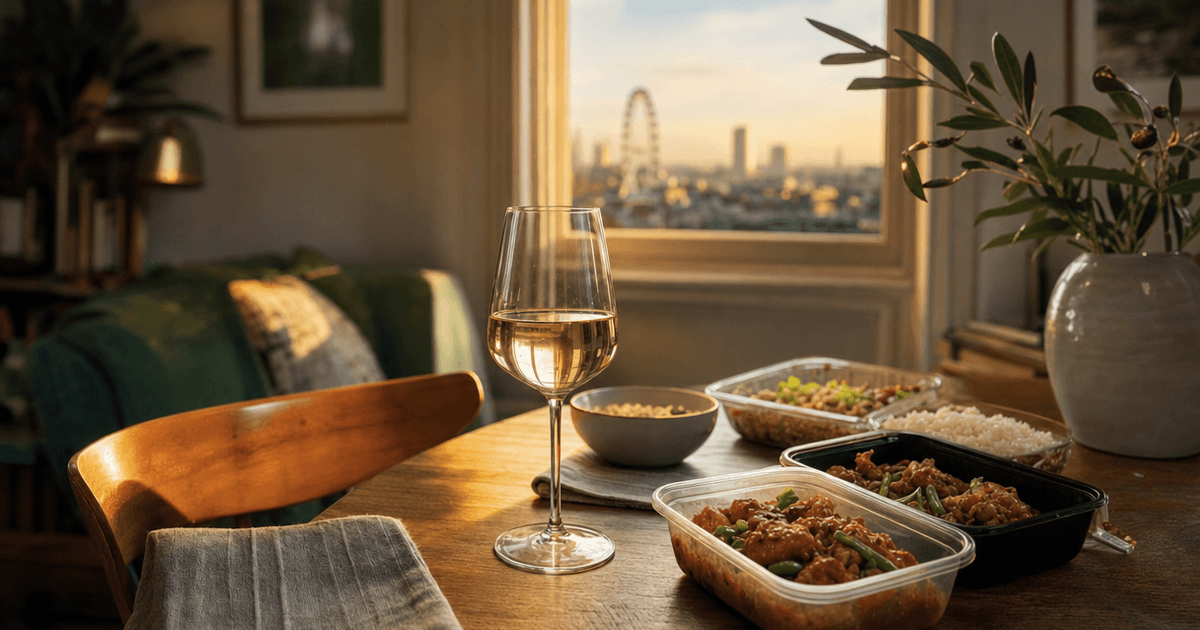
The best wine with Chinese food reveals itself the moment you stop reading the menu by its meats and start reading it by its sauces — every dish is really a sauce wearing a different protein, and the sauce is what your glass has to answer to. Wine pairing with Chinese food then comes down to managing the three things those sauces throw at a glass all at once: sugar, chilli heat, and the saltiness of soy. Get those right and almost any style of Chinese cooking — from a Friday chow mein to a full Cantonese banquet — has a wine that suits it. By the end of this you’ll know exactly which bottle to grab on a Tuesday night, and which one to save for the steak.
What is best to drink with Chinese food?
Trade opinion keeps landing on the same shape: aromatic white wines with a touch of sweetness — Riesling, Gewürztraminer — proper sparkling wine, and light, low-tannin reds like Pinot Noir or Beaujolais. What gets left behind, almost every time, is anything big, oaky or heavy with tannin. A Cabernet Sauvignon built for a rib-eye will fight your sweet and sour pork rather than sit next to it nicely.
Here’s the bit that took me longer to understand than I’d like to admit: it’s not really about “Chinese food” as one cuisine, it’s about what tannin does to chilli and sugar. Tannin grips onto capsaicin and turns up the burn; it also clashes with sweetness and reads as thin and bitter against soy. Acid and a bit of residual sugar do the opposite — they cool the chilli down and pick up the sweetness in the sauce rather than argue with it.
That’s why Riesling shows up so often on these lists, particularly a German Kabinett with a little sweetness, or something dry and steely from Alsace. Gewürztraminer, especially Alsatian, does something similar with its lychee-and-rose-petal lift — it’s built for spicier dishes. Grüner Veltliner earns a quiet place here too, and it’s worth reading up on properly if you’ve never given it a fair go — see Grüner Veltliner: Austria’s answer to everything. For fizz, Champagne and English sparkling wine both do the job of resetting your palate between a black bean dish and a sweet-and-sour one. If you’re standing in the shop with one Friday order to cover, a German Kabinett Riesling somewhere in the £10–£15 band is the single most useful bottle on this whole page — enough sweetness for the sauce, enough acid for the chilli. If this all feels like a bigger question than one takeaway order, the wider picture is in Bringing the vineyard home: drinking well in the city.
Matching the wine to what’s actually on the table
This is where reading sauces first pays off in actual bottle choices. Here’s the shape of it, dish by dish — sauce first, protein second:
| On the table | Reach for |
|---|---|
| Sweet and sour | Off-dry Chenin Blanc |
| Black bean sauce | Alsace Gewürztraminer |
| Soy-based stir-fry | Off-dry Riesling, or a fruity Beaujolais |
| Hoisin, duck pancakes | Big, oaked Chardonnay |
| Peking duck | Red Burgundy, or off-dry German Riesling (Auslese) |
| Szechuan or Hunan spice | Off-dry Riesling (Spätlese/Auslese), or Alsace Gewürztraminer |
| Dim sum | Champagne or English sparkling wine |
| Fried rice | Dry or off-dry Riesling, or Pinot Gris |
None of this is gospel — a table with six dishes going at once needs a different answer, which I’ll come to. And no, tonight isn’t the night to reach for a big claret. If you fancy that kind of structured red another evening, it’s worth knowing how second wines: how to drink a great château without the grand vin price work — just not with the sweet and sour.

What wine goes well with chow mein?
Chow mein’s a good test case, because it changes character completely depending on what’s tossed through the wok. A prawn or veg chow mein wants the citrus snap of a New Zealand Sauvignon Blanc, or an off-dry Riesling; push it toward beef or a darker, oyster-sauce version and a fruity Beaujolais or lighter Pinot Noir holds its own without the tannin that soy sauce turns bitter. Keep one of each at home — a zippy white and a soft, juicy red — and you’ve covered every chow mein the local menu can throw at you.
That acid-over-oil logic is the same reason Sauvignon Blanc does well with fried starters generally — it cuts through the grease rather than sitting heavy alongside it. If what you’re after is that slightly charred, smoky wok-hei flavour on a beef or duck chow mein, a glass with a bit more fruit weight earns its keep, but stick to lighter-bodied wine as a rule. Chow mein doesn’t reward a big, structured red, however good that bottle might be with a Sunday roast.
What alcoholic drink goes well with Chinese food?
Wine isn’t the only sensible answer, and plenty of good Chinese restaurants know it. Beer — a crisp pilsner, a wheat beer, or a cold lager — handles chilli heat just as well as any white wine, sometimes better. Chinese tea, served throughout the meal, is the traditional palate-cleanser, and rice wine such as sake or warm Shaoxing sits closer to the cuisine’s own roots than anything from Burgundy or the Rhône.
There’s also an old Cantonese banquet habit worth knowing, even if you never try it: Cognac, mixed with 7-Up or soda water, served alongside dishes built on soy or black bean sauce. It sounds odd next to a wine list, but it does the same job — sweetness and fizz cutting through salt. Plum wine tends to turn up at the end of the meal rather than alongside it, more a closing note than a pairing choice. If you’d rather stay in cocktail territory, look for anything built on a light white spirit — gin or vodka — over anything dark and heavy.
The big feast problem: one wine for a table that’s arguing with itself
Order for one and this is easy. Order for a table of six sharing eight dishes — sweet, sour, salty, chilli-hot, all landing at once — and the one-wine-per-dish approach falls apart before the first plate arrives. What you want instead is an all-rounder, something built to reset the palate rather than match any single flavour exactly.
Sparkling wine is the obvious answer, and recent trade coverage backs this up: Champagne, English sparkling wine, Cava, or a well-chilled Prosecco all do the palate-cleansing job well across a table of clashing dishes. As a buying rule: Prosecco or Cava when it’s a Friday order for the sofa, English sparkling when the table’s worth showing off to. If the meal leans heavily on red-braised, strongly seasoned meat, a lightly chilled sparkling red such as Lambrusco earns its place too — enough fizz to cleanse, enough fruit to keep up.
This isn’t Port-and-cheeseboard territory, where the wine is the slow, considered finish to an evening (if you’re curious whether Port even needs years in bottle before it’s worth opening, that’s a separate question entirely). Wine pairing with Chinese food wants to be poured young, cold, and without ceremony — glasses topped up between dishes rather than swirled and studied.
Questions customers ask us
Which wine is best for diabetics? That’s a question for your GP or pharmacist, not your wine merchant, and I won’t pretend otherwise. What I can tell you, factually, is that dry wines carry less residual sugar than off-dry styles like Kabinett Riesling, if that’s useful when comparing bottles.
What’s good with dim sum specifically? Sparkling wine and Chinese tea both do well here, alongside a lighter-bodied white or a German Riesling — dim sum is varied enough across the trolley that nothing heavy is ever needed.
What about proper spicy Szechuan or Hunan food? Off-dry Riesling at Spätlese or Auslese level handles real heat better than most reds, and a cold beer does no harm either. Beaujolais is about the only red that keeps up.
The merchant’s last word
I’ve sold wine to people ordering a Friday takeaway for fifteen years, and the mistake I made early on was recommending the same “safe” red to everyone, whatever they’d ordered. It doesn’t work like that — a sweet and sour dish and a black bean one want different things in the glass. Keep it light, keep a little sweetness in reserve, and leave the big reds for another night. If you’d like a bottle already sorted for an evening like this, browse the Red cellar.



