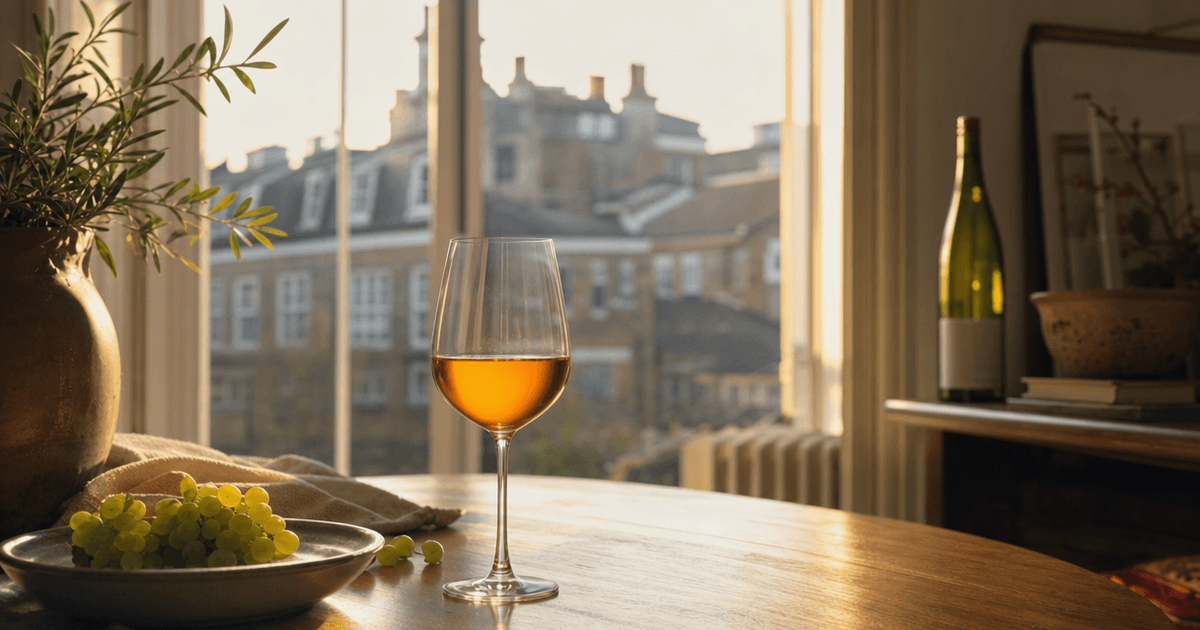
The Grüner Veltliner grape is the only white on my shelf that bites back — a genuine snap of white pepper running through the finish — and that bite is the thread to hold onto through everything else about it. It’s Austria’s own white grape, and by some distance its most planted, doing the work of about a third of the country’s entire vineyard on its own. It’s a natural cross between Savagnin and an obscure old vine once found near St Georgen in Burgenland, first written about back in the eighteenth century. By the end of this you’ll know whether it’s dry or sweet, how close it really sits to Riesling and Sauvignon Blanc, and where in the price range to spend your money to get the good stuff rather than the merely fine.
What the grape actually is
Grüner Veltliner covers close to half of Austria’s white grape land as of the last count, and it dominates Niederösterreich (Lower Austria) in particular — Weinviertel, Kamptal, Kremstal, Wachau, Wagram. That’s a lot of one grape doing a lot of different jobs.
Clear up the name first, because I got this wrong myself for years behind the counter: despite the shared “Veltliner”, it has no relation to Roter Veltliner or Frühroter Veltliner. Different grapes entirely, DNA profiling settled that. And the name has nothing to do with Valtellina in Italy either, whatever the old guidebooks implied.
That pepper bite has a name and a cause. The compound is rotundone — the same thing that gives black peppercorns their snap — and Austrians call the sensation Pfefferl: a peppery, faintly tactile bite alongside a savoury, vegetal register. Green beans, lentils, mangetout, cress, sometimes rhubarb or roasted red pepper, with citrus zest running underneath. It’s an unusual flavour lexicon for a white wine, and it’s exactly why Grüner Veltliner wine doesn’t taste like anything else on the shelf. My shorthand for customers: if it smells of white pepper and green beans and still finishes bone dry, you’re in Grüner country — and once you’ve placed it, the next question is simply which version of it to buy.
Is Grüner Veltliner dry or sweet?
Grüner Veltliner is virtually always dry. Sweet bottlings exist — the odd Eiswein or late-harvest style — but they’re the exception, not the rule, and you’ll usually see them flagged clearly on the label rather than left to guesswork.
Where people get caught out is confusing riper with sweeter. Wachau’s classification runs Steinfeder (lightest), Federspiel (medium), Smaragd (fullest) — a scale of ripeness and body, not sugar. A Smaragd can carry more alcohol than a Riesling from the same hillside, sometimes over 14%, and still finish bone dry — even the pepper reads richer, but never sweet. Weinviertel’s Reserve tier even allows a touch of botrytis-affected fruit for extra richness and texture — again, still dry. Richness and sweetness are not the same conversation with this grape, and knowing that is what stops you buying the wrong weight of bottle for the evening you’ve planned.
Is Grüner Veltliner similar to Riesling?
They’re Austria’s two great dry, high-acid whites, often grown on the very same slopes — in Wachau’s best single-vineyard sites, only Grüner Veltliner and Riesling are permitted at all. So yes, there’s real kinship: both age well, both are built on acid rather than fruit sweetness.
But the soil tells a different story. Riesling wants poor, stony, dry ground to struggle on. Grüner Veltliner, oddly for such a vigorous vine, actually prefers clay and loess that hold water — put it on dry stone and it sulks. That’s why you’ll often find Riesling on the steepest, poorest terraces and Grüner Veltliner just below on the richer loess. In the glass, Riesling tends toward a purer, more floral citrus line; Grüner brings that savoury, peppery weight and a rounder mouthfeel. If you love hunting out these soil-driven contrasts, it’s worth a wander through Beyond the classics: the wine map’s best-kept secrets — Austria is far from the only place where geology does the talking.
Is Grüner similar to Sauvignon Blanc?
There’s a genuine overlap in the green, herbaceous register — Grüner’s cress and green bean notes will feel familiar if Sauvignon Blanc is your usual pour. But it’s not the same green. Sauvignon Blanc’s is grassier and zippier; Grüner’s is softer, more savoury, and carries that distinctive pepper snap Sauvignon simply doesn’t have.
Texture is the bigger tell. Good Grüner Veltliner has a waxy, almost lanolin-like roundness to it, especially with a bit of bottle age — where Sauvignon stays linear and taut, Grüner fills out. If the appeal of Sauvignon is its brightness with a herby edge, you might also get on well with Albariño and the wines of green Spain — a different grape chasing a similar freshness from a very different coastline. And if the pepper is what hooks you, there’s no substitute: that’s Grüner’s alone.
Choosing a style: the regions do the deciding
This is the bit that actually matters at the till. Grüner Veltliner isn’t one wine — it’s a family, and the region tells you almost everything before you’ve opened the bottle.
| Region | What shapes it | What’s in the glass |
|---|---|---|
| Weinviertel | Cooling northerly breezes, DAC rules mean single-varietal Grüner only | The most peppery style — citrus, green fruit, high acid, medium body |
| Wachau | Steep Danube terraces, three ripeness tiers (Steinfeder–Federspiel–Smaragd) | Ranges light to full-bodied; top Smaragd wines can age for decades |
| Wagram | Loess soils, warming influence off the Pannonian plain | Medium body, high acid, good to very good quality, mid-to-premium pricing |
| Kamptal / Kremstal | Named alongside Wachau and Wagram among Austria’s top sites | Broadly similar quality ambitions to Wachau, site by site |
If you’re new to the grape, start in Weinviertel — it’s the most typical, most peppery expression, and the DAC rule means you know exactly what you’re getting. Move to Wachau once you want to see what the grape does when it’s allowed to be serious. In buying terms: a Weinviertel Klassik or a Federspiel is your aperitif-and-weeknight bottle at the value end, Wagram and the Reserve wines are the mid-range step up for a proper dinner, and single-vineyard Smaragd is the occasion bottle you cellar or gift.
Serving it right
Grüner Veltliner earns its keep at the table more than most white grapes. The food-pairing list reads almost comically long — asparagus, pork, roast veal, scallops, oysters, sushi, Wiener Schnitzel, Thai and Indian spice, mushrooms — and that’s because the pepper and savoury vegetal notes actually flatter dishes that fight most whites. Asparagus alone, the famous wine-killer, is reason enough to keep a bottle in the fridge door.
Pour it properly chilled but not fridge-cold — straight from the fridge and you’ll mute the pepper entirely, which rather defeats the point. A decent-sized glass helps too; the aromatics need a bit of room to unfurl rather than being trapped in something narrow.
Is Grüner Veltliner wine good?
Yes — but the range is wide, and knowing that is half the job of buying well. At high yields it can be, in the trade’s own blunt phrase, inoffensive if unexciting: pleasant, forgettable, fine for a Tuesday. At its best, particularly from Wachau’s steepest sites, it’s genuinely world-class and ages for decades.
The old habit of bottling it in casual one-litre formats did the grape’s reputation no favours — plenty of that wine was honest and good value, but it framed Grüner Veltliner as a shrug rather than a serious pour. I still get customers surprised the same grape made both the party bottle of their Vienna city break and the twenty-year Smaragd I keep talking up. Grüner Veltliner wine price tends to track region and ambition fairly honestly: everyday Niederösterreich bottlings sit at the value end, Wagram and Weinviertel Reserve sit in the middle, and single-vineyard Wachau Smaragd sits at the top, priced and built to last. Trade opinion has settled on calling it fashionable, versatile, and genuinely top-quality when it wants to be — I’d agree, with the caveat that you do need to know which bottle you’re reaching for. That’s not a flaw; it just means the label rewards thirty seconds of attention before the till.
Questions customers ask us
What does Grüner Veltliner actually taste like, in one line? Citrus zest and green vegetal notes — think lentils and green beans — with a peppery, almost tactile bite running through the finish. It’s savoury rather than fruity as whites go.
Which Grüner Veltliner should I try first? A Weinviertel Klassik is the honest entry point — DAC rules keep it single-varietal, and it shows the peppery, citrus style the grape is known for without any complication.
Does Grüner Veltliner age well? The everyday styles don’t need to. But top Wachau Smaragd wines are built for the cellar and can improve for decades — a different proposition entirely from the wine you’d drink this week.
Is it similar to Chardonnay? Not directly, though the trade has drawn the comparison for versatility’s sake — food-friendly, capable of both simplicity and seriousness. If you want to see how far a single white grape can be pushed toward purity, Chablis: the purest Chardonnay? makes for a useful side-by-side read.
The merchant’s last word
I used to sell this as the “safe” white for people who didn’t want to think too hard — and I was underselling it badly. Grüner Veltliner does casual Tuesday and serious Sunday roast equally well, which is rarer than it sounds. Work out which job you need it for, pick the region to match, and you won’t go far wrong. Have a look through the browse the France cellar and see what’s calling to you — and if it’s your first bottle, ask me for the peppery one.



