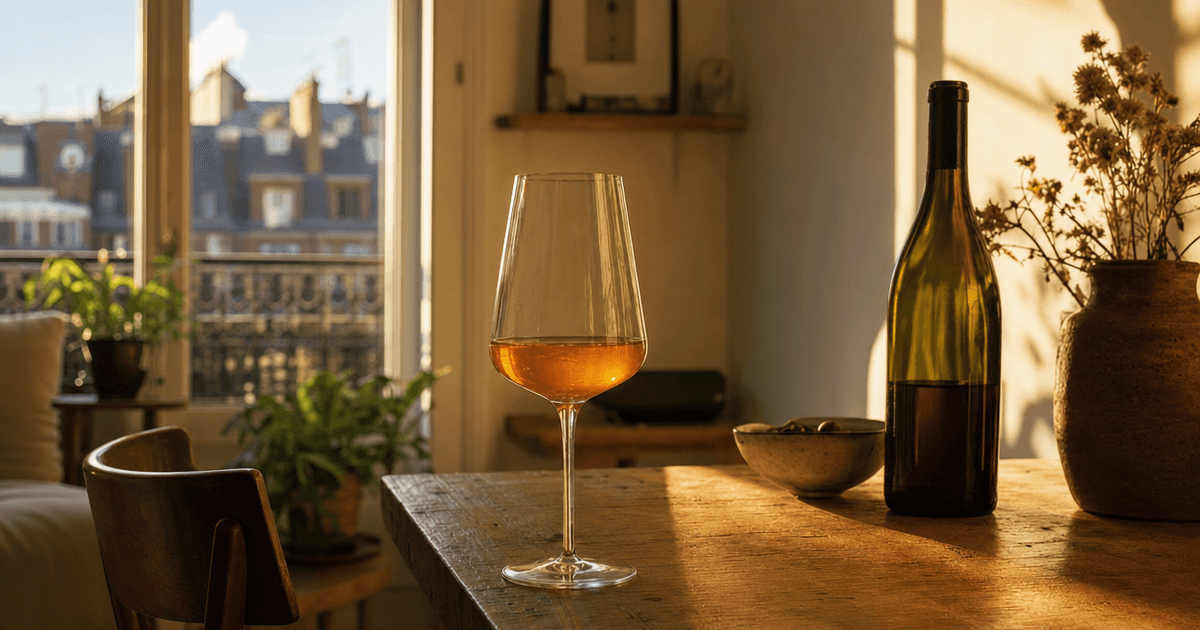
What is natural wine, honestly? Here’s the thing nobody tells you first: every other bottle in this corner of the shop is defined by a place — a valley, an island, a slope. Natural wine alone is defined by a promise. In two sentences: it’s an unregulated term for wine made from organic grapes with next to nothing added and next to nothing taken away — no cultured yeast, no acid adjustments, minimal or no sulphur. And because nobody official checks that promise, the customer holding the slightly cloudy bottle with the hand-drawn label is right to be half-suspicious of it. By the end of this you’ll know what’s actually in the glass, how it differs from a standard bottle on the next shelf, and whether that extra fiver is worth it on a Tuesday.
What is considered a natural wine?
At its plainest: hand-picked, organically grown grapes, fermented with wild yeast from the vineyard and cellar air, with nothing else added — no enzymes, no lab yeast, no lactic bacteria — and nothing stripped out by heavy fining or filtration. Most producers use little or no added sulphur, sometimes a small dose at bottling and nothing more. There’s no single legal definition, so quality genuinely varies bottle to bottle.
That looseness isn’t an accident. A 2020 OIV presentation described the natural wine movement as more of a philosophy than a practice — the idea of minimal intervention to achieve maximum purity. Some producers go further still: the term “zero-zero” describes wine with nothing added and nothing subtracted at all, not even a light filter. Others allow themselves a coarse filtration and call that pragmatic, not a compromise.
France has the only nationally recognised certification, Vin méthode nature, which is fairly recent; beyond that, associations such as VinNatur publish their own standards, and any winery can simply claim the word without anyone checking. Worth knowing too: in French, “nature” applied to a still wine usually just means non-sparkling — a different sense of the word entirely, and one that trips people up on old labels. Germany once had its own version, Naturwein, meaning must with no added sugar or water, but that term was abolished by the 1971 wine law in favour of Prädikat classifications. “Natural” has meant different things to different generations — it isn’t new, and it isn’t fixed.
What’s the difference between natural wine and regular wine?
Regular wine is allowed to be corrected. Natural wine, by design, isn’t. Conventional winemaking permits acidification, chaptalisation (adding sugar), reverse osmosis, cultured yeast strains chosen for reliability, and fine or cross-flow filtration to polish the wine before bottling. Natural winemaking rejects all of it, aiming instead for the vineyard and the vintage to speak for themselves, faults and all.
Here’s the shape of it side by side:
| Practice | Regular wine | Natural wine |
|---|---|---|
| Yeast | Cultured strains chosen for reliability | Wild, ambient yeast |
| Acid adjustment | Common, especially in warm vintages | Rejected |
| Added sugar (chaptalisation) | Permitted in some regions | Rejected |
| Filtration | Fine or cross-flow, standard | None, or coarse only |
| Sulphur dioxide | Added at several stages | Minimal, often only at bottling |
| Temperature control | Extensive | Minimal |
None of this makes conventional winemaking dishonest — it’s about consistency, about a Rioja tasting recognisably like Rioja three vintages running. Natural wine leans the other way: a 2018 and a 2019 from the same tiny plot can taste like different wines entirely, because nothing’s been smoothed over. You’ll also hear “low-intervention” used as a more descriptive stand-in for “natural” — it’s the same idea without the baggage the word “natural” now drags with it. Skin-contact whites sit in this world too; if you want the fuller picture there, Orange wine explained: the fourth colour covers it properly.
Why is natural wine better?
It isn’t automatically better — it’s different, and the quality gap within the category is wider than in almost any other style I stock. At its best it tastes vivid, alive, transparent to the place it came from. At its worst it tastes cloudy, vinegary, or has that damp-farmyard “mousy” character some drinkers can’t get past. I sold this wrong for years, honestly — I used to let the romance of the story do the selling and forgot to warn people what they might actually get in the glass.
The trade argument runs both ways, and it’s worth knowing it exists before you spend money. Some respected importers have publicly refused to stock natural wine, arguing that too many bottles let faults masquerade as character. Others — plenty of sommeliers among them — argue the opposite: that stripped of additives and correction, natural wine is the truest expression of terroir going. Both camps are right about the wines they’re each thinking of; that’s rather the problem with a category this loosely defined. A promise, unlike a place, can’t be tasted blind.
The movement’s roots go back further than the current fashion suggests — to figures like Jules Chauvet, a winegrower and scientist working around Beaujolais from the mid-20th century, and later to biodynamic advocates such as Nicolas Joly in the Loire, whose Renaissance des Appellations network still has more producers in that valley than anywhere else. Small, disruptive collectives have carried it since, from Beaujolais crus like Morgon through to newer scenes as far as the Adelaide Hills. The best of it, in my glass anyway, comes from growers who’ll tell you plainly: their real goal was good wine, natural methods just happened to be how they got there.
Buying and serving it well: what the label tells you
Look for “Vin de France” on a bottle from a known natural-leaning grower — many decline their own appellation deliberately, because AOC rules can restrict wild ferments or zero-sulphur bottling. “Zero-zero” on a shelf-talker means exactly what it says: nothing added, nothing removed. A touch of harmless sediment or a slight spritz isn’t a flaw here; it’s often just what minimal filtration looks like. If you’re buying your first bottle, don’t start at the deep end: a low-intervention white from the Loire or a cru Beaujolais — Morgon country — will show you the vivid side of the style before you go anywhere near the wilder zero-zero shelf.
If a wine smells a bit reductive when you first pull the cork — a whiff of struck match or rubber — give it air. A decant, or even just a good swirl and five minutes, sorts most of that out before the glass, not the bottle, does its job. Serve funkier reds a shade cooler than you would a polished equivalent; it tends to firm up the fruit and calm the wilder edges. Labels reward reading properly, much like they do in fizz — the same instinct applies in Grower Champagne vs Grande Marque: what the label tells you.
Where it comes from — and what that means for price
Natural winemaking clusters where low-input viticulture already had a head start: the Loire Valley (Sancerre, Muscadet, Anjou), Beaujolais, Jura, and pockets of Piemonte around Barolo where organic, hands-off growing was already the local instinct. Outside Europe, Australia’s Adelaide Hills has built a genuinely serious scene since small groups of winemakers there started experimenting through the 2000s, disrupting a fairly conservative regional identity along the way.
None of this is cheap to make. Hand-picking, lower yields, and the labour of babysitting an unstable ferment cost more than mechanised, corrected winemaking — so natural wine rarely turns up as a bargain-bin filler, though it isn’t automatically premium either. Recent trade coverage suggests the category has been building steadily since around 2009, only really hitting fever pitch in the last few years, which is part of why the shelf-talkers can feel newer than the wines actually are. When you’re deciding where to spend, follow the clusters: the Loire, Beaujolais and the Jura have been at this longest, which means more growers to choose from and more practised hands behind the bottles. If you want to explore beyond these obvious spots, Beyond the classics: the wine map’s best-kept secrets is a good next stop.
Questions customers ask us
Does organic wine prevent headaches? That’s not a claim any honest wine shop can make. Organic certification is about how the grapes were grown, not sulphite levels specifically — those vary bottle to bottle regardless of organic status, so ask about SO2 levels directly if that’s your concern.
Which wine is best for diabetics? That’s a medical question, and your GP or dietitian will give you a far better answer than I can. What I can help with is finding drier styles with lower residual sugar, natural or conventional, if that’s useful to know.
What is the natural wine movement, in one sentence? A loose, international attitude rather than a rulebook — minimal intervention as a philosophy — with real energy running from Beaujolais and the Loire through to small, disruptive scenes as far as South Australia.
The merchant’s last word
I like natural wine best when nobody’s trying to sell me the story instead of the wine. Some of it is genuinely thrilling; some of it, honestly, needs more sulphur than its maker was willing to add. Taste around, trust your own palate over anyone’s manifesto, and don’t be afraid to send a corked-tasting bottle back. If you fancy exploring where these styles actually come from, browse the France cellar.



