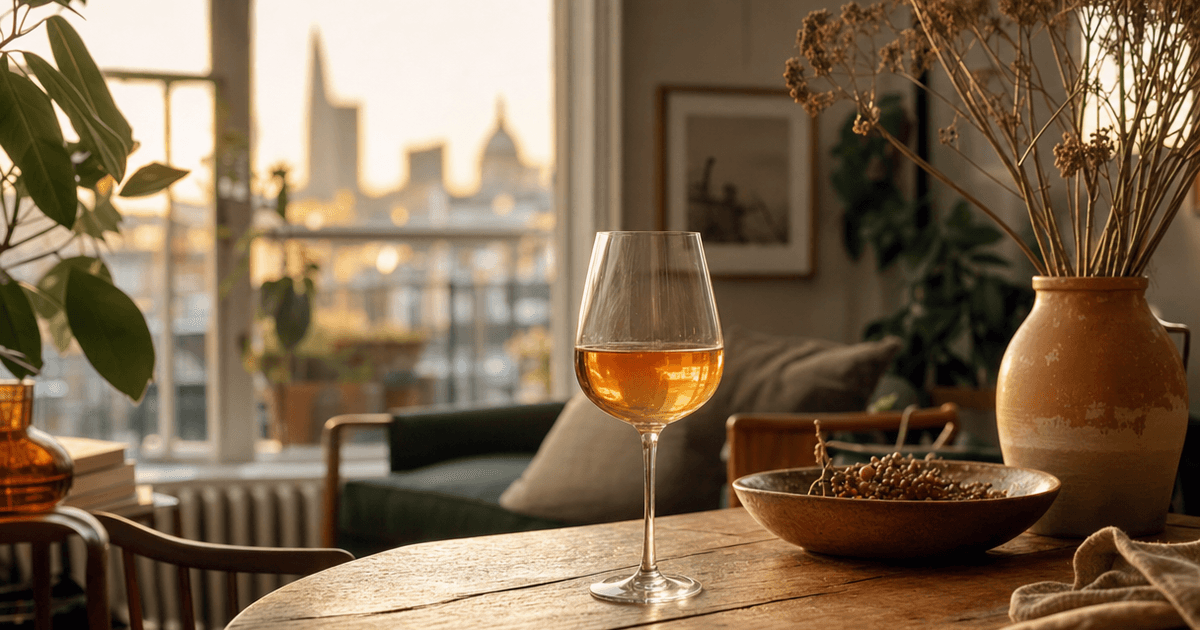
Type orange with wine into a search bar and you’ll land in two completely different shops. One sells a dry, tannic style poured in wine bars from Tbilisi to Tooting. The other is trying to work out whether orange juice and a bottle of red make any sense together. Orange wine is a dry, tannic wine made from white grapes left to sit on their skins the way red wine is made — it has nothing to do with the fruit. This piece keeps both shops open: you’ll find out which one you actually meant, how the real thing is made, and whether it deserves a spot in your glass.
Orange wine, the fourth colour: what’s actually in your glass
Here’s the bit that trips people up: orange wine is white wine, made red-style. Ferment the juice of ripe white grapes together with their skins and pips (sometimes the stems too) for anywhere from a week to a full year, and you get something that isn’t pale straw any more — it’s yellow, amber, gold, orange, sometimes even pink, depending on the grape, how ripe it was, how long it sat, and what it fermented in.
Clay vessels — qvevri in Georgia, amphorae elsewhere — are increasingly fashionable for this, but they’re not essential; plenty of good orange wine is made in ordinary tanks and old wood. The style has different names depending where you are: vino naranja in Spain, vino bianco macerato (or just vino orange) in Italy, Orangewein or maischvergoren in Germany. The English term is younger than the wine itself — trade history credits a British wine buyer working in a Sicilian cellar with coining “orange wine” back in 2004, though the technique itself is thousands of years old, going back to amphora fermentation in Georgia.
One aside worth knowing: colour genuinely changes how we taste. Wine science research has shown that a deeper-coloured wine gets described as more intense on the nose even when the liquid inside is identical — your eye primes your palate before the glass reaches your lips. And amber tones aren’t unique to this style either; a very old Madeira goes gold, orange, even chestnut, purely from age, nothing to do with skin contact at all.
Does wine go with orange?
Yes, brilliantly — if you mean the fruit, and if you pick a wine with enough sweetness or fizz to meet it halfway. A still, dry red or white generally loses to citrus acidity; something sweeter or sparkling stands its ground. This is a genuinely different question from whether an orange-coloured wine suits your dinner, which we’ll get to.
The classic pairing partners for oranges as a dessert or citrus dish include:
- Moscato d’Asti or Asti, for a light, gently sweet lift
- Orange Muscat or Muscat de Beaumes-de-Venise, for an obvious flavour echo
- Sauternes or a late-harvest Riesling, for richer, more concentrated orange desserts
- Tokaji from Hungary, if you want real depth alongside marmalade or candied peel
- A simple sparkling wine, if you just want to cut through the sweetness
If it’s the fruit you’re buying for, that list is your shopping order: Moscato d’Asti for a low-stakes lift, Tokaji when the pudding turns dark with marmalade or candied peel. Put wine and orange together in most people’s heads and they picture that fruity, sweet-wine territory — not the tannic, savoury style we’re building towards.
What is wine made with oranges called?
There isn’t one — no established fine-wine category is actually fermented from orange fruit. “Orange wine” the style is named for its colour, not its ingredients, and that naming choice causes half the confusion in this whole topic.
Even the grape names that mention oranges aren’t about the fruit. Orangetraube, grown mainly around Vienna, gives wines with racy acidity and stone-fruit character — the name refers to its aromatics, not orange juice. Orange Muscat (also called Muscat Fleur d’Orange) is a cross of Chasselas and Muscat Blanc à Petits Grains grown in small pockets of California, Oregon and Trentino. Goldburger, a Burgenland cross of Welschriesling and Orangetraube, mostly ends up in sweet wines. None of them contain a drop of actual orange.
What’s it called when you mix wine and orange juice?
Mixing sparkling wine with orange juice gives you a mimosa — bar-cart territory, not really a merchant’s job to weigh in on beyond that. There’s no recognised trade term for mixing a still wine with orange juice; it’s just a drink someone invents on a Sunday, not a wine style with a lineage.
So back to that phrase, orange with wine — by now you know which shop you actually wanted. The rest of this piece is about the real one: the dry, skin-contact, tannic style that’s earning shelf space well beyond hipster wine bars.
How it’s made: skin contact, amphorae and time
The engine room of orange wine is maceration — leaving white grape skins in contact with the juice for far longer than normal, sometimes with pips and stems too. In parts of Friuli Venezia Giulia, especially the Oslavia corner of Collio, and just over the border in Slovenia’s Brda, producers push maceration anywhere from eight days to six or eight months, then age the wine for two to six years in large old barrels before it’s even bottled.
The methods tend to travel together: organic farming, a fondness for local grapes (Ribolla Gialla is the great local hero here, though Malvasia Istriana gets the same treatment in the Carso), fermentation with whatever wild yeast turns up rather than a lab strain, no temperature control, and often no fining or filtration at all. The habits travel as a set, but don’t read them as a manifesto — what actually builds the style is the skin time, and you can taste the weeks in the glass.
What you get from all that skin time is genuinely different fruit and structure: dried fruit, dried herbs, hay, nuts, and real tannin — flavours that just aren’t available to a normally-pressed white. If any of this makes you want to see how differently regions can build the same idea, our Beyond the classics: the wine map’s best-kept secrets piece goes further into the corners of the wine world doing their own quiet, unfashionable thing.
Choosing and serving orange wine well
Treat it like neither a white nor a red, and you’ll do fine. (And to be clear, you’re firmly in the first shop now — the fruit stays in the bowl.) The tannin and freshness together make it unusually good at switching between courses — one New York sommelier once called it his get-out-of-jail-free card on tasting menus that lurch from fish to meat and back again, because it just keeps up with both.
Trade opinion has also taken to calling it a proper autumn wine: rich enough for the first cold evenings, fresh enough not to feel heavy if the sun comes out. Reach for it with things that echo its own flavours — nutty cheeses, roast root vegetables, anything with a dried-fruit or dried-herb note in the sauce. It’s also, fair warning, not cheap for what it is; scarcity and a devoted following among sommeliers and natural wine drinkers keep prices at a premium compared with everyday whites.
If you’re new to the category, don’t start with the most extreme, most oxidative bottle on the shelf. Start somewhere with restraint — a shorter maceration, a lighter hand; a Ribolla Gialla from Friuli with days rather than months on the skins is the classic first step — and let your palate meet the style halfway before you go looking for the six-month-on-skins version.
Questions customers ask us
Which wine is best for diabetics? That’s a question for your GP, not your merchant — we won’t make health claims either way. What we can tell you honestly is that dry wines have far less residual sugar than sweet styles like Sauternes, so if sugar content matters to you, a bone-dry bottle is the simpler starting point.
Is orange wine the same as natural wine? Often overlapping, never identical. Most orange wine leans on natural-leaning methods — wild yeast, little or no added sulphur — but plenty of cleaner, more controlled versions exist too. Our piece on What is natural wine, honestly? untangles that question properly.
Is orange wine the same as rosé? No — they get their colour from opposite directions. Rosé takes brief contact with red grape skins for its pink; orange wine takes long contact with white grape skins, which carry no pink pigment at all. If you want the full picture on the pink side, How is rosé actually made? covers it.
Is orange wine supposed to look cloudy? Sometimes, yes, and that’s not a fault. Skip the fining and filtration — as many producers here deliberately do — and a gentle haze is simply what unfiltered wine looks like.
The merchant’s last word
I used to file orange wine under “for the beard-and-tote-bag crowd” and steer regulars away from it. That was lazy of me — some of the most interesting bottles on my shelves now wear this colour, and they’ve won over customers who swore they only liked “proper” red or white. Try one with an open mind rather than a fixed idea of what wine should look like, and go browse the France cellar to find where to start.



