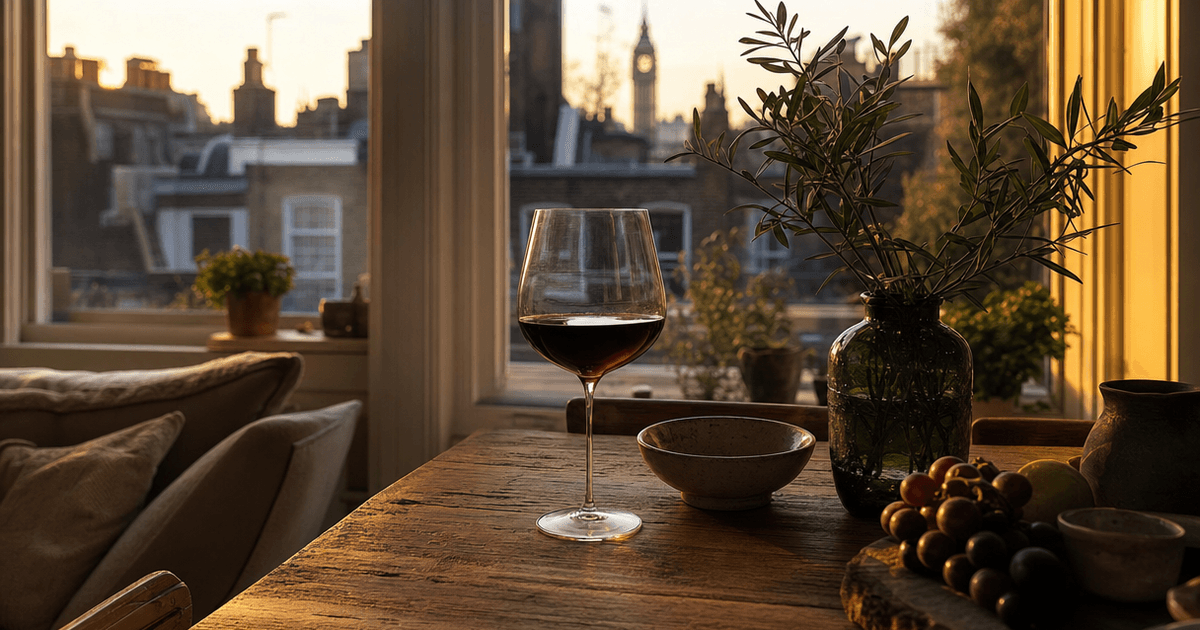
A wine tasting at home is a dinner party run backwards: the wine does the talking and the food keeps quiet. That’s the whole idea, and it’s worth holding onto, because everything else about the evening — how many bottles, which glasses, what order — falls out of that one reversal. Instead of one glass accompanying dinner, several wines sit open side by side and get compared; the wines are the conversation, not the background to one. No cellar, no sommelier, no spittoon required. By the end of this you’ll know how many bottles to open for two people or twelve, what glass and temperature genuinely matter, and how to keep the night feeling like a good night in rather than an exam. Done properly, wine tastings at home are the fastest route I know to working out what you actually like, glass by glass, at your own kitchen table — and the tuition costs an evening, not a course.
What actually counts as a wine tasting at home?
The picture in most people’s heads — a cellar, a spittoon, someone in a blazer saying “minerality” — is the single biggest reason more people don’t do this, and none of it is required. I’ve had customers apologise at the counter for wanting to “do a tasting” as if they were asking to borrow a cathedral. You’re not. Trade tastings — the ones held in judging rooms for the big wine shows, or twice a year in the cellars of Champagne — exist to compare and score, sometimes sixty or seventy wines in a single day. Yours exists to enjoy and remember four or five. Same basic principle, entirely different stakes, and nobody’s marking you down for liking the “wrong” one.
The other objection I hear is geography — “but we’re nowhere near wine country” — and the wine world dismantled that one decades ago. The urban winery idea, grapes trucked in from vineyard country and fermented in a warehouse on the edge of town, got its start in the San Francisco Bay Area in the mid-1980s and has since turned up from New York to Hong Kong to London, usually with a tasting room bolted on that’s as much about teaching people as selling to them. Vienna goes one better: vineyards genuinely sit within the city limits, and the local wine — Wiener Gemischter Satz, a field blend of up to twenty grape varieties grown and picked together — is made dry, unoaked, and meant to be drunk young in someone’s front room rather than laid down for a decade. If a capital city can grow the wine, your kitchen can certainly taste it.
That’s the spirit worth borrowing at your own table: pour what’s interesting, pour it soon, don’t overthink the room. A tasting doesn’t need a pedigree. It needs a corkscrew, a bit of curiosity — and, next, a sensible number of bottles.
How many wines should I open for a tasting at home?
For most kitchen-table evenings, four to six wines is the sweet spot — enough to compare properly, not so many the fifth blurs into the fourth. That’s the line to remember when you’re stood in the shop. Trade opinion suggests a novice taster shouldn’t go much past four wines in one sitting, while a professional would barely feel the detour worthwhile below fifteen. You’re neither of those extremes, so aim for the comfortable middle ground, and don’t feel you’re doing it wrong if you stop at three.
Here’s the bit that surprises most people when I explain it across the counter: a standard bottle holds enough for fifteen to twenty genuine tasting pours — a mouthful and a think, not a full glass each time. That means one bottle of each wine easily stretches across a table of six or eight, with plenty left over for anyone who falls for a particular one and wants a proper glass once the comparing’s done and the chat’s moved on to something else entirely. It also means a five-wine tasting costs no more than a modest round of dinner-party bottles — comparison is cheaper than it looks.
| Group size | Wines to open | What one bottle gives you |
|---|---|---|
| 2–4 people | 3–4 wines | full glasses, generous leftovers |
| 5–8 people | 4–6 wines | comfortable tasting pours all round |
| 8–12 people | 5–6 wines | tight but workable — pour, don’t self-serve |
One trick worth stealing from the professionals when you’re planning a tasting at home: get one person to pour rather than leaving everyone to help themselves. It keeps portions honest and stops the evening racing to round two before anyone’s actually finished round one, which happens more often than you’d think once people get chatting. Order matters more than people expect, too — dry before sweet, light before full-bodied, whites generally before reds — so each wine gets judged on its own terms rather than flattened by whatever came just before it. Bottle count and running order sorted, the kit question turns out to be the easy one.

What glasses and temperature actually matter?
You don’t need a cupboard of matching crystal — one decent, clear, tulip-shaped glass per person is plenty, enough bowl to swirl and gather the smell before it reaches your nose. Temperature matters rather more than glass shape: serve whites and anything sparkling properly chilled, and reds a touch cooler than “room temperature” really means, because every wine drifts warmer in the glass regardless of where you start it and how carefully you pour.
If you want to get fussy about it, the textbook ideal is a room somewhere between 15 and 18°C, decent natural daylight, and nothing scented competing with the glass — no candles burning away on the sideboard, no simmering pan of garlic three feet off. In practice, a table full of people talking generates its own warmth and its own smell soon enough, so it’s no bad thing to start a touch cooler than feels comfortable and let the room catch up over the course of the evening. And because wine always moves towards the temperature around it, serving at the cooler end of that bracket buys you a proper half hour before everything turns lukewarm and loses its edge.
Don’t lose sleep over the lingering whiff of aftershave or last night’s dinner still hanging about the kitchen. Even the people who judge wine for a living learn to live with that, and so will you after the first glass or two settles everyone in. The wine does the talking — the glasses just need to stay out of its way.
How do I stop it turning into a wine exam?
Ditch the spitting unless someone specifically wants to, skip the notebooks, and don’t let one confident voice set the vocabulary for the whole table. The point of a tasting at home is comparison and conversation, not correctness. If somebody says a wine reminds them of wet dog and means it fondly, that’s a tasting note worth having as much as any other, and often the one people remember longest.
A few practical habits help more than any book on the subject ever did. Keep the group somewhere between five and ten if you want everyone a fair say — much smaller and you haven’t got enough wines open to compare properly, much bigger and half the table’s drifted into a side conversation by wine three, and you’ve lost the thread of the evening entirely. Give it a loose theme, one grape across three regions or one region across three styles, because an unthemed tasting turns into six unrelated opinions rather than one interesting comparison worth having. And you genuinely don’t need matching stemware for any of this — a cupboard of odd glasses picked up from three different sets over the years does the job fine, so long as each one’s got a bit of a bowl to it and isn’t a tumbler.
If you want help choosing the actual bottles rather than just running the evening, How to buy wine like a merchant: labels, ratings and value is worth reading before you go shopping, so the theme and the bottles arrive together rather than as an afterthought — and if you’d rather skip the shopping altogether, that’s precisely the sort of flight I enjoy putting together for customers.
Bringing the vineyard home: themes worth stealing
Some of the best home tastings borrow their theme from a country rather than a single grape. New Zealand is generous ground for this: a rich, savoury Chenin Blanc from Gisborne, running with lanolin and quince, sits interestingly alongside a chalky, cool-climate Pinot Noir from North Canterbury, and a dense, elegant Bordeaux-style red blend from Hawke’s Bay shows how differently the same broad idea can play out region to region within one relatively small country. If you’d rather be handed the shopping list than write one, that trio is it — one rich white, one chalky red, one structured blend — three bottles, one country, and the comparison practically runs itself.
Food does more work in a tasting than people give it credit for. A classic claret-style red — Cabernet Sauvignon and Merlot, often with a splash of Cabernet Franc — sits happily with cheddar, lamb, game or roast pork, so a small claret-style flight alongside a cheeseboard quietly does double duty as tasting and supper, and nobody feels short-changed by the evening. It’s the easiest flight to buy for, too: claret-style blends turn up at every price, so pick three at roughly the same money and let the differences come from the wine rather than the wallet. That same-money rule is the single best buying habit a home taster can pick up — it turns every flight into a fair fight.
If pink or fizz suits the occasion better, I’ve covered both properly elsewhere: Rosé, seriously: a merchant’s guide beyond the pink and Champagne, explained by a merchant: styles, houses and how to choose. Either makes a ready-made theme if you’d rather borrow one wholesale than build your own from scratch on a Tuesday evening with limited notice.
What happens after the tasting?
Plan for the leftovers when you buy, not when you’re staring at five open bottles at midnight. That’s the one piece of after-care that has to happen before the evening starts, and it changes what goes on the shopping list.
My standing trick: make the last slot in the line-up a fortified wine. A bottle of madeira, unlike a serious claret or a vintage port, doesn’t demand to be drunk in one sitting or wasted if it isn’t — recork it carefully, keep it standing upright rather than on its side, and a good one will still be worth pouring weeks or even months later. So choose four wines for the comparing and a madeira for the “just in case,” and nobody worries about waste on the night or feels obliged to press on regardless. It’s the cheapest insurance policy in the whole plan — one bottle that refuses to go off.
As for the rest, an open still wine doesn’t die at midnight either — most will hold a day or two recorked in the fridge, whites and reds alike — and a tasting’s leftovers make the following week’s dinners better than they had any right to be. Britain has form here, incidentally. Long before anyone had an actual vineyard down the road worth visiting on a Sunday, this country made its own wines at home from whatever was to hand — elderflower, rhubarb, even root vegetables. A good home tasting proves the same point a jar of parsnip wine proved a generation ago: you don’t need to own the vineyard to bring a bit of it home with you.
Questions customers ask us
Do I need spittoons at home? No. Spitting is a working habit for people tasting dozens of wines back to back at trade events — for an evening of four to six wines with friends, drinking each glass properly is entirely the point of being there.
Can I run a tasting for just two people? Easily, and it’s one of my favourite sizes to plan for. Open three or four half-bottles if you can find them, or simply plan to keep leftovers — a bottle stretches a long way at proper tasting-pour sizes, so two people can comfortably work through four or five wines together across an evening.
Should I hide the labels? Only if you fancy it. Blind tasting is fun for a laugh, but it adds a layer of pressure that isn’t necessary for an evening meant to be enjoyable rather than a test of anyone’s memory for labels.
What if someone brings a wine I don’t rate? Pour it anyway and let the table decide for itself. Half the pleasure of a home tasting is discovering that palates genuinely differ — someone always loves the wine you’d have quietly left on the shelf.
The merchant’s last word
I’ve run tastings that turned pretentious within ten minutes, and ones round a wobbly kitchen table that taught me more than any course did. The difference was never the wine — it was whether the wine got to do the talking and everyone felt free to answer back, wet dog and all. Pick four or five bottles, pour properly, keep the mood loose, and you’ve got everything that actually matters. If you’d like a starting flight already thought through for you — the New Zealand trio, a claret three, or something built around what you cook — browse the red wine cellar and I’ll take the shopping list off your hands.



