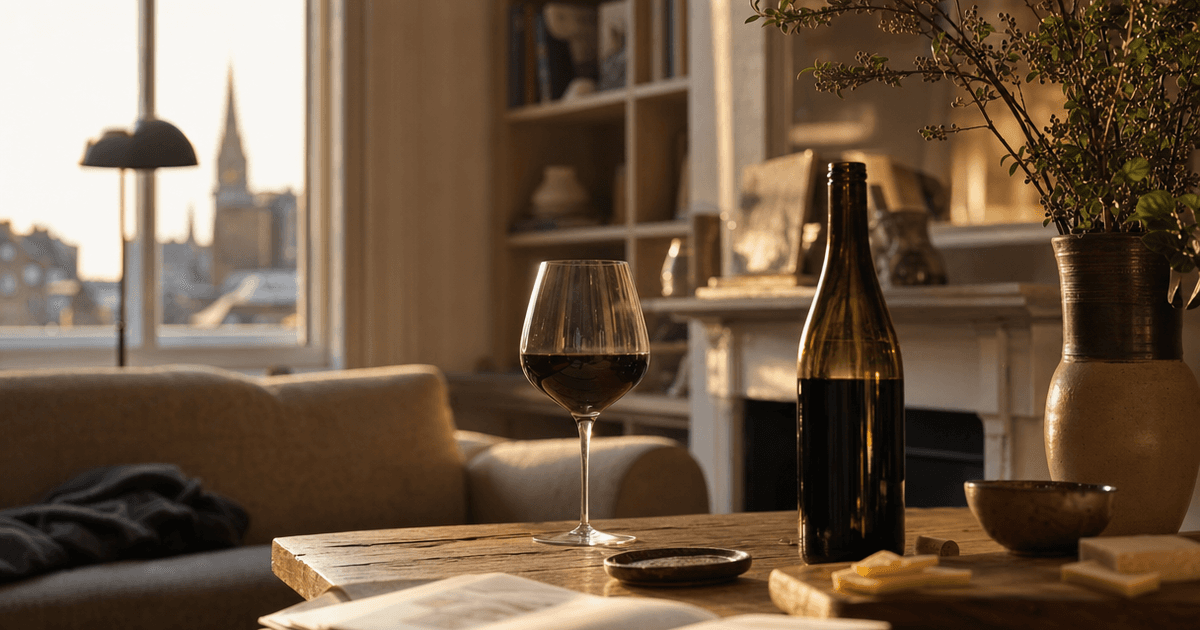
You don’t learn wine by drinking more of it — you learn it by drinking it twice. Two glasses, side by side, one question: what’s different? That’s the whole method, and it’s the honest answer to how to enjoy wine, because a palate learns by comparison, not consumption — weight against weight, acidity against acidity, one finish against another — and certainly not by owning the right glass or knowing the right words. I call it the two-glass habit, and this entire page is just that habit applied to different corners of the subject. By the end you’ll know how to train your own palate on purpose, what a dry glass genuinely means if you’re asking about diabetes or GERD, and which serving habits are worth keeping versus pure theatre. Everything else the wine world sells you — the journals, the stemware, the courses — is accessories to those two glasses.
How do I train myself to like wine?
You train a palate by drinking slowly and on purpose, side by side, not by drinking more of it. Pour two wines you already sort of like, taste them one after the other, and ask what’s different — which is more acidic, which sits heavier in the mouth, which finishes first and which lingers. Do that a dozen times over a few months and you build a vocabulary for your own preferences, rather than borrowing someone else’s. If you want a pair that teaches a lot for modest money, put an unoaked Chablis against an oaked Chardonnay — one evening, and you’ll know exactly what barrel does. A Muscadet against a soft Viognier does the same job for weight. Neither pair needs serious money, and that’s rather the point — the lesson is in the contrast, not the labels, and a decent pair costs less than one impressive bottle while teaching you more.
The old wine textbooks reckon a beginner does best with no more than four wines at a single sitting — any more and your nose adapts, stops noticing, and everything starts tasting the same. A working taster might want fifteen; you don’t need fifteen. Two or three, tasted at a relaxed pace with a proper pause between each glass, will teach you more than a dozen rushed through in an evening.
Here’s the shape of a training session that actually works:
- Pick two or three wines with one shared trait — same grape from different regions, or the same region across two vintages.
- Taste them together, not days apart. Flavour memory is short and unreliable.
- Pause a minute or two between glasses. Your nose tires faster than you’d expect.
- Write one honest line per wine — not a tasting note, just what struck you.
- Repeat the same pairing a month on. Note what’s shifted, because your palate moves with practice even when you’re not trying.
There’s a decent chunk of connoisseurship in learning to meet a wine halfway rather than judging it against some imagined perfect version — approaching it with a bit of humility and attention does more for your enjoyment than memorising which slope a vineyard sits on. I hear some version of this question most weeks across the counter, and the honest answer is always the same one: taste more, but taste narrower — same grape, two addresses beats ten random bottles every time — and ideally taste with someone who won’t make you feel daft for asking. That’s most of what a decent merchant is for, if I’m honest — steering you toward what you’ll actually like rather than what you’re supposed to like. If you want the fuller version of building this into ordinary weeknights, the pillar guide on Bringing the vineyard home: drinking well in the city walks through it properly.
Is dry wine ok for diabetics?
That’s a personal medical question, and I won’t pretend a wine merchant is qualified to answer it for you — please put it to your GP or a dietitian, because it depends entirely on you. What I can tell you is the wine fact sitting underneath the question: dry wines are fermented until almost all their sugar has converted to alcohol, so a dry Sauvignon Blanc, a Chablis, or a fino or manzanilla Sherry carries only a fraction of the residual sugar you’d find in an off-dry German Kabinett or a genuinely sweet wine like Sauternes.
If you’re weighing up styles for any reason, that’s the useful distinction to hold onto — bone-dry versus off-dry versus properly sweet — rather than red versus white, which tells you almost nothing about sugar. Muscadet, unoaked Chablis, most Provençal rosé and dry Sherry sit at the driest end. Kabinett Riesling, most Prosecco, and dessert wines sit further along the scale. When you’re shopping, ask for the driest end by name rather than by colour — it’s the one request that never gets misread across a counter. Beyond that, it’s a conversation with your own doctor, not a shop.

Is wine bad for GERD?
Same answer, different question — this one belongs with a doctor, not a merchant, because everybody’s comfort is different. What I can speak to is the wine side of it: some styles are naturally higher in acidity than others. Young Sauvignon Blanc, unoaked Chablis and most Champagne sit at the zippier end; a soft Viognier, an oaked Chardonnay, or a mature red from a warm region generally feels rounder and less sharp in the mouth. The two-glass habit earns its keep here too — pour the crisp and the round side by side once, and you’ll know your own comfort zone better than any list can tell you.
Serving temperature changes how that acidity reads, too — a crisp white poured too cold can taste sharper and more austere than the same wine at a slightly gentler temperature, where the fruit has room to show. If acidity is something you’re navigating for any reason, that’s worth mentioning to whoever’s advising you medically, and it’s also worth mentioning to whoever’s pouring your glass — a good merchant can point you toward the rounder end of the shelf without you having to explain why — a mature red from a warm region is often the gentlest place to start.
What the glass is actually doing for the wine
Think of the glass as the instrument the two-glass habit gets played on — its job is to stay out of the comparison’s way, and almost everything sensible about glassware follows from that.
The stem exists for one practical reason: so your hand doesn’t warm the wine. Cup a glass by the bowl and you’re nudging the temperature up faster than you’d think, dulling everything delicate about it — and if the two wines you’re comparing have drifted to different temperatures, the comparison itself goes soft. Clear, plain glass matters more than shape does, in my experience — you want to see the colour and clarity of what you’re drinking, and an engraved or tinted glass gets in the way of that. Fill it no more than half to two-thirds full, which looks stingy but isn’t; it leaves room to swirl and lets the aroma actually collect above the wine instead of escaping the second you pour. Learning to swirl without soaking the tablecloth takes a bit of practice — start by rotating the glass gently on a flat surface before you try lifting it, and the wrist action comes with time.
For white wine specifically, a smaller bowl with a narrower opening keeps the aromatics concentrated and the wine cooler for longer, which is why you’ll see whites served in tighter glasses than reds. But here’s my honest opinion after years of watching customers agonise over stemware: six identical plain glasses beat six fancy shapes every single time, because matching glasses are what make a fair comparison possible. There’s no solid published evidence that a specific shape uniquely improves a specific grape’s flavour, and how a glass looks and feels in the hand may matter to your enjoyment more than any of the chemistry does. Don’t take my word for it — run the habit on the glassware itself: pour one wine across two different glasses and trust your own nose over the marketing. The deeper detail on which shapes are worth the money and which aren’t lives in Glassware that matters (and glassware that doesn’t).
Questions customers ask us
Should I taste wines in a particular order? Generally lighter before heavier, dry before sweet, and younger before older — put a big, tannic red before a delicate white and the white will taste thin by comparison. It’s not a strict rule, but it saves you from wrecking a good bottle by pouring it after a bigger one.
How do I enjoy wine with food instead of on its own? Match weight to weight rather than colour to colour — a delicate fish dish wants a light white, a rich stew wants something with more grip, regardless of what’s “supposed” to go with fish or meat. There’s a longer look at how different food cultures build this instinct at the table in How wine cultures eat: Italy, Spain and France at the table.
Do I need to decant everything? No — decanting properly earns its keep on older reds that have thrown sediment in the bottle, which tastes bitter if it ends up in your glass. Younger, powerful wines sometimes get poured into a jug simply to give them air and open them up faster, but it’s a convenience, not a rule.
Is buying an expensive glass worth it? Only if you enjoy the ritual of it — the evidence for shape improving a wine’s actual chemistry is thin, though a nicer glass can genuinely make the moment feel better, which counts for something.
The merchant’s last word
I’ve poured wine into everything from proper stemware to a chipped mug on a Tuesday, and both taught me something. Training your palate isn’t about owning more kit or knowing more names — it’s two glasses side by side, tasted closely, more often. You don’t learn wine by drinking more; you learn it by drinking twice. If you fancy starting tonight, pick yourself a pair — same grape, two addresses, or one oaked and one not — and browse the Red cellar to find them. Tell me which pair you opened and what you noticed; that’s the kind of conversation this shop was built for.



