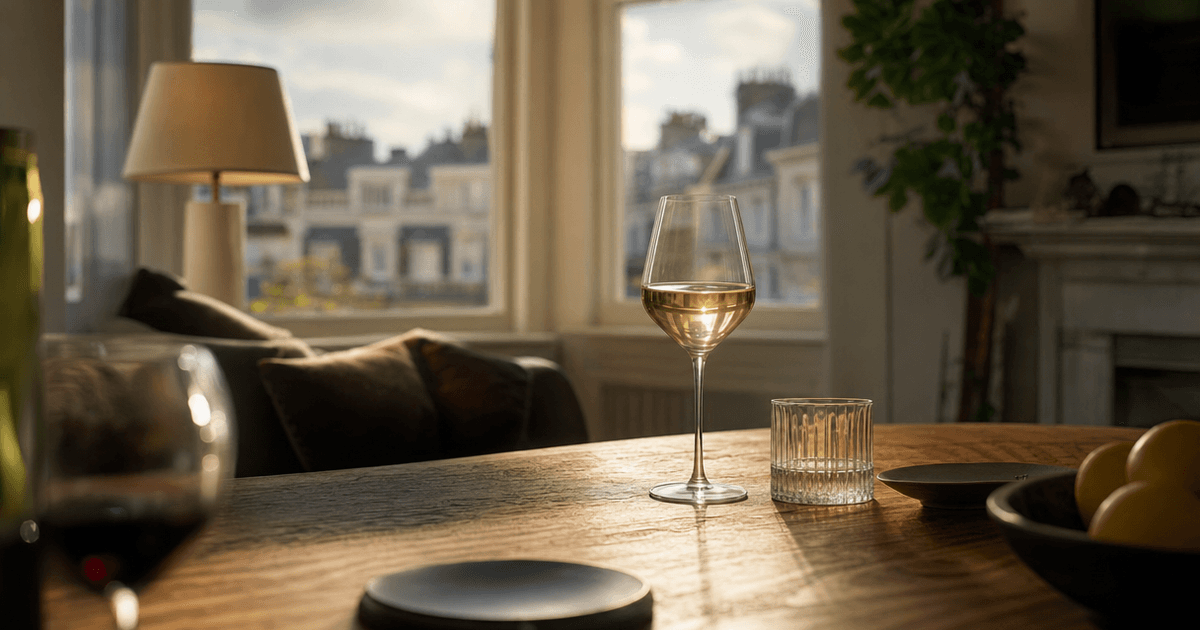
I once stocked six shapes of wine glass in this shop because the catalogues told me to, and watched customers who bought the full set use exactly two of them — the universal and the flute, every time. That failed experiment is the spine of this piece. The best wine glasses aren’t the prettiest ones in the cabinet — usually they’re the plainest, thinnest, cheapest set you own, because a wine glass has one job: carry the wine from bottle to nose to mouth without getting in the way. The classic shape is a clear stemmed bowl that tapers slightly at the rim — the tulip form you’ll see in tasting rooms from Bordeaux to Burgundy — built to hold aroma in rather than let it spill past your nose before you’ve had a chance at it. By the end of this you’ll know which features are worth paying for, which are marketing dressed up as science, and whether you need four cupboard shelves of shapes or just the one.
What are considered the best wine glasses?
The best wine glasses share four traits: a stem, a clear bowl, thin walls, and a rim that tapers in slightly at the top. The trade standard is ISO 3591 — small, tulip-shaped, stem around 5cm tall — built with nothing to argue with. Buy for those four features first, before you buy for a grape variety or a price tag.
Plain glass matters more than people credit. Coloured or cut crystal looks handsome on a dresser, but it hides the one thing a glass is meant to show — the wine’s actual colour and clarity. A pale, watery rim on a supposedly “big” red, or a faint green tinge on an old white from Chablis or the Mosel, are clues worth seeing. Cut glass buries them.
Thinness is the other quiet giveaway of quality. Hold a glass to the light — good crystal shows near-transparency at the rim; cheap soda glass looks clumsy and feels it too, and a thick rim genuinely changes how wine lands on your lip before you’ve even tasted it.
Then there’s the industry built around shape itself. Several glassmakers have built businesses on the claim that every appellation needs its own bowl — a Rioja glass, a Barolo glass, a Chablis glass, each subtly different. There’s real science in how a bowl shape moves aroma toward your nose. But the finer distinctions between a glass for the Côte de Nuits and one for the Rhône owe more to marketing than measurable difference. A good glass helps. A glass shaped for one obscure appellation mostly helps the shop selling it — and I know, because for a while I was that shop.
Stem, clear bowl, thin walls, tapered rim: if a glass has those four, the wine won’t notice what it cost. Carry that sentence into any homeware aisle and you’re protected from most of the catalogue.
Choosing between red, white and universal glasses
If you’re building a set from nothing, the honest answer from my six-shape misadventure is that you need one shape, not four. Red wine glasses have bigger, rounder bowls to give wine more air and lift its aroma; white wine glasses run smaller and narrower to keep things cool and concentrated; a universal glass sits between the two and does both jobs adequately — which for most kitchens is the whole point.
| Glass style | Bowl | Best for |
|---|---|---|
| Red wine glass | Large, rounded, wide opening | Reds needing air — Rioja, Barolo, red Burgundy |
| White wine glass | Smaller, narrower opening | Crisp whites from Chablis or Sancerre, holding chill |
| Universal glass | Mid-sized, tapered | Everyday use — reds, whites, rosé, fizz |
| Flute/tulip | Tall and narrow | Champagne and other sparkling wine |
Burgundy has its own tradition worth knowing, even if you never buy the glass for it: a red from Gevrey-Chambertin or Vosne-Romanée is often served in a wide balloon bowl, on the theory that good Pinot Noir throws off enough aroma to need the extra room before it reaches you. Most home drinkers use a smaller version of the same shape. Sherry from Jerez gets its own tulip-shaped copita; Port from the Douro and Madeira are traditionally served in smaller tulip glasses too, though a plain white wine glass does the Madeira job just as well — a brandy glass, by contrast, warms the wine too fast. Alsace and some German regions along the Rheingau and Mosel sometimes use a coloured-stem glass called a Rohmer, mostly out of habit rather than necessity.
If you want the best wine glasses for red and don’t fancy a second shelf for whites, buy the universal shape and stop worrying. The best red wine glasses for daily use are rarely the biggest in the shop — they’re the ones you’ll actually reach for on a Tuesday. Buy the shape you’ll use weekly — it’ll pour Rioja on Saturday and Sancerre on Wednesday without complaint — and the decision’s made.

Serving it right: fill line, swirl, and hold
Fill a glass no more than a third to a half full — even a fortified wine like Port only wants filling to two-thirds at most, leaving room to swirl and let the aroma build rather than spill. Hold the glass by the stem, not the bowl; your palm warms wine fast, and a red served too warm loses its shape just as quickly as a white served straight from the fridge loses its aroma.
Swirling is a skill, not a flourish. Start by rotating the glass on the table before you trust your wrist with it in the air — the motion should come from the shoulder, wrist held still, until it becomes second nature. Holding the glass by the base while you swirl is a look some people go for; it’s mostly showing off, and it doesn’t change what’s in the glass.
Temperature matters as much as shape, and the two work together — a properly chilled rosé in the wrong glass warms up before you’ve finished the first sip. We’ve written a whole piece on serving rosé and how cold is too cold, which covers exactly that trade-off. Get the fill line and the stem-hold right and even a modest glass punches well above its price.
What is the 20 minute wine rule?
There’s no single codified “20 minute rule” the trade agrees on — if your search brought you here looking for one fixed number, I’d rather be straight about that than invent one. What is true is that a wine’s aroma keeps developing after you pour it, and serious tasting notes are often built over fifteen minutes or more per glass, sometimes across half an hour, as fragrance shifts and settles.
In practice, this is why we tell customers: pour a big red, or a rich, complex white, and don’t judge it in the first thirty seconds. Give it twenty minutes or so in the glass — closer to the true spirit of the rule than any stopwatch — and it often shows a different, better wine. Champagne is the exception worth flagging separately. A youthful non-vintage wants serving cold and drinking promptly; a mature vintage benefits from slightly less chill and, if you’re pressed for time, a fast decant rather than the slow patient approach. Our guide on how to serve Champagne — temperature, glasses and opening the bottle goes further into that case. Patience costs nothing, which makes it the best serving upgrade in this whole piece.
What glass shape actually costs you
This is where that six-shape experiment of mine belongs. One shape for Bordeaux reds, another for red Burgundy, another for Sauvignon Blanc — the catalogues made each sound essential, and the shapes that went unused didn’t just sit there harmlessly. They sat in a cupboard being fragile and expensive for no return, a standing rebuke to the catalogue that sold them.
A cheap, thick-rimmed glass costs you more than money. It dulls how the first mouthful hits your palate, and a stubby bowl with no taper lets aroma escape before it reaches your nose — you lose exactly the sensory information a glass is meant to protect. A single, well-chosen universal glass, bought in a set of six so breakages don’t leave you drinking from a jam jar, will outperform a mismatched bargain set every time, and costs less than half of any specialist collection.
Where spending more genuinely pays off: thinner crystal, a properly tapered rim, and glasses sold as an identical matching set — because if you’re ever comparing two wines side by side, say a Rioja Crianza against a Rioja Reserva, drinking from two different shapes stacks the odds against you before you’ve taken a sip.
Questions customers ask us
Which type of wine glass is best? For most people, the glass they already own is close enough — plain, clear, stemmed, with a rim that tapers in. If you’re buying fresh, one universal shape will outperform a random assortment of specialist ones.
Which wine is best for diabetics? That’s a question for your GP, not your merchant — we don’t give health advice here. What we can tell you is which styles run driest in residual sugar, if that’s the useful bit of information behind the question.
The merchant’s last word
I’ve sold both ends of this — the £4 supermarket glass and the boxed crystal set nobody dared use. My honest advice, after years behind this counter: buy one good plain shape, use it for everything, and spend the money you save on better wine instead. If you want a fuller grounding in serving well at home, our guide on bringing the vineyard home is a good next stop — or come and browse the Red cellar and let’s find something worth pouring properly.



