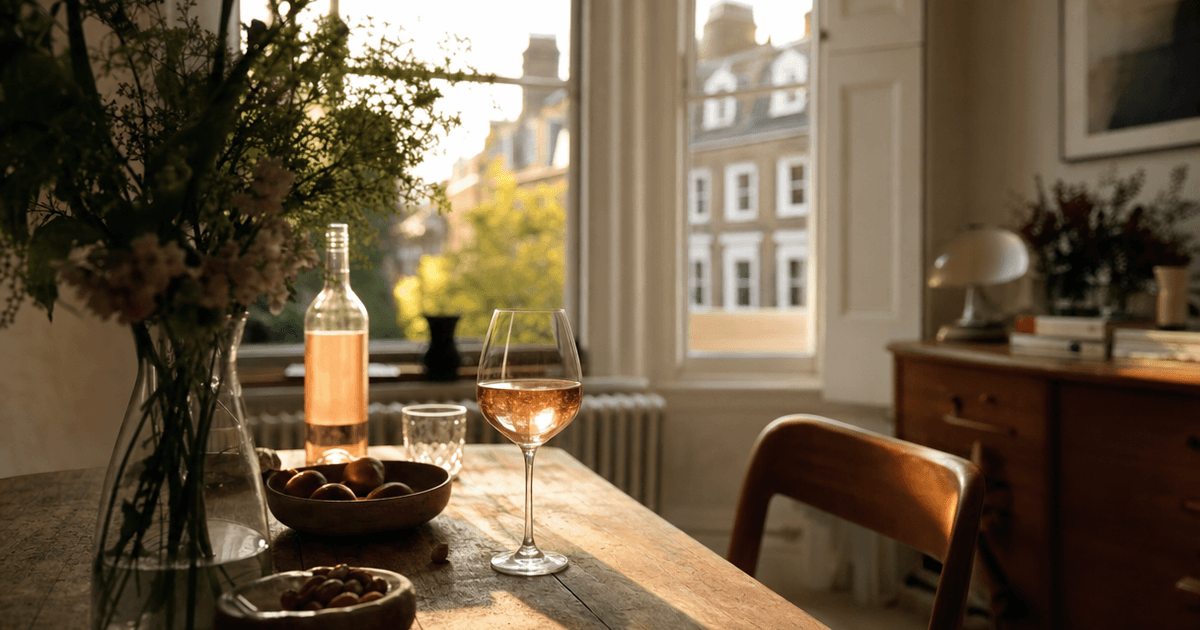
What temperature is rosé wine served at? Ask five people in my shop and you’ll get five different fridges’ worth of opinion. Rosé is a pink wine made mostly from red grapes, given only a few hours’ contact with their skins before the juice is drawn off — that’s why it’s pale, not because someone’s watered down a red. The honest, useful temperature for rose wine sits between about 7°C and 12°C: fridge-cold, not ice-bucket-numbing. By the end of this you’ll know where in that range your bottle wants to sit, how long it actually takes to get there, and when a splash of ice is genuinely fine rather than a crime.
What temperature is rosé wine served at?
Most rosé is happiest at 7-12°C, straight from the fridge door rather than the back of the freezer. Trade guidance from Decanter settles on around 11°C as a sensible average; older reference texts bracket rosé alongside sweet and sparkling whites at roughly 6-10°C. The deciding factor is the individual bottle: a simple, fruity glass wants the colder end, a richer, food-worthy rosé wants a bit more warmth to show what it’s actually made of.
Here’s the bit that took me a while to explain properly to customers: temperature doesn’t just make wine feel cold, it changes what you can smell. The warmer a wine gets, the more its aroma compounds lift off the surface — that’s chemistry, not fussiness. Serve rosé too cold and you clamp down on the fruit; go past about 20°C and the alcohol starts to dominate and the whole thing tips out of balance. Rosé sits in the sweet spot precisely because it’s built for refreshment, not for slow contemplation.
One thing worth knowing: wine always drifts toward room temperature once it’s out of the fridge, so starting near the bottom of that range — say 7°C on a warm July afternoon — isn’t a mistake. It buys you time before the glass turns lukewarm and forgettable.
Not every rosé wants the same shelf in the fridge
This is where a lot of rosé gets served wrong, and it’s not really the drinker’s fault — nobody tells you that “rosé” covers a huge range of wine. A pale, dry Provençal style wants the cold end of the range, around 7-9°C, because its whole appeal is freshness and delicacy; chill it any less and you’re just masking thin fruit. A deeper-coloured, more structured rosé — the kind with real weight from grapes like Mourvèdre or Grenache, or one that’s seen a bit of oak — behaves more like a light red and prefers 10-12°C, sometimes a touch above, so its texture isn’t flattened.
Sparkling rosé follows its own logic. A young, straightforward fizz is better properly cold, nearer 8°C, while a more serious vintage cuvée opens up with a little more warmth, closer to 10-13°C — the same rule sommeliers apply to Champagne generally (I’ve written more on that in how to serve Champagne, if fizz is your thing). Rosé Port, meanwhile, sits with the white Ports in the fridge — properly chilled, not “cellar cool” like a tawny — because it’s built the same way, for lightness rather than depth.
| Rosé style | Suggested serving temperature |
|---|---|
| Pale, dry (Provence-style) | 7-9°C |
| Richer, structured, some oak | 10-12°C |
| Young sparkling rosé | 7-9°C |
| Mature/vintage sparkling rosé | 10-13°C |
| Rosé Port | Fridge-cold, like white Port |
There’s a lot more to unpack on why rosé styles vary so wildly — think grape skins, saignée versus direct-press, and the winemaking choices behind that colour in your glass. I’ve laid all that out properly in Rosé, seriously: a merchant’s guide beyond the pink, so I won’t repeat it here.

What is the 20 minute rule for wine?
The “20 minute rule” is the idea that a fixed 20 minutes in the fridge is enough to bring any bottle to serving temperature. It’s a half-truth. A fridge cools wine at roughly 2°C every ten minutes, so 20 minutes only takes off about 4°C — useful for topping up a glass that’s gone a bit warm on the table, not for chilling a bottle that started at room temperature.
Do the sums and you’ll see why so much rosé ends up served wrong. A bottle sitting at a typical British room temperature of around 20°C needs to lose eight to thirteen degrees to land in range. At 2°C per ten minutes, that’s closer to 45 minutes to an hour in the fridge — not the 20 minutes everyone assumes. I’ve watched people pull a bottle from the cupboard, give it twenty rushed minutes in the door shelf, and wonder why it still tastes flat and warm. It’s not the wine. It’s the maths.
The fix is simple: plan ahead, or use the fridge door shelf (it’s the coldest, most consistent spot) well before guests arrive. If you’re caught out, a properly chilled glass poured from a bottle that’s spent an hour in the fridge beats a rushed twenty minutes every time.
Ice in the glass — sin or sensible?
There’s been a proper scrap in the trade press about this, and I think both sides are half right. The traditional argument is that ice dilutes wine as it melts, softening flavour, aroma and structure — fine on a hot day with something simple, less fine with a rosé you’ve paid attention to. Recent coverage has also flagged the opposite problem: retailers reporting that a good number of British drinkers over-chill their rosé, storing it far colder than it needs and losing the fruit entirely before the ice cube even comes into it. One winemaker’s line stuck with me — serving wine too cold can mute the very flavours you bought it for.
My own rule of thumb: if it’s a warm afternoon and the rosé is a simple, inexpensive glass meant for refreshing rather than reflecting, an ice cube or two isn’t heresy — some well-regarded producers do it themselves with their more casual styles. If it’s a rosé with real fruit concentration and some structure behind it, skip the ice and just make sure it’s properly chilled to begin with. Interestingly, trade data shows rosé sales genuinely spike once temperatures cross about 20°C outdoors — proof that most of us reach for it as a refreshment wine first and a “serious” wine second, which is no bad thing.
The glass matters here too, more than people think — a wide bowl warms wine faster just from your hand around it. Worth a proper look if you’ve never thought about it: glassware that matters (and glassware that doesn’t).
Questions customers ask us
What wine is best for GERD? That’s genuinely a question for your GP or a dietitian, not your wine merchant — everyone’s tolerance is different and it’s not something I’m qualified to advise on. What I can help with is how a wine actually tastes and feels in the glass.
Is rosé wine ok for diabetics? Styles vary a great deal — most rosé sold in the UK now is dry rather than sweet — but sugar content and how it affects you is a medical question, best discussed with your doctor or diabetes team who know your situation.
Does rosé need to be served in a specific glass to hit the right temperature? Not strictly, but a smaller glass helps — less surface area means it warms up more slowly once poured, so you get longer in the sweet spot before it drifts.
Is 11°C really the “correct” number, or just an average? It’s an average, and a useful starting point rather than a rule carved in stone — think of the whole 7-12°C band as fair game depending on the style in your glass.
The merchant’s last word
I used to serve every rosé from the same shelf, same temperature, no questions asked — and I got it wrong for years without realising. Once you start matching the chill to the style, the difference is obvious in the first sip. Have a play with the range, trust your own glass over any rule, and if you fancy something new to try it on, browse the rose wine cellar.



