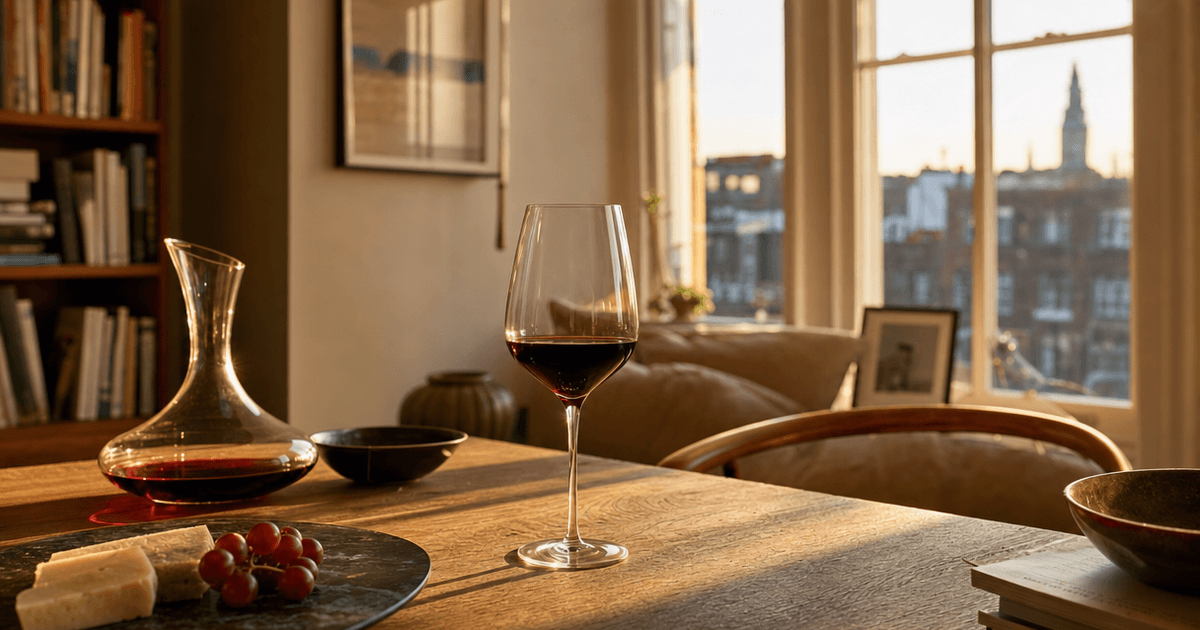
Here’s a confession to open on: the decanter is the one piece of wine kit I most often talk customers out of using. How to decant wine is the easy half of the question — really it’s just pouring wine from its bottle into another vessel before you serve it. Knowing when it’s worth the bother is the half that matters, because most bottles on your rack are happier poured straight. A decanter is nothing more exotic than a clean glass container, usually with a wider belly than the bottle, so more wine meets more air. You decant a wine either to leave old sediment behind in the bottle, or to give a young one a shot of oxygen to loosen it up. What follows is a sorting exercise: the short list that genuinely needs the treatment, the long list that doesn’t, and how long to leave the deserving few once they’re in there.
What actually needs decanting — and what doesn’t
Here’s the split I’ve settled on after years of watching customers agonise over it needlessly. Young, tannic reds — Cabernet Sauvignon, Nebbiolo, a beefy Syrah — often benefit from a splash into a decanter because it wakes up fruit that’s been shut in a bottle. Old reds with visible sediment, the sort of mature claret or Barolo that’s been lying down for a decade or two, need decanting for a different reason entirely: to separate the wine from the gritty, bitter crust that tannins and colour pigments form as they age (we go into more depth on this in decanting Bordeaux: how long, and does it really matter?). Vintage Port always needs it — it’s bottled so early in its life that a heavy deposit is guaranteed, not optional.
| Wine style | Decant? | Why | Roughly how long |
|---|---|---|---|
| Young tannic red (Cabernet, Nebbiolo, Syrah) | Yes, if you fancy it | Opens tight fruit, softens the grip | 30 minutes–4 hours |
| Aged red with sediment (mature Bordeaux, Barolo, Brunello) | Yes, for the sediment | A crust drops out of the wine with age | Long enough to pour clean, then drink |
| Vintage or crusted Port | Always | Heavy deposit, bottled young | Stand upright 2–3 hrs, decant, serve promptly |
| Old vintage Madeira | Yes, generously | “Bottle stink” needs real time to clear | A day or more |
| Everyday filtered red or white | Rarely needed | Modern filtration leaves little to no deposit | Skip it, or pour for the fun of it |
| Rich, powerful vintage Champagne | Occasionally | Only if you’re short on time | A couple of hours open is usually kinder |
Whites, rosé and sparkling wine are never wrong to decant — it’s just not required. One Champagne expert I trust puts it plainly: decanting can flatten the texture of fine fizz, so unless you’re pressed for time at a restaurant table, just pull the cork and let it sit a while instead. That’s the quiet headline of this whole subject, in fact: for the everyday run of modern, filtered bottles, the decanter adds theatre, not flavour — save it for the wines in the top half of that table.
How to decant red wine (and how to decant port wine)
Give the bottle a good few hours standing upright before you go anywhere near the corkscrew — a full day if you’re dealing with something older or gnarlier with sediment — so everything grainy has time to drop cleanly to the bottom instead of hanging in suspension. When you’re ready, position something bright behind the glass — a torch angled just right does the job, no need for candlelit theatrics unless you fancy it — and keep your eye fixed on the shoulder throughout the pour. Go steady, into a decanter that’s genuinely odourless (not just rinsed — actually neutral-smelling), since even a faint mustiness will taint the wine while everyone wrongly points a finger at the cork. The instant sediment starts creeping toward the neck, stop pouring — write off that final splash as the cost of doing business, and tip it into whatever’s simmering on the stove rather than into anyone’s glass.
Port needs the same patience with one extra wrinkle. Old corks in vintage Port can be soft or crumbling, so use a corkscrew with a sharp point and an open helix rather than a solid worm, or you’ll pull the cork apart and send fragments into the wine — a fine-mesh funnel or a clean piece of muslin catches them if it happens anyway. If there’s a wax seal, a sharp tap with the corkscrew handle breaks it away cleanly. We’ve written a full walkthrough of temperature and timing in how to serve Port: temperature, decanting and the cheese question, which is worth a look before your next bottle of vintage.
If you want the full show — decanted wine served back in its original, label intact — that’s double decanting: rinse the decanter with a splash of the wine first, pour the rest through, then rinse the empty bottle with clean water until it runs clear before funnelling the wine back in. It’s a bit of theatre for a dinner party, nothing more, and I won’t pretend it changes the taste.

What are common decanting mistakes to avoid?
The three that come up again and again in the shop: a dirty or musty decanter tainting a good wine, shaking the bottle before pouring so sediment you’d carefully settled goes straight back into suspension, and decanting a fragile old wine hours too early so the fruit has faded by the time it reaches the table. Get the decanter properly clean, keep old bottles still, and taste as you go rather than trusting a fixed clock.
There’s a subtler mistake too, which took me a while to unlearn myself: assuming every bottle deserves the grand ceremony. A young, robust Malbec doesn’t need standing overnight — it wants a vigorous splash into the decanter, air mixed right through it, and it’s often ready to drink within the hour. Treating a £12 weeknight red like a 1996 claret just slows down your dinner for no reward. And skipping the light source is an easy one to fall into when you’re in a hurry — without it, you genuinely can’t see the sediment line, and you end up pouring cloudy wine into the decanter along with everything you were trying to leave behind.
How long should you leave wine in a decanter?
There’s no single number that fits every bottle, but here’s the shape of it: young bold reds are usually happy anywhere from 30 minutes up to about 4 hours, old delicate reds often want barely any time at all beyond the pour itself, and vintage Port needs its 2–3 hours standing upright before you even pull the cork. Old Madeira is the outlier — it can want a full day or more to shed the stale, reductive smell that builds up in a stoppered bottle over decades.
You may have heard of the “20 minute rule” — the idea that a young red needs about 20 minutes in the decanter before it shows its best. It’s a reasonable starting point for how long to decant red wine that seems shut down or sharp on opening, but it’s shorthand, not science. Wine science actually complicates the popular idea of “breathing”: simply pulling a cork does very little, because the wine’s contact with air at that point is tiny. Decanting does more, because you’re genuinely mixing wine and oxygen — but the useful change is often the release of aromatics that were sitting just under the surface, not some dramatic transformation over hours. My honest advice, and the one I give across the counter: pour a small glass the moment you decant, then another twenty minutes later, and taste the difference yourself rather than trusting anyone’s stopwatch — mine included.
Leftover wine: the other reason to own a decanter
If your decanter spends most of its life in the cupboard — as I’ve been arguing it should — here’s the job that earns it more outings than the ceremony ever will. If you don’t finish a bottle, decanting the leftover wine into a smaller, clean container — a half-bottle, say — cuts down the amount of air sitting on top of it, which slows oxidation considerably. How much time you’ve got depends on the wine: a young table wine can turn within two or three days once opened, a tawny Port or oloroso sherry holds for a few weeks, and a good Madeira can go for months, sometimes years, without much bother at all. It’s the cheapest trick in the book for making a Tuesday-night bottle stretch into Wednesday too.
If any of this has you thinking about building out a proper home wine routine rather than just solving tonight’s bottle, our pillar guide on drinking well in the city covers the wider picture — glassware, storage, the lot.
Questions customers ask us
Is wine good for cardiac patients? That’s a medical question, and we’re wine merchants, not doctors — we’d always point you to your GP rather than guess. What we can help with is serving whatever you choose to drink properly, in the right glass, at the right moment.
What is the 20 minute wine rule? It’s the rough habit of giving a young red about 20 minutes of air before deciding what you think of it — useful as a starting point, not a rule to obsess over. Taste it before, taste it after, and trust your own palate over any fixed clock.
The merchant’s last word
I used to over-decant everything, honestly, because it felt like the “proper” thing to do. These days I only reach for the decanter when a wine actually asks for it — sediment to leave behind, or fruit that needs waking up. Get that judgement right and the rest is just pouring carefully and having a bit of patience. If you’re choosing a bottle for a occasion where decanting will genuinely earn its keep, browse the Red cellar and I’ll point you towards the right ones.



