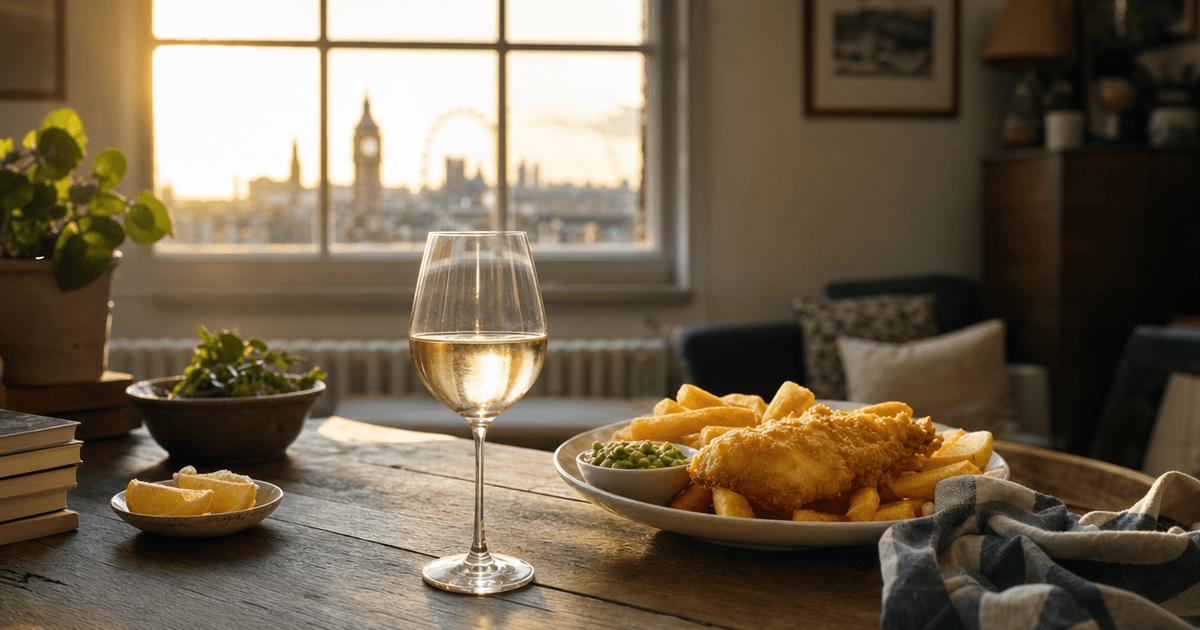
Wine with fish and chips is one of those questions people expect a single tidy answer to — there isn’t quite one, but there is a shape to it, and once you see the shape the choosing gets easy. Fish and chips is fried fish, usually in a beer batter or breadcrumb crust, served with thick chips and a good splash of malt vinegar. That fat, crunch and sharpness is what your glass actually has to answer to, not the fish underneath it. By the end of this you’ll know why the chippy on the corner and a proper sit-down version of the same dish sometimes want two different bottles — and which to reach for on a Friday.
What wine goes with fish and chips?
For the classic chip-shop plate, go for something with bubbles or bright acidity: Champagne, Cava, Prosecco, a dry Sauvignon Blanc, unoaked Chardonnay, Pinot Grigio, or a dry rosé. All of them do the same job — they cut through the batter’s fat, reset your palate bite to bite, and don’t sulk about the vinegar. That’s the honest, best wine with fish and chips shortlist, and if you’re in a hurry, that’s your answer.
Here’s why it works rather than just what works:
- Bubbles — Champagne, Cava, Prosecco. The carbonation scrubs the oil off your palate the way nothing still can.
- Unoaked Chardonnay — clean, appley, no vanilla or butter to muddy things.
- Dry Sauvignon Blanc — the citrus edge mirrors the vinegar instead of arguing with it.
- Pinot Grigio — light, neutral, forgiving; the wine equivalent of a plain white shirt.
- Dry rosé, especially something in the Bandol style — a bit more structure if you want red fruit without tannin.
What you’re avoiding, more than picking, is oak and tannin. A big oaked Chardonnay wrestling with malt vinegar tastes faintly metallic — I’ve poured that mistake for a table more than once and watched the faces fall. Tannic reds do something similar; the tannin grips the fish oil and turns bitter in a way it never does with a steak.
What wine goes with cod and chips?
Cod is what most chippies actually use, and it’s mild, flaky and forgiving — the trade tends to group it with haddock and trout as a “medium-textured” fish, sturdier than sole or plaice but nowhere near as assertive as tuna or mackerel. Dry Sauvignon Blanc, Sancerre, unoaked Chardonnay, dry German Riesling and a good Chablis all suit it — clean and citrus-driven, never heavy.
If the cod’s baked rather than fried — say, at home in butter and lemon rather than dunked in batter — you can afford more weight: a broader, lightly oaked Chardonnay, even something Meursault-adjacent, handles the richer preparation without swamping the fish. Dry Chenin Blanc or a dry Vouvray does a similar job with a bit more orchard fruit. Smoked haddock is its own animal entirely — that smoke wants a dry fino sherry or a properly dry Riesling, not the soft citrus wines above — worth knowing if the chippy does a smoked option or you’re cooking kedgeree at home.

What wine goes with battered fish?
Batter, more than the fish itself, is what decides your glass. It’s the oil and the crunch you’re pairing with, not the cod or haddock underneath. Sparkling wine — Cava, Prosecco, Champagne — is the reliable answer, alongside a crisp Vinho Verde, Vermentino, Trebbiano or Pinot Grigio. All of them share the same trick: high acid, low weight, nothing to compete with the fry.
If there’s tartare sauce or aïoli on the table, that changes things slightly — a Sancerre or a Sauvignon Blanc with real citrus lift handles the garlic and egg richness of aïoli better than a plainer Pinot Grigio would. Gewürztraminer, oddly enough, does well here too if the aïoli has any chilli kick — its slight sweetness and spice cope with heat that a bone-dry wine sometimes fights. Breadcrumb-crusted fish, by contrast, is drier and lighter than a beer-battered one, so you can get away with something a touch softer and less aggressively acidic.
Serving it right — the glass, the chill, the vinegar
Pour it colder than you would a delicate white on its own — fried food is rich, and a properly chilled glass keeps the wine’s acidity sharp against the fat rather than going flabby. An everyday tumbler-style wine glass is fine here; nobody needs a grand crystal bowl for a chippy tea on the sofa.
Order matters more than people think. Have a chip or two, a dab of vinegar, then take your first sip — tasting the wine against a totally clean palate first gives you the wrong impression of how it’ll behave through the meal. And if there’s a squeeze of lemon on the fish, lean into it: lemon and a crisp dry white are old, reliable friends, no clash there at all.
Chippy tea or a proper sit-down plate — matching the occasion
A Friday-night takeaway eaten out of paper on the sofa and a plated, restaurant version of cod and chips with a proper sauce are, food-wise, cousins rather than twins — and the sit-down version can carry a slightly more serious bottle. There’s a lovely trade story about someone finding nothing in the fridge one evening but a half bottle of good Champagne and a packet of fish fingers — and it turning out to be one of the best pairings they’d had all year. I believe it. Fried fish and a proper dry sparkling wine were made for each other; there’s no rule that says you save the good bottle only for the tasting menu.
If Champagne’s your instinct but you fancy trying something a little different, it’s worth reading about Tasmanian sparkling wine: the southern challenger to Champagne? — cool-climate fizz with real backbone, and a genuinely interesting alternative on a Friday. Or if Chablis is more your speed for the cod route above, Chablis: the purest Chardonnay? goes into why that chalky, unoaked style suits fried and simply-cooked fish so well. And if you’re building out a proper home wine routine rather than just solving tonight’s dinner, Bringing the vineyard home: drinking well in the city is the fuller picture.
Questions customers ask us
What do you drink with fish and chips? Beer and cider are the traditional route — ale, pilsner or a dry sparkling cider all do the fat-cutting job brilliantly. If you’re pouring wine instead, the same principle holds: cold, dry, a bit of zip, nothing heavy.
Can you drink red wine with fish and chips? You can, within reason — light-bodied reds like Beaujolais or a young Bardolino, served slightly chilled, have enough freshness to avoid the tannin clash that a Cabernet or Malbec would give you. It’s not the obvious choice, but it’s not a wrong one either.
What about smoked fish instead of battered? Different pairing entirely — smoked fish wants a dry fino sherry, a dry Alsatian or Mosel Riesling, or a Blanc de Blancs Champagne. The smoke needs something with a bit more backbone than a straightforward Pinot Grigio gives you.
The merchant’s last word
I’ve sold wine to people who apologise for asking about fish and chips, as if it’s beneath a proper bottle. It isn’t. Some of the best pairings I’ve poured have been at a kitchen table with paper still greasy on it. Get the acid right, keep it cold, don’t overthink the rest — and if you want a bottle picked for exactly this kind of evening, browse the Red cellar.



