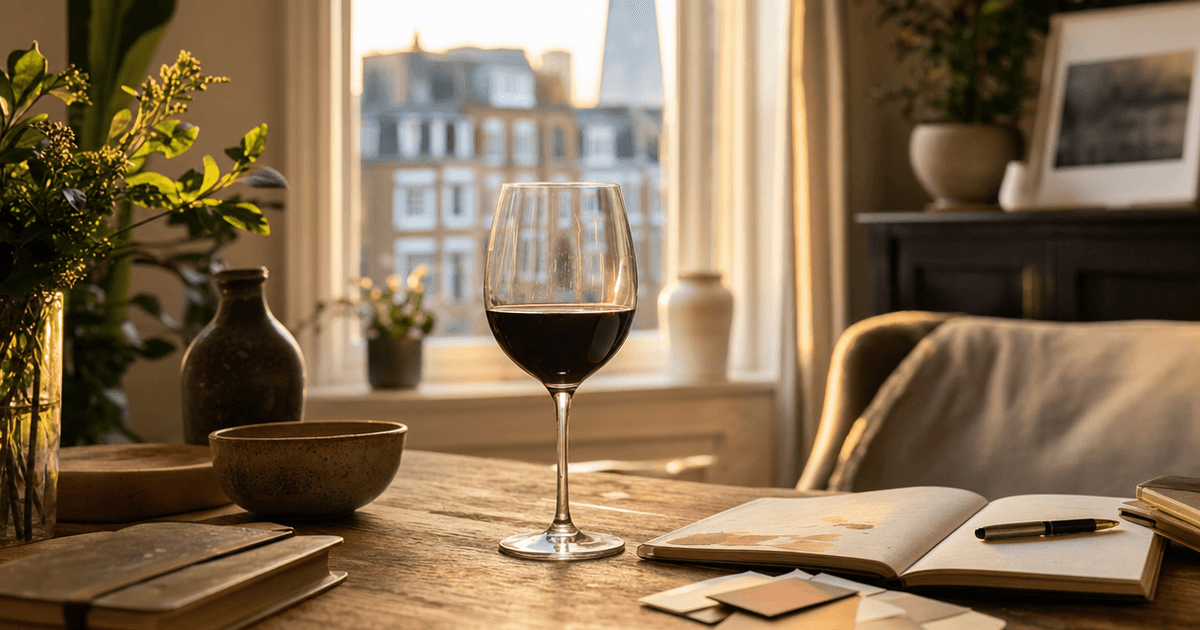
Every wine you’ve ever bought left a receipt; almost none of them left a verdict. A tasting journal fixes that — it’s the only piece of wine writing that records what you paid and whether it was worth it, judged by the one palate that matters: yours. A tasting note is simply a short record of what you saw, smelled and tasted, finished with a conclusion about whether it worked. By the end of this you’ll know what’s worth writing down, how much detail helps rather than buries you, and how to read your own notes back and actually buy better next time. Trade tasters keep these at every serious tasting; you can keep yours at the kitchen table with a biro and the back of an envelope.
What are tasting notes in wine?
A tasting note is a written record of what your eye, nose and mouth pick up in a glass, closed with a conclusion about balance and quality. Trade tasters often divide it into four stages — Appearance, Aroma, Taste, Conclusions — though that’s a convenience, not a rule you’re bound by at home.
I used to write mine like I was showing off. Six adjectives deep, a metaphor about a hedgerow, the works. Six months later I couldn’t remember a single one, or which bottle I’d meant. Opinion on length varies wildly among people who write these for a living — some manage it in six words, others run to sixty or more — and what matters isn’t the word count, it’s whether the note still means something when you’re standing in a shop wondering whether to buy the same wine again.
Worth knowing too: the language changes depending on who it’s for. A note written to sell you a wine reads differently from one written for an exam, or one a collector jots down for nobody but themselves. Yours has one job — jogging your own memory — so it can be as plain as you like.
What are the 5 S’s of wine taste?
See, Swirl, Smell, Sip, Savour — the sequence most tasters work through, and it maps onto that appearance-aroma-palate-conclusion structure, just broken into five things your hands and nose actually do.
- See — hold the glass to the light. Clarity and colour depth hint at a wine’s age and weight before you’ve smelled a thing — a young Rioja sits pale and violet-edged, an old Barolo turns brick and amber.
- Swirl — releases the aroma compounds. Give it longer than feels natural; a wine’s aroma keeps changing the more air it gets, and rushing this stage means missing most of it.
- Smell — and don’t panic if the word won’t come. There’s a well-documented phenomenon where you recognise a smell perfectly but can’t name it; researchers call it the tip-of-the-nose effect, and it happens to professionals too.
- Sip — take it slowly. Tannins bind with proteins in your mouth, which is part of why a red often tastes softer on the second sip than the first — the first sip is actually closer to how the wine will taste with food.
- Savour — this is the conclusion stage, and arguably the one that matters most. More on that below.

Setting up a journal that works for you
You don’t need anything fancier than a notebook, though plenty of collectors now use online cellar tools for the sorting and searching they make possible. What matters is what you record, not what you record it in.
Give each wine four basics: the name and vintage, the price and where you bought it, the date, and a note on the occasion — Sunday lunch, a birthday, a bottle opened because the boiler broke and you needed cheering up. That context does more work than you’d think; a Sancerre that seemed thin on its own might have been perfect against the mackerel it was poured with.
Then write the tasting note itself, dated, underneath. If you’re storing anything longer-term with a professional facility, note where and since when — it matters if you ever need to query a bottle’s condition.
One habit worth keeping as seriously as your triumphs: log the failures too. A note that says “reminded me of a leaking biro, never again” is doing exactly its job — that’s the ledger half of the page earning its keep, a pound spent turned into a lesson banked. Fancy an easy pair to open the journal with? Pour a crisp Vinho Verde one night and a young Rioja crianza the next — two styles far enough apart that the differences practically write themselves. If you’re building this into a proper routine at home, our guide to bringing the vineyard home covers the wider setup — racking, temperature, the lot.
Finding words that actually help
Skip the fruit salad. The advice worth hearing again and again is the same: pick half a dozen descriptors at most, ideally ones with something in common, rather than reaching for every fruit in the bowl. “Cherry, clove, a bit of graphite” tells you more than a paragraph of scattered comparisons about a young Rioja crianza.
Structure matters as much as flavour — is it light or full, soft or gripping, short or long in the finish? And be honest rather than polite. Wine writing leans heavily on positive-sounding words even when a wine is properly bitter or astringent, because those words carry better connotations. Your journal doesn’t need to be polite. If it was too tart, say too tart.
Borrow your own life for the words, not showroom vocabulary. “Smelled like the inside of my nan’s biscuit tin” will mean more to you in a year than “notes of baking spice” ever will. A descriptor chart — the kind that lists two hundred possible aromas — is a memory aid, not a checklist you’re failing if you don’t tick every box. When you’re cross-checking a bottle against what’s printed on the label, our piece on reading a wine label is worth having open alongside your notebook.
Balance, length, and knowing when a wine’s actually good
The most important part of any tasting note isn’t the list of smells — it’s the conclusion. Ask whether the wine feels in balance, and how long the flavour lingers after you swallow; both are the clearest signals of quality a home taster has. A young Barolo or a cellar-worthy Bordeaux blend can taste harsh and tannic now and still be a fine wine in ten years — balance takes experience to judge, and even trade tasters get it wrong on wines still finding their feet.
Should you score what you drink? Your call, and don’t feel you need a 100-point scale to do it properly. Some critics stick to a simple star system, on the reasoning that nothing is ever quite perfect enough to earn full marks. There’s decent evidence behind the instinct too — research into scorecards has found simpler ones produce more consistent judging over time than elaborate ones crammed with categories. A five-point scale you actually use beats a twenty-category card you abandon by the third glass. And if you want a bottle that teaches balance cheaply, pick up a Chablis or a Sancerre — styles whose bright acidity makes any wobble easy to spot, and easy to write down.
How your notes actually make you buy better
This is the whole point of the exercise — the moment the notebook stops being a diary and starts being a ledger. It only pays for itself the next time you’re standing in front of a shelf trying to decide.
Price and supplier logged against each note means you’ll spot when a wine you loved has crept up, or when a producer’s second label might be the smarter buy — our guide to second wines is worth a read if that’s new territory for you. Cross-referencing your notes against a bottle’s price, rather than its score, is also most of what separates buying well from buying by reputation — the whole argument in our piece on buying wine like a merchant.
And your hazard warnings earn their keep here more than anywhere. The Vinho Verde that tasted thin at £9 isn’t worth trying again at £14 just because the label looks nicer. And when a note keeps saying “thin at the price”, read it as a steer rather than a sulk — a couple of pounds more on the same style is usually the cheapest upgrade the journal will ever hand you.
Questions customers ask us
Which wine is best for diabetics? That’s a question for your GP or diabetes nurse, not your wine merchant — any dietary decision needs someone who knows your health picture, not a shop owner with an opinion. In tasting-note terms, dry styles like Chablis, Vinho Verde or a brut Champagne are made to leave minimal sugar on the palate; a note that says “dry” or “bracing acidity” rather than “off-dry” is describing exactly that.
Do I need special glasses to write a good tasting note? No. A decent tulip-shaped glass helps concentrate aroma, but plenty of excellent home notes have been written from a supermarket wine glass at the kitchen table.
Should I write notes for wines I don’t like as well as ones I love? Especially those. A note on a wine that disappointed you is often more useful next time than one on a wine that delighted you — it’s the one doing the actual saving-you-money work.
The merchant’s last word
I’ve kept a version of this journal, badly at first, for the better part of two decades, and the only regret I have is not starting sooner and writing shorter. Your tasting notes don’t need to sound clever. They need to sound like you, six months from now, will know exactly what you meant. Fancy an occasion to put the habit to work on? Browse the Red cellar.



