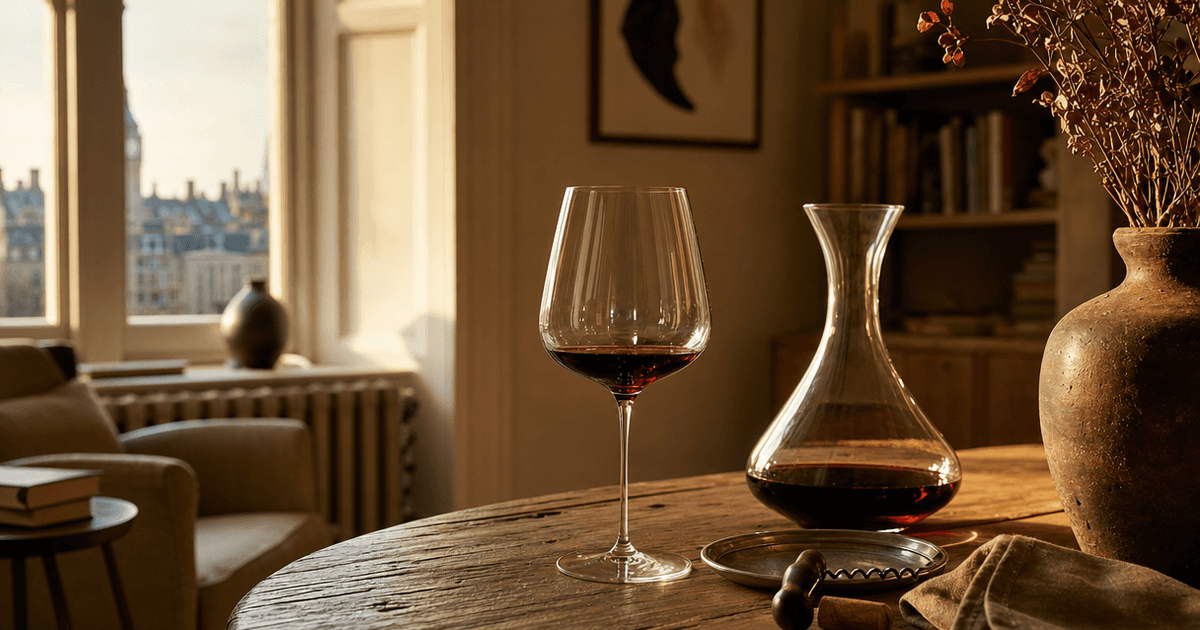
Serving aged Barolo properly is less about ceremony and more about not undoing years of patience in the last five minutes before it hits the glass. Barolo is 100% Nebbiolo from a handful of communes around Alba in Piedmont — Serralunga d’Alba, Monforte d’Alba, La Morra and Castiglione Falletto are the big names among them. Italian rules make it age for years before it ever reaches a shop shelf, and the best traditional bottlings are built to keep changing in the bottle for decades after that. By the end of this you’ll know what “aged” actually means for a Barolo in your rack, whether to decant it or leave it be, and which glass lets it say what it’s been quietly working towards.
At what age should Barolo be served?
There’s no single number here, and I wish there were — it’d make my job easier. Trade opinion (drawn from the drinking windows producers themselves publish) puts most Barolo needing at least ten years before the tannins soften and the fruit turns from bright cherry to something darker and more savoury. The biggest traditional bottlings, the sort built in large old Slavonian casks rather than small new oak barrels, can want thirty years or more to reach what one grower’s family has called “full maturity.”
Vintage-by-vintage, the windows vary a lot. A structured 2006 might be drinking well through 2031; a 2010 from a powerful cru could run from 2020 to 2040; a 1978, tasted decades later, came across as shockingly youthful rather than tired. That spread is the whole point of Nebbiolo — it doesn’t age on a straight line, and a “closed” phase in the middle years is completely normal, not a fault.
What actually tells you a bottle’s ready has nothing to do with the label. Look at the rim: young Barolo is a deep ruby, and as it ages that rim turns brick, then garnet, then almost orange at the edge. Smell it: fresh cherry and violet giving way to truffle, tar, dried rose petal and leather is the tell. If a Barolo Riserva has already had years in cask before release — some spend six years maturing before the label even goes on — it’s arriving at your table with a head start that a standard Barolo from the same vintage won’t have.
If you like the idea of that grand, patient structure without paying grand cru prices, the same logic of patience-for-value shows up in second wines: how to drink a great château without the grand vin price — different region, same trade-off.
How should Barolo be served?
Stand the bottle upright for a day before you open it, so any sediment settles to the bottom rather than swirling through the wine when you pour. Whether you decant depends entirely on the bottle’s age: young, tannic Barolo can benefit from a decanter and even benefits from double decanting, while genuinely old bottles are fragile and many in the trade would rather pour straight from the bottle than risk the shock.
That’s the debate in a nutshell, and it’s a real one — I’ve had it across the counter more times than I can count. One camp treats decanting as essential: it separates the wine from sediment (which tastes bitter if it ends up in your glass) and it opens up a young wine’s aromas fast. The other camp, and some serious Italian wine critics sit here, argue that decanting an old, fragile bottle is like starting a novel on page fifty — a sudden hit of oxygen and you lose something you never get back.
My own view, for what it’s worth: the split mostly comes down to the wine’s age, not a house rule. A young Barolo — tight, tannic, maybe five to ten years old — often does want air, and double decanting (pouring into a decanter, then back into the rinsed original bottle) is a trick some sommeliers use specifically on structured young reds like this to open them fast. A properly old bottle, fifteen, twenty, thirty years on, doesn’t need persuading open. It needs a gentle pour and a bit of patience in the glass instead.
| Young Barolo (roughly under 10 years) | Aged Barolo (15+ years) | |
|---|---|---|
| Decant? | Often yes — can double decant to open it fast | Usually no — sediment only, poured carefully |
| Standing time before opening | Not really needed | Stand upright 24 hours to settle sediment |
| Time to give it | 30 minutes to a few hours in the decanter | Pour and watch it evolve in the glass instead |
| What you’re managing | Firm tannin, closed fruit | Fragile aromatics, delicate structure |
If there’s visible sediment in an old bottle, pour slowly and steadily from the shoulder, watching the neck, and stop the moment you see cloudiness — a clean decanter or even a jug will do the job without any drama. Temperature matters here too, more than people think; if you want the full breakdown by wine style, wine serving temperatures: a cheat-sheet for every bottle in the house is worth ten minutes.

What glass should Barolo be served in?
A large-bowled glass, close in shape to a Burgundy glass, is the right call — Nebbiolo’s whole appeal is aromatic (tar, dried rose, truffle, leather) rather than fruit-driven, and a big bowl with a narrower rim gathers that perfume and funnels it towards your nose. A small, straight-sided glass just flattens it.
There’s a nice trick some sommeliers use on ambitious old bottles, Barolo included: start with a smaller glass to catch the first restrained aromas, then switch to a bigger glass ten or twenty minutes in, once the wine’s had a chance to open and needs the extra room to develop. It’s a bit of theatre, admittedly, but it does actually work — I’ve done it at tastings and watched people’s faces change.
The parallel with Pinot Noir is worth knowing if you’re already comfortable serving Burgundy: both are pale, both are about scent more than weight, and both punish a mean little glass. If that’s useful context, how to serve red Burgundy: temperature, glass and the decanting question covers the Pinot side of that same idea. And for the wider picture of where Barolo sits alongside Brunello and Chianti, Italy’s great reds: Barolo, Brunello and Chianti, explained is the one to read next.
Food or no food — does it need a plate at all?
Some in the trade argue the greatest aged wines deserve to be tasted on their own first, before food arrives, because a sauce or a strong side dish can drown out exactly the subtle layers — truffle, dried rose, mineral — that decades of ageing built. It’s a fair point, and I’ve had aged Barolo that genuinely rewarded five minutes of just sitting with it before anyone reached for a fork.
That said, don’t feel you need the full parade of an Italian menu — antipasto, primo, secondo, contorno, dolce — to do it justice. Italians themselves rarely eat through every course; a plate of aged pecorino, a simple grilled dish, or nothing at all works just fine alongside a serious old Nebbiolo. The wine’s the guest of honour here, not the meal.
Questions customers ask us
Do you need to stand the bottle up before opening it? Yes, ideally a day ahead — it lets any sediment settle to the bottom rather than clouding your glass. It’s a small thing but it makes pouring an old bottle much less stressful.
Should you serve Barolo the same way you’d serve Barbaresco? Broadly yes — same grape, same region, same aromatic profile of tar, rose and leather, and the same age-versus-decant logic applies. Barbaresco tends to soften slightly earlier than Barolo, but the serving approach barely changes.
Can Barolo be served too warm? It can — a Barolo served too warm loses its lift and the alcohol starts to dominate the truffle and rose notes you’re paying for. Wherever you picked your bottle up from, the same cool-cellar temperature rule applies.
Once it’s open, how long does it hold its character? An old, delicate bottle changes fastest — often within the hour — while a younger, sturdier Barolo can hold its shape for an evening. Either way, drink the good stuff at a pace that lets you actually notice it changing.
The merchant’s last word
I’ve poured plenty of old Barolo wrong over the years — decanted a beautiful old bottle once purely out of habit and watched it fade in the glass within minutes. Lesson learned the hard way. Get the age right, the pour gentle, and the glass generous, and an old Barolo does the rest of the work itself. If you want to put any of this into practice, browse the italy cellar.



