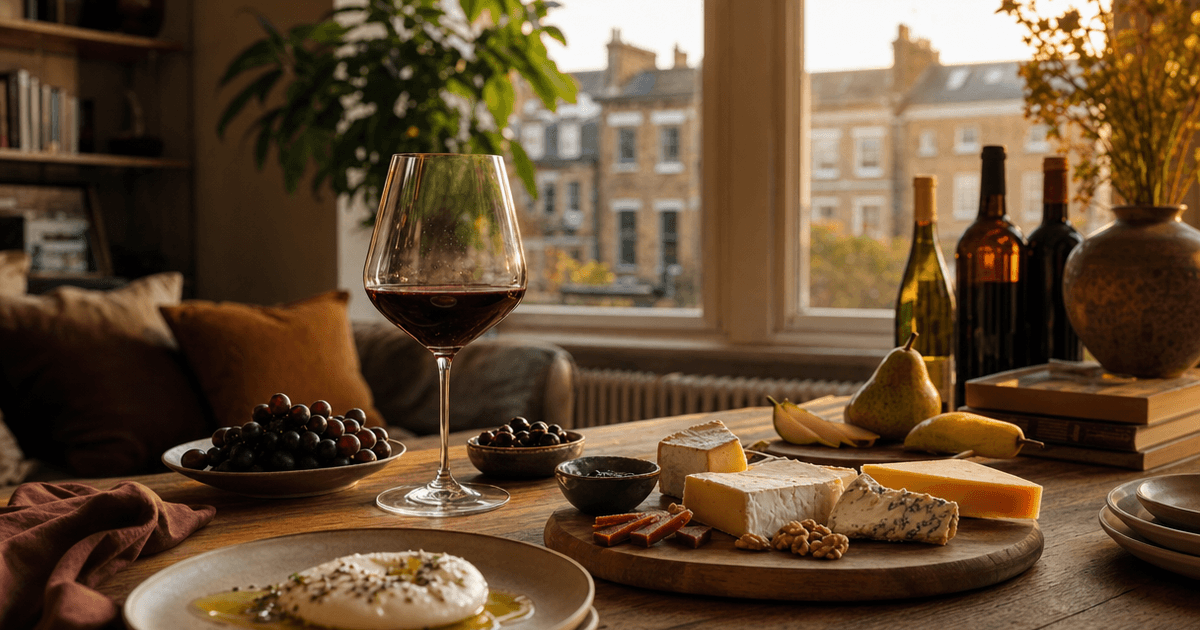
Every other pairing question I get across the counter has one dish in it — a steak, a curry, a roast chicken. Wine with cheese is the exception, and it’s why everyone thinks they’ve got it sorted until the actual board turns up and the Stilton starts fighting the Cabernet: a cheese board isn’t one dish, it’s four or five dishes wearing one name, all pulling in different directions, and no single bottle does right by every one of them. Cheese and wine are, in a real sense, cousins — made in the same regions, often on the same calendar, and built from the same instinct to preserve milk or grapes for the lean months. By the end of this you’ll know which wine style suits which cheese, how to run a board as the little menu it really is, and when it’s worth reaching for something sweet instead of red.
Why do people have wine with cheese?
Because fat and acid do something for each other that neither manages alone. Wine’s acidity cuts through a cheese’s richness and cleans the palate for the next bite, while tannin or sweetness balances the salt and pungency that strong cheeses carry. It isn’t only tradition — it’s mouthfeel, worked out by trial and error over a few hundred years of shared cellars.
The general shape of it: cheeses with high fat and a mild, nutty character tend to get on well with tannic reds — think a firm Alpine cheese and a Chardonnay with real weight. Stinkier, pungent cheeses usually want something sweeter to counterbalance them, which is why a washed-rind cheese so often ends up next to a late-harvest Riesling rather than a Bordeaux. I used to reach for the big red every time a cheese board came out. Took me a fair few flattened Cabernets against soft Brie before I worked out why it wasn’t singing.
There’s also a school of thought — a good one — that talks about complementing versus contrasting. Complementing means matching intensity for intensity: a simple, milky goat’s curd doesn’t want a heavyweight Châteauneuf-du-Pape any more than a delicate Pinot Noir wants to sit next to a three-year Cheddar. Contrasting is the sweet-with-salty trick, port with blue, Sauternes with a strong washed rind. Both are legitimate. Neither is a rule you’ll be arrested for breaking.
Is cheese better with white or red wine?
Neither wins outright, and it took me longer than I’d like to admit to stop assuming red was the safe answer. Soft, bloomy cheeses like Camembert or Brie often do better with a bright white, a dry sparkling wine, or Chablis than with a big red — the tannin can flatten their delicate, earthy character. Mature Cheddar or aged Gouda, on the other hand, can carry a proper structured red without blinking.
A loose rule: the softer and creamier the cheese, the more it wants acid rather than tannin. The harder, saltier and more aged the cheese, the more tannin it can take on board.
| Cheese style | Works well with |
|---|---|
| Soft, bloomy (Camembert, Brie, Vacherin) | Chablis, Champagne, light red Burgundy, dry cider |
| Fresh goat’s cheese | Sauvignon Blanc, Chardonnay, Sancerre |
| Hard, aged (Cheddar, Gouda, Mimolette) | Rioja, Rhône red, Cabernet Sauvignon, tawny port |
| Washed-rind (Muenster, Raclette) | Alsatian Gewürztraminer, off-dry Riesling, Madeira |
| Blue | Sauternes, tawny or vintage port, sweet sherry |
Sparkling wine deserves a special mention here — Champagne, especially Blanc de Blancs, sits comfortably against both a mild Gruyère-style cheese and a ripe Camembert, which is more than most reds manage.

How to choose wine for your specific cheese
This is where cheese pairings with wine get genuinely interesting, because the answer changes cheese by cheese, not just soft-versus-hard.
- Camembert or Brie: a Chardonnay with little to no oak, brut Champagne, or a light red Burgundy. Chablis works because its acidity is doing the heavy lifting.
- Strong Cheddar: a Rioja or a California Cabernet Sauvignon with some grip, or a ruby or vintage port if you fancy something richer.
- Fresh goat’s cheese (Bûcheron-style): Sauvignon Blanc or a lean Chardonnay — the acid in the wine mirrors the tang in the cheese.
- Strong, aged goat’s cheese: this is where Moscato d’Asti, sweet Muscat, or a glass of Sauternes earns its keep — the sweetness tames the intensity.
- Washed-rind cheeses (Muenster, Raclette, Vacherin): Alsatian Riesling or Gewürztraminer, Tokay Pinot Gris, or Madeira for something with more backbone.
- Blue cheese: tawny port or Sauternes, without much argument from anyone at the table.
- Triple-cream cheeses (Pierre Robert and similar): red Bordeaux, Margaux especially, has the structure to sit against that density.
If you want the fuller logic behind matching any dish to a bottle, not just cheese, our Food and wine pairing: a merchant’s complete guide to getting it right walks through the same principles from the other direction.
Can I drink wine with cheese?
Yes — and this is where the board-as-menu idea earns its keep: build it with the wine’s order in mind and most of the battle is already won. Start light and fresh, with a goat’s cheese and a Sauvignon Blanc or Sancerre. Move through the nutty, hard cheeses with something a bit fuller. Then the washed rinds with an aromatic white. Finish on blue, with something sweet.
There’s a cheese expert’s tip worth repeating here: don’t eat the cheese board straight after a big meal, and give it at least an hour to breathe if you can. The order matters for the same reason it matters with wine flights — you’re building intensity, not scattering it. Goat’s cheese refreshes the palate first; a washed rind mellows things out; blue brings the whole thing together at the end rather than blowing everyone’s tastebuds out at the start.
Practically: let the cheese come to room temperature before serving, keep whites properly chilled, and don’t be shy about pouring two wines rather than one if your board has real range — a dry, acidic white alongside a fuller red covers most eventualities without you having to open four bottles. You’re catering for several small courses, remember, not one plate.
What good pairing wine with cheese costs you, in shape
Here’s the bit that surprises people: you don’t need a full glass of everything. A cheese board is a grazing occasion, so a half bottle of something special goes further than it would at dinner. This is exactly where Sauternes: the sweet Bordeaux the world forgot earns its place on the shelf — a half bottle sees a blue cheese course through comfortably, and it isn’t the extravagance people assume.
The same goes for What is Colheita Port? The single-year tawny explained — a single-vintage tawny is built for exactly this kind of small, considered pour alongside Cheddar or blue, rather than a full session. If your cheese board is doing Christmas duty, our guide on What wine should you serve with Christmas dinner? covers how it sits in the wider meal, not just at the end of it.
Questions customers ask us
Which wine is best for diabetics? That’s a question for your GP or pharmacist, not your wine merchant — we can only speak to style and taste, never health. If sweetness level interests you for other reasons, drier styles like Chablis or a dry sherry sit at the opposite end of the shelf from something like Sauternes.
How many wines do I need for a cheese board? One good, versatile bottle is fine for a casual evening. Two — a dry white and a structured red — covers most boards without fuss, and a small glass of something sweet or fortified is the one genuine upgrade if your board runs to blue cheese.
Does sparkling wine work with cheese? Very well, particularly Champagne or a Blanc de Blancs against a mild Gruyère-style cheese or a ripe Camembert. The bubbles and acidity cut through richness in a way still wine sometimes struggles to match.
The merchant’s last word
I’ve watched more good cheese boards get let down by the wrong bottle than by the wrong cheese. Pairing wine with cheese isn’t complicated once you stop assuming red is the default, stop treating the board as one dish, and start asking what each cheese actually needs — acid, sweetness, or a bit of tannin. Come in and talk to me about what’s on your board this week, or browse the Italy cellar and I’ll point you at the right bottle for it.



