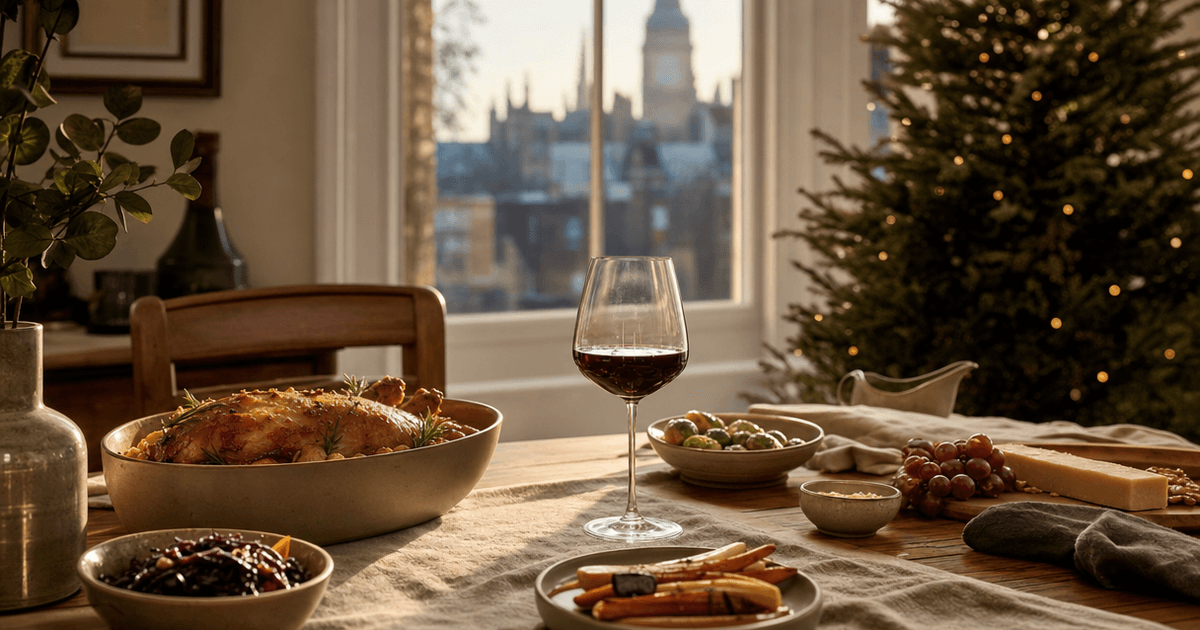
Every other pairing question ends with a bottle; Christmas is the one that ends with a shopping list. Good wine for Christmas dinner is a short line-up — three bottles, each with one job — because Christmas dinner isn’t one dish, it’s four or five flavours going for the same fork at once, poured for a table that never agrees. In plain terms: you want a wine with enough acidity to cut through sweet-savoury sauces, and enough backbone to survive sitting next to cranberry sauce, bread sauce and gravy inside the same fifteen minutes. (There’s no single grape that owns the day — Pinot Noir, dry Riesling, Beaujolais and a good sparkling wine all have a proper claim.) By the end of this you’ll know what to pour with turkey, what to save for the beef eaters, and where your money’s best spent.
What kind of wine is good for Christmas?
The honest answer is more than one. A good Christmas table runs sparkling wine for the start, a fruity, low-tannin red or a dry white through the main event, and something richer for cheese and pudding. Beaujolais and New World Pinot Noir are the safe middle-of-the-table reds; dry Riesling and lightly oaked New World Chardonnay do the same forgiving job in white.
Here’s the thing I got wrong for years behind the counter: I kept steering people towards big, structured reds because that’s what felt “special” for the day. Turkey doesn’t want that. High tannin fights the meat and turns cranberry sauce sour in the glass. What the bird actually wants is high acidity and soft tannin — and a Riesling at Kabinett level adds a whisper of fruit sweetness that gets on famously with the trimmings. Trade opinion in recent years has leaned hard on Pinot Noir as the season’s safe bet, and I’d not argue with it.
If red isn’t your thing at all, a lightly oaked Californian-style Chardonnay or an Alsace Pinot Gris does the same balancing act without the tannin question ever coming up.
Matching wine to what’s actually on the plate
This is where good wine for Christmas dinner really gets decided — not at the label, but at the plate. Turkey with all the trimmings is a genuinely tricky pairing, because you’re serving something lean against sauces that are sweet, tart and savoury all at once.
| Course | Wine style that works | Where to look |
|---|---|---|
| Aperitif / canapés | Traditional-method sparkling, dry sherry | Champagne, Crémant, English sparkling, Amontillado |
| Turkey with trimmings | Fruity, low-tannin red or dry-to-off-dry white | Beaujolais-Villages, New World Pinot Noir, German Riesling |
| Beef Wellington / roast beef | Structured red | Red Bordeaux, red Burgundy, Rioja |
| Roast leg of lamb | Firm, savoury red | Red Bordeaux, Napa Cabernet, Rioja, Médoc |
| Cranberry-heavy plate | Fruit-forward, moderate acid | Zinfandel, Beaujolais, Alsatian Pinot Gris |
| Cheese board | Rich red or fortified | Aged Rioja, tawny port |
| Pudding, mince pies | Sweet, rich | Sauternes-style, Muscat, vintage or tawny port |
The general shape holds for most roasted meat, not just turkey: something with enough fruit to stand up to gravy and roasting juices, without so much tannin that it dries out a lean cut. If beef’s on the table instead — Wellington, a rib joint, whatever your household does — that’s when the bigger reds earn their keep, because the fat and richness of beef actually wants that structure. For the full logic behind matching weight, acid and sauce to a plate (not just at Christmas), our food and wine pairing guide goes through it properly.

What wine is good for diabetics?
That’s a question for a GP, not a wine merchant, and I’d never dress it up as anything else. What I can tell you, so the conversation with them is a useful one, is how sugar actually shows up in wine: bone-dry styles carry the least residual sugar, sweet styles like Sauternes or ice wine carry the most, and most table wine sits somewhere in between. Get the steer from them on what fits, then come back and I’ll match a bottle to the answer.
Is wine good for cardiac patients?
Same principle, different question — that one belongs with a doctor as well, not with the shop counter. If it helps shape what you ask them, I can tell you which reds run lighter-bodied and lower in tannin (Beaujolais, most Pinot Noir) versus which sit at the big, full, tannic end (Rioja Reserva, aged Bordeaux, Barolo). Get their view first; picking the bottle afterwards is the easy bit.
Serving it right on the day
Order matters more than people think — this is where the line-up earns its keep, each bottle stepping up for its own stage of the day. Pour lighter before heavier, whites and fizz before reds, and don’t be afraid of a glass of dry sherry — Amontillado or Palo Cortado — before anyone’s even sat down; it’s an old habit and a good one. Chill your whites and sparkling properly the night before, not in a rushed ice bucket at noon.
If you’ve gone for an older, more tannic red with the beef, give it air an hour or two ahead — a decanter, or just an open bottle on the side, does the job. And if the day turns properly cold, a jug of mulled wine on the hob for anyone drifting in from outside is a genuinely nice touch, not just tradition for its own sake.
For the fizz specifically — if you want to know why a proper traditional-method sparkling costs what it does, and why it behaves so differently in the glass to a tank-method Prosecco, our piece on how Champagne is actually made is worth five minutes. And if cheese is following the main event rather than replacing pudding, our guide to hosting a cheese and wine night covers the order to pour that stage properly.
What it costs, in shape
The shopping list doesn’t need to be a dear one — you don’t need six expensive bottles. Recent trade coverage tends to group Christmas reds by budget for good reason — a solid bottle under £15 for the everyday pour, then one better bottle held back for whoever’s actually paying attention that day. Bordeaux and Burgundy sit at the top of most people’s “push the boat out” list, but a well-chosen Rioja Reserva or a New World Pinot Noir does real work at a gentler price.
Spend where the room will notice: the red going with the main, or the fizz opened at the door. Nobody’s really tasting the difference in the aperitif whites once the sprouts arrive.
Questions customers ask us
Do I need a different wine for cheese, or can I keep pouring the main course red? You can keep pouring it, honestly — most reds on the table handle cheese well enough. If you want to do it properly, something with a bit more richness (an aged Rioja, a tawny port) suits hard cheeses better than a light, fruity red.
What if half the table drinks red and half drinks white? Don’t overthink it — open one of each and let people cross over. Pick both from the forgiving middle of the table above (soft tannin on the red side, dry-to-off-dry on the white) and every plate gets covered without a second trip to the rack.
Is Champagne actually necessary, or will Prosecco do? Prosecco does the job for a toast. Where Champagne earns its price is texture and length — if you’re opening one “proper” bottle all day, that’s often the one.
I’m bringing a bottle as a gift, not to drink myself — what should I pick? Go a shade more special than you’d buy for your own table; a vintage Champagne or a mature Rioja rarely goes wrong. Our wine gift guide has more on choosing well for someone else’s taste, not your own.
The merchant’s last word
I’ve stood behind this counter every December watching people panic over one bottle when the real answer was three modest ones, each doing its own job. Get the fizz right, the main-course red or white right, and something rich for the end — that’s genuinely the whole trick. If you want it done for you rather than worked out from scratch, browse the Italy cellar and I’ll take it from there.



