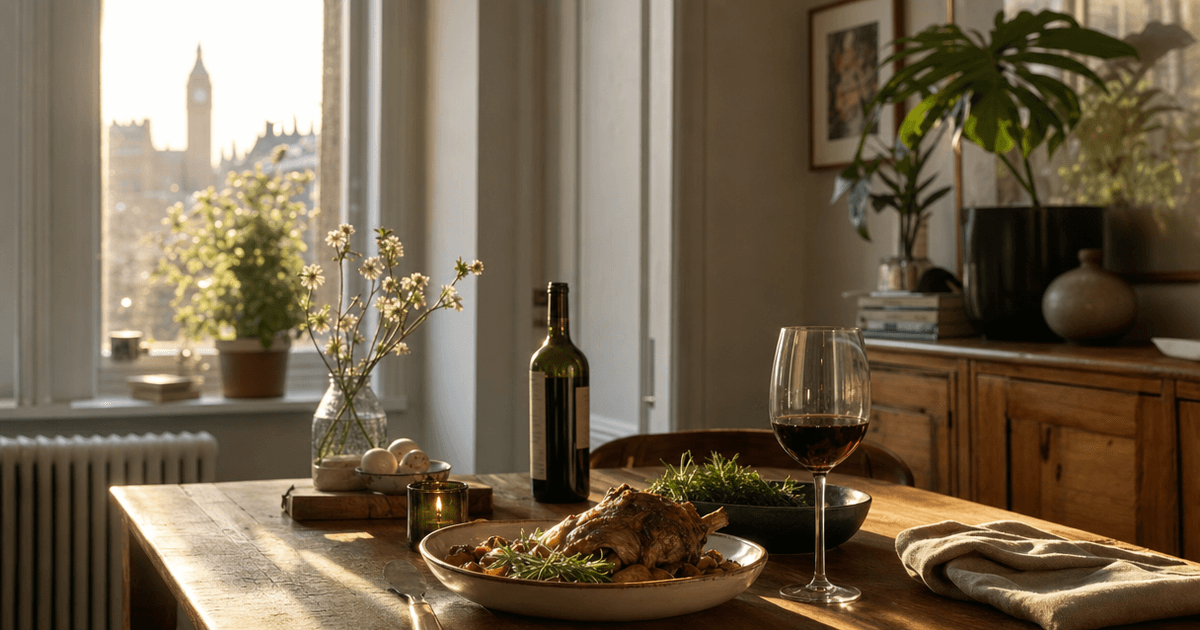
Lamb with red wine sauce is one of the oldest, safest bets on a British table, and it’s the one dish in our pairing series where the wine sits on both sides of the plate — in the pan as well as the glass. That changes how you choose the bottle, because a proper red wine sauce for lamb is a reduction of stock, wine and aromatics spooned over the meat, rather than a gravy thickened with flour off the roasting tin, and a reduction concentrates whatever you give it. Lamb needs the partnership: the meat’s fattier, more savoury pull wants a wine with grip and lift to meet it halfway. By the end of this you’ll know which style of red to pour depending on the cut you’re cooking, how a jus differs from a gravy, and when the classic pairing is worth breaking.
Does red wine sauce go with lamb?
Yes, unreservedly. Lamb’s higher fat content and slightly gamey, mineral edge (more pronounced in mature lamb or hogget than in pale, delicate spring lamb) needs a wine with real acid and tannin to cut through it. A red wine sauce doubles down on that logic — it’s built from the same base notes as the wine in your glass, so the dish and the drink are effectively singing the same tune.
This isn’t romantic guesswork, it’s just how the fat and the tannin behave together. Lamb has a delicate texture but is rich and fatty at the same time, so a wine with proper acid structure earns its place at the table far more than one chosen for weight alone. That’s why Old World reds with a leathery, savoury edge — Gigondas, Hermitage, the wider northern Rhône — get reached for again and again alongside lamb. There’s something almost too neat about the two together, as though northern Rhône Syrah and lamb were made to sit on the same table.
One small trick worth knowing, and it’s the rule this whole dish runs on: cook from the bottle you’ll pour. A sauce concentrates whatever goes into the pan, so a thin, characterless wine gives you a thin, characterless sauce, however carefully you reduce it. If that leathery Rhône style appeals, a Crozes-Hermitage is the friendly way in — one bottle happily covers the pan and the table.
Best wine with lamb: it depends on the cut, not just the animal
There’s no single best wine with lamb, and I’d be doing you a disservice pretending otherwise — cooking method changes the dish as much as the meat itself does. A pink roast leg wants something different from a slow-braised shank, and a delicate rack of spring lamb wants something different again. Here’s the shape of it, cut by cut:
| Cut or method | Reds that work well |
|---|---|
| Roast leg, served pink to medium | Claret (red Bordeaux), Rioja, Cabernet Sauvignon (Napa-style or Médoc) |
| Grilled leg, chops or cutlets | Red Bordeaux, Rioja Reserva, Shiraz/Syrah, fruity Zinfandel |
| Braised shanks or shoulder | Young red Bordeaux, Rhône reds, Super Tuscan, Syrah, Californian Pinot Noir with rosemary |
| Rack or loin, served pink | Red Burgundy (young, fruity Pinot Noir) |
| Delicate spring or “baby” lamb | Light-bodied red Bordeaux, Ribera del Duero, Rioja |
| Rich stew, tagine or Moroccan spicing | Châteauneuf-du-Pape, Grenache-led reds, fruity Zinfandel |
If you want three honest steers rather than a table: for a pink Sunday leg, an everyday claret or a Rioja Reserva — no need for anything grander; for shanks, a mid-priced Rhône red or a ripe Malbec; for a delicate spring rack, a young red Burgundy. Claret earns its reputation here fairly — red Bordeaux and roast lamb is one of those pairings that barely needs explaining, which is exactly why it’s worth knowing when to reach for something else. If you want the detail on which side of the Gironde suits a Sunday roast best, our guide to Left Bank vs Right Bank: the only Bordeaux divide that matters and our piece on which Bordeaux for the Sunday roast both go further than I can here. And if Rioja’s more your thing, it’s worth understanding the ageing ladder before you buy — a Crianza and a Gran Reserva behave very differently next to a rich sauce, and we cover that in Rioja Crianza, Reserva, Gran Reserva: the ageing ladder. Whichever cut is going in the oven, that’s the shape to shop to — one style for the pan, the same style for the glass.

How to make red wine jus for lamb?
A proper jus starts with the roasting tin, not a saucepan. Deglaze it with a glass of the red you’re drinking, scraping up everything stuck to the bottom, then reduce that hard with a good lamb or beef stock and aromatics — thyme, a bay leaf, maybe a bruised garlic clove. Strain it, reduce again until it coats the back of a spoon, then finish with a small knob of cold butter for shine. That’s the shape; quantities shift depending on how many you’re feeding, but the principle — reduce, don’t thicken — stays constant.
That principle is worth committing to memory as a definition: a jus is a reduction, a gravy is a thickening, and that one distinction separates the restaurant plate from the family roast. A jus relies on natural gelatine and hard reduction for its body, so it stays glossy and intense rather than thick. Some cooks take this further, braising lamb slowly in a red wine gravy until the meat falls apart, then pouring a second, different wine alongside for drinking — one wine does the cooking, another does the toasting. It’s a lovely approach for a lazy Sunday when you’re not watching the clock. And since the jus takes a glass from the bottle, buy a bottle you’re glad to give a glass of.
How do restaurant chefs make red wine sauce?
Restaurant recipes for red wine sauce shift a little from kitchen to kitchen and cookbook to cookbook, so rather than promise one exact method, here’s the shape that most good versions share. Soften shallots in butter, add red wine and reduce it right down until it’s syrupy, then add a good stock and reduce again. Off the heat, whisk in cold butter a little at a time until it goes glossy — that’s what gives the sauce its shine and body rather than a raw, thin edge.
The one thing worth remembering, wherever the recipe comes from: the sauce only tastes as good as the wine that went into the pan. If you wouldn’t drink it, don’t cook with it — which, happily, is also the simplest wine-shopping rule there is.
Lamb shanks with red wine: why braising changes the bottle
Lamb shanks with red wine is a slightly different conversation from a pink roast leg, because the long, slow cooking does most of the tannin-softening work for you. The meat falls off the bone and the sauce is already rich, dark and reduced, so you don’t need a young, gripping red to cut through fat in the same way you would with a rare-cooked cut. What you want instead is something ripe and rounded that won’t feel thin next to all that concentrated flavour — a young red Bordeaux, a Rhône red such as Crozes-Hermitage, a Super Tuscan, Syrah, or a Malbec with enough fruit to match the dish’s weight.
In Easter week I watch these bottles leave the shop in pairs — one for the pan, one for the table — and the customers who’ve cooked it that way once rarely go back to sacrificing the dregs of something they didn’t want to drink. If the shanks have gone the Moroccan route — cinnamon, cumin, dried apricot — Grenache-based reds or a fruity Zinfandel handle the spice better than anything tannic and austere. Save the serious claret for the plainer roast; it deserves a dish that lets it speak, not one shouting over it with cumin and chilli.
Questions customers ask us
How to make red wine gravy for lamb? Start the same way as a jus — wine, stock, the juices from the tin — but instead of reducing to a glaze, whisk in a little flour or cornflour to thicken it properly. It’s the heartier, more forgiving version, better suited to a big family roast than a restaurant plate.
Is rosé ever the answer for lamb? For a rosy-pink rack of spring lamb, yes — rosé Champagne or a good English sparkling rosé has enough acidity and red-fruit character to work as a genuine alternative to Pinot Noir, not just a novelty pour.
What about lamb marinated Greek-style, with garlic and lemon? Marinate and grill it that way and a crisp, citrussy Greek white such as Assyrtiko can outshine a red entirely — the lemon and oregano pull the dish towards white wine territory, whatever the meat.
Which wine suits really young, delicate spring lamb? Reach for something lighter than you would for a mature roast — a light-bodied red Bordeaux, Ribera del Duero, or Rioja all have enough structure without overwhelming the more delicate flavour of young lamb.
For the wider principles behind all of this — why acid matters more than most people think, and why “big wine, big food” isn’t always the right rule — our Food and wine pairing: a merchant’s complete guide to getting it right is worth ten minutes of your time.
The merchant’s last word
I’ve poured claret next to lamb more Sundays than I can count, and it still gets me every time — that leathery, savoury handshake between the two. But don’t let tradition talk you out of trying a young Rioja with the shanks, or an Assyrtiko with the garlicky Greek version. Lamb’s forgiving that way. Tell me the cut and I’ll tell you the bottle — one that earns its place in the pan and the glass alike. Come and browse the Italy cellar and I’ll point you towards a bottle that suits whatever’s going in your oven this weekend.



