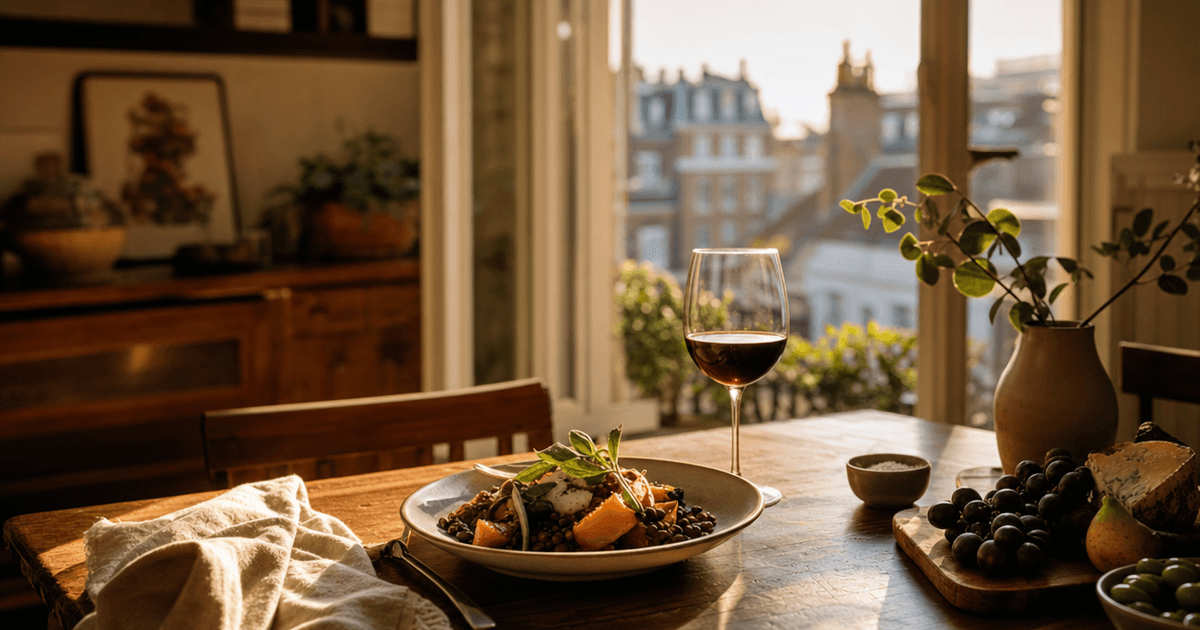
“Wine pairing food” — that’s how the question arrives typed into a search bar. Across this counter it arrives one plate at a time: steak tonight, sushi tomorrow, somebody’s Christmas bird in December. Either way the answer runs on four levers — match a wine’s weight, acidity, sweetness and tannin to the weight, acidity, sweetness and richness of the dish, so neither one flattens the other. Every single-dish answer on this blog is those four levers pulled in a particular order; this is the piece where I hand over the machinery itself. The levers can be learned in an afternoon, or stretched into a lifetime’s study — plenty of serious wine people have built careers on it. By the end of this you’ll know how to pick a bottle for a given plate, what to put out with drinks before anyone’s even sat down, and when the so-called rules are worth quietly ignoring.
What food pairs well with wine?
Almost anything, technically — you can drink any wine with any food and nobody’s coming to arrest you. But some combinations sing and some go flat, and the gap between them is nearly always one of those four levers pulled wrong. In practice: weight against weight, acid against the dish’s fat or acid, sweetness at or just above the dish’s own, and you’re most of the way there.
I used to think pairing wine with food was mostly about the protein — red with beef, white with fish, done. It took me a good few years selling wine to learn the better question: what’s on the protein? A tomato-based sauce behaves completely differently from a cream one, even sitting on the same piece of chicken. Trade writing on this has settled on much the same idea in recent years — a barbecue sauce with real natural sugar in it wants a wine that can match that sweetness, not fight it; a cream sauce wants a white wine, not a big tannic red, which is why a rich Alfredo and a young Barolo make each other taste worse, not better.
A few plain examples worth knowing, because they come up constantly on a Tuesday night:
- Vinegar-dressed salads and pickled things want a genuinely acidic wine — a Sancerre (Sauvignon Blanc from the upper Loire), a Vinho Verde, a Muscadet (Melon de Bourgogne, down at the river’s Atlantic end) — because a soft, low-acid wine just seems to vanish next to vinegar.
- Cream-based dishes generally want a white wine rather than a big red — ideally one with some flesh of its own, which is why Chardonnay keeps earning its row in the table below.
- Slow-stewed dishes suit a full-bodied white as often as people expect a red.
- A young, straightforwardly fruity red — the Merlot and Zinfandel end of the shelf — is the natural partner for well-done meat, where char and simplicity matter more than complexity.
None of those whites needs deep pockets, either. Muscadet and Vinho Verde are two of the best-value high-acid styles going, and if your cooking leans sharp, green and vinegared, that pair is your restock before anything grander.
There’s an older debate worth knowing about too, because it explains why people argue about this at dinner parties. Interest in formal food-and-wine matching really took off in America in the 1980s, partly as wine producers tried to plant the drink firmly at the dinner table rather than let it be seen as something drunk on its own. That gave rise to a genuine reverence for the subject among sommeliers — and, in reaction, a school of thought that says pairing rules are nonsense and the only thing that matters is drinking what suits your mood. Both camps have a point. I’d rather you knew the shape of the rules and then broke them on purpose, than never learned them and broke them by accident.
One more thing worth deciding before you shop: are you mirroring or contrasting? A rich, buttery Chardonnay next to a creamy fish dish is mirroring — like meets like. A sweet, honeyed wine next to a sharp blue cheese is contrasting — the wine fills a gap the dish leaves open. Neither is more “correct.” Both are just choices about pairing wine and food you can make on purpose once you know they exist — and deciding which mood you’re buying for tonight rules out half the shelf before you’ve read a single label. That’s most of what buying well actually means.
Choosing a wine style for your dish
Once the four levers are in your head, choosing a bottle is mostly pattern-matching. This is the table I’d sketch on the back of a receipt if you asked me at the counter.
| Dish or style | Reach for | Steer clear of |
|---|---|---|
| Classic French cooking, simply prepared meat | Red Bordeaux, white Burgundy, Chardonnay, Pinot Noir | Fusion food, raw garlic, real spice, sweetness, vinegar |
| Roasts — beef, lamb, duck, game birds | Rhône reds, red Bordeaux, Cabernet Sauvignon, Chianti Classico, Grenache | — |
| Grills, barbecue, burgers, ribs, roast or grilled chicken | Merlot, Zinfandel, off-dry rosé, sparkling wine | Cream sauces, oysters, raw shellfish |
| Cream-based sauces and dishes | Full-bodied white — Chardonnay and similar | High-tannin reds: Barolo, Barbaresco, Cabernet, Syrah, Zinfandel |
| Vinegar dressings, pickles, sharp salads | High-acid white — Sancerre, Muscadet, Vinho Verde, Champagne | Delicate, low-acid Old World reds |
| Curry and spicy Asian food | Off-dry Riesling, fruity New World red such as Shiraz | Fine wine, high-alcohol wine, heavily tannic or oaked wine |
| Game and venison | Barolo, Barbaresco, Rioja, Châteauneuf-du-Pape, Super Tuscan, sparkling wine | — |
A couple of things worth flagging that don’t fit neatly into a row. If you’re cooking with wine — a fondue, a red wine sauce, a coq au vin — the safest move is to serve the same wine you cooked with, or at least the same style. It’s an old trick and it works because the flavours are already, quite literally, in the pan. And curry deserves its own line: fine, high-alcohol, heavily tannic or heavily oaked wines all struggle against sweet or spicy curry, which is exactly why an off-dry Riesling so often outperforms an expensive Bordeaux at the local Indian. If Friday night at yours usually involves spice, keep an off-dry German Riesling and a fruity Shiraz within reach and you’re covered either way — that’s the sweetness lever and the weight lever, handled in advance.
Most households, honestly, eat from three or four of those rows, not all seven. Work out which rows are yours and stock for them — that’s the difference between owning wine and owning the right wine.

What to serve as nibbles with wine?
Charcuterie and cheese are the honest, low-effort answer, and they happen to sit well with a wide range of wines. Mild cheeses like young Cheddar or Monterey Jack suit a fruity red or an off-dry rosé; full-flavoured cheeses — blue, Gorgonzola, aged Gouda, Parmesan — hold up much better against a medium-bodied red like Merlot. A dry fino or amontillado sherry from Jerez is the classic aperitif for exactly this reason: bone-dry, savoury, made for salty food.
If you’re doing something spiced — chilli-rubbed nuts, a bit of chorizo — a rosé Champagne handles the heat better than most people expect, and it looks the part on a table before dinner. Off-dry sparkling wine is my usual answer when I genuinely don’t know what a mixed group of guests will like; it’s acidic enough to cut through fat, has just enough sweetness to be forgiving, and nobody’s ever complained about it. Herbs matter here too — sage in particular turns up again and again as wine-friendly, which is handy if you’re doing anything with sausage or a herby cheese straight from the fridge.
Serve all of this properly chilled, by the way — nibbles wine served too warm just tastes flabby and loses its point. If you want the actual numbers rather than my rule of thumb, our wine serving temperatures cheat-sheet has them laid out bottle by bottle. And if you take one buying cue from this whole section, make it the sherry — a proper fino costs less than most party whites and beats every one of them next to anything salty.
Which wine is best for diabetics?
Honestly, I’d rather not guess at something so personal — sugar and health questions really do need a proper professional, like your GP or a dietitian, who can look at your full picture rather than a bottle label. Where I can genuinely help is on the wine side of things: talking you through how sweetness differs from one style to the next, so you’ve got a bit more to go on next time you’re browsing the shelves.
Dry wines carry very little residual sugar — a Muscadet, a dry Riesling, a brut Champagne are all built to taste crisp rather than sweet. At the other end, styles like Sauternes, tawny or vintage port, and sweet oloroso sherry carry a great deal more sugar by design; that’s the entire point of them, made for pudding rather than the main course. Somewhere in the middle sits dry Madeira, which behaves more like a savoury, food-friendly wine than a dessert one despite the name. None of that is medical advice — it’s just the shape of the sugar spectrum, so any conversation you have with a doctor about diet has some context behind it.
Getting the occasion right, not just the plate
There’s a principle from the wine writer Karen MacNeil that I think about more than any technical rule: great with great, humble with humble. A hot sandwich on a Tuesday doesn’t need an expensive bottle behind it, and an expensive bottle deserves better than being poured next to a hot sandwich. It works the same way with delicacy and boldness — a delicate red Burgundy will taste like water next to a fiery curry, while a big Shiraz can stand up to it and enjoy the fight. It’s the weight lever again, really — applied to the occasion instead of the plate.
This is also where a lot of good pairing plans quietly fall apart: multi-course meals. Restaurant tasting menus with a dozen small courses have become a real headache for sommeliers, because no single bottle, or even a sequence of half bottles, can sensibly follow food changing direction every ten minutes. At home the same problem shows up in smaller form at any dinner party with more than one course — a wine perfect with the starter can be wrong for the main. If you’re planning something with courses, it’s worth thinking it through properly rather than grabbing whatever’s open; our guide to planning wine for a dinner party walks through exactly that.
And “great with great” doesn’t have to mean expensive. This is where a second wine earns its keep — the same estate’s more everyday bottling, built to drink well now rather than age for a decade, at a fraction of the price of the grand vin. Save the serious bottle for the occasion that matches it, and let a second wine carry the weeknight roast without any sense of letting the side down.
Questions customers ask us
What is the 20/20/20 rule for wine? I’ll be honest — I’ve never come across an agreed version of this in the serious wine literature, and I’m not going to pretend one exists just because the question gets asked. What most merchants mean by something like it is a rough three-point check: match the weight, match the acid, match the sweetness, in that order — three of the four levers, in their working order.
Does red wine always go with red meat? Not really, no. A fuller-bodied red does suit richer, oilier fish like a grilled or barbecued salmon rather well, while delicate white fish and raw shellfish generally prefer something white and acidic instead. Colour is the least reliable of the four levers; weight is the one doing the real work.
What wine goes with pizza? For a pepperoni pizza specifically, a fruity, medium-bodied red such as Zinfandel is the classic match — enough fruit and grip to stand up to the cured meat and tomato without turning bitter. Weight against the meat, fruit against the tomato: two levers, one slice.
Is red wine always right with cheese? Not with the creamy stuff. High-tannin reds like Barolo, Barbaresco or a young Cabernet actively clash with soft, creamy cheeses, and do far better paired with harder, full-flavoured ones instead. On a cheese board, tannin is the lever to watch.
The merchant’s last word
I’ve poured enough wrong pairings across this counter to know the stakes are lower than people fear — worst case, you open a second bottle. Four levers, pulled with a bit of attention to what’s actually on the plate in front of you — that’s the entire method, and it’s the same one working quietly underneath every single-dish answer on this blog. If you’d rather I did some of that pulling for you, the shelves are already sorted by plate: go and browse the Italy cellar, pick the dinner rather than the grape, and I’ll have done the matching before you arrive.



