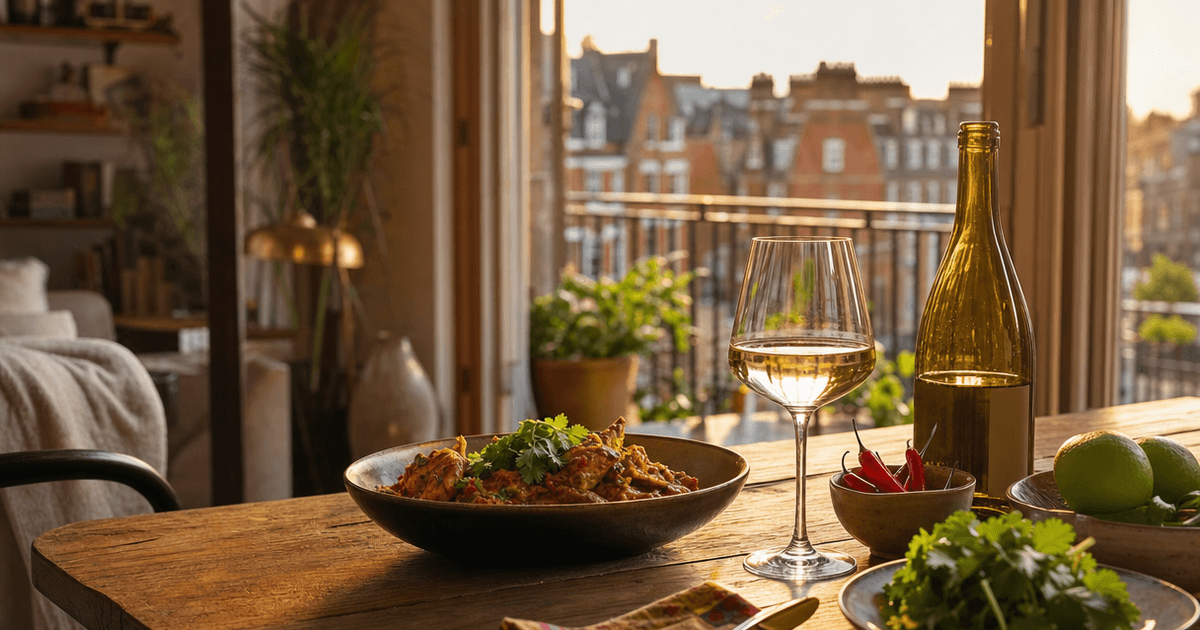
White wine with spicy food is the one pairing where the wine doesn’t just sit beside the plate — it physically turns the heat up or down. Chilli isn’t a flavour so much as a burn, and what’s in your glass acts on that burn directly; no amount of clever flavour-matching does anything so mechanical for a steak or a cheese board. So here’s the short version: spicy food wants a wine with a touch of sweetness, decent acidity and low alcohol — full stop. Big, oaked, high-strength wines crank the burn instead of settling it. By the end you’ll know exactly which white styles to reach for, when a red does the job better, and how to serve either so the pairing earns its keep rather than getting lost under the chilli.
What white wine goes with spicy food?
Off-dry whites with a bit of fruit and restrained alcohol are your safest bet: German Riesling (Kabinett or Spätlese), Alsatian Gewürztraminer, off-dry Chenin Blanc, Vouvray sec or demi-sec, unoaked Pinot Gris, and Grüner Veltliner. The sugar takes the edge off the burn, the acidity keeps rich, spiced sauces in check, and the lower strength stops the whole thing tasting hotter than it is.
Gewürztraminer deserves a special mention here, and it took me a good few years behind the counter to work out why it does more than simply cool things down. Its own character — lychee, rose petal, ginger, sometimes a clove-like spice note — actually echoes what’s happening in the dish rather than just dampening it. That’s a different job to a neutral, bone-dry white, and it’s why Alsace keeps coming up whenever Chinese or Indian spicing is on the table.
Muscadet is the odd one in this list — bone dry, no sugar at all — but trade opinion consistently pairs it with spicier dishes precisely because its acidity is so bracing it slices straight through richness. Grüner Veltliner does something similar with a peppery lift of its own (we’ve written more on that grape here: Grüner Veltliner: Austria’s answer to everything). If you want one bottle to keep in the fridge for whatever spicy thing turns up on a Tuesday, an entry-level German off-dry white, sitting around 11-12% ABV, is hard to beat — and it won’t cost you much either.
Can you drink wine with spicy food?
Yes, absolutely — but how you drink it matters more than whether you do. Alcohol dissolves capsaicin, the compound behind chilli heat, and that dissolving process actually increases how much burn you feel, not less. A high-alcohol wine will make a vindaloo taste hotter than it did a moment ago.
That single fact explains a lot of pairings that go wrong. A big 14.5% Chardonnay, oak and all, doesn’t just clash on flavour — it turns the volume up on the spice itself. Tannin makes matters worse again; trade coverage is blunt about it, calling heavy tannin the worst enemy of spice, because it grips onto chilli oils and turns them harsh and bitter on the palate. That’s the reasoning behind avoiding tannic, oaked, high-alcohol wine with hot food generally, whatever the grape.
There’s an interesting contrast across the world here. In parts of Sichuan, diners reach for baijiu, a very high-proof spirit, specifically alongside fiery food — a deliberate choice to lean into the heat rather than avoid it. For wine, though, lower alcohol nearly always serves you better, unless you’re actively going for that fire-on-fire effect.

Which wine pairs best with a spicy dish?
There are really two strategies, and it’s worth deciding which one you’re playing before you pick a bottle — because the wine is effectively the dish’s volume knob. Off-dry whites and lighter, low-tannin reds turn the heat down. Fruity, low-tannin reds and sparkling wine turn it up, for anyone who actually enjoys the dish getting hotter as the meal goes on.
If you’re in the “amplify” camp, red wine with spicy food means Beaujolais (chill it slightly), young Californian Zinfandel, Dolcetto, young Rioja, or a fruit-forward Shiraz/Syrah from a warmer southern-hemisphere region — fruit over tannin every time. You’ll occasionally see Cabernet Sauvignon or white Bordeaux suggested alongside tandoori dishes specifically; I’d still nudge most people toward the softer, fruitier styles first, because tannin and chilli rarely make friends.
Sparkling wine sits in both camps depending on style — a dry Cava or inexpensive sparkling wine calms things down, while Champagne rosé, with its extra fruit weight, can hold its own against real heat. If sweetness levels in fizz confuse you, our guide on Brut, Extra Brut, Demi-Sec: what Champagne sweetness levels really taste like is worth a look before you buy. For the fuller picture on matching wine and food generally, our Food and wine pairing: a merchant’s complete guide to getting it right covers the principles behind all of this.
Matching wine to the cuisine, not just the heat
Chilli isn’t the only thing driving these dishes — coconut milk, garlic, citrus and five-spice all pull the pairing in different directions. Here’s how I’d shop by cuisine.
| Cuisine | What’s really driving it | Reach for |
|---|---|---|
| Indian (curry, tikka, tandoori) | Rich, spiced, often creamy sauces | Off-dry Chenin Blanc, Riesling Spätlese, New Zealand Sauvignon Blanc for spicier starters, Pinot Noir with tandoori |
| Thai | Chilli plus coconut milk richness | Viognier, off-dry Sylvaner, Grüner Veltliner, unoaked white Burgundy for milder curries |
| Szechuan / Hunan | Numbing chilli, garlic, heavier meats | Alsatian Gewürztraminer, off-dry Riesling (Spätlese/Auslese), Beaujolais |
| Mexican | Fresh chiles, citrus, salsa | German Riesling Auslese, New Zealand Sauvignon Blanc, young Rioja, off-dry Zinfandel |
| Chinese (five-spice, chilli oil) | Warm spice rather than pure heat | Off-dry Alsatian white, Gewürztraminer, Muscadet, Pinot Blanc |
If you’re working through a full Indian takeaway menu rather than a single dish, we’ve gone deeper on that specifically here: Wine with an Indian takeaway: pairing korma to vindaloo. And if a night of spicy Thai food is what you’re planning, the coconut-milk column above is your starting point — Viognier in particular handles that richness without disappearing.
Serving it so it actually earns its keep
Chill your white a notch colder than you would for a delicate Chablis — the extra cold mutes alcohol perception and feels more refreshing against real heat. Pour smaller glasses more often rather than one generous glass sat going warm; spicy food is a marathon, not a single course.
If you’re working through several dishes of rising heat — say a mild dal, then a hotter curry — start with your driest wine and let the wine’s own sweetness climb as the food does. That sequencing does more for the meal than agonising over the perfect single bottle.
What decent bottles actually cost you
You don’t need to spend big here, and honestly, spending big can work against you. Inexpensive sparkling wine is repeatedly the pairing of choice in trade circles for exactly this reason — you’re not paying for oak or extended ageing, both of which clash with chilli anyway. An entry-level off-dry German Riesling or Alsatian white typically sits at the accessible end of the shelf, and that’s no accident; these are workhorse styles, not trophy wines.
Where I’d actively steer you away from spending is on an aged, oaked New World Chardonnay or a serious tannic Bordeaux for a Tuesday-night curry. Save those bottles for the dishes they were built for — a plain roast chicken, a steak — and let your spicy food money go toward two or three lighter, cheaper bottles instead.
Questions customers ask us
Can I serve red wine chilled with spicy food? Yes, and with lighter reds like Beaujolais or Dolcetto I’d actively recommend it. A slight chill keeps the fruit fresh and stops any warming alcohol sensation compounding the dish’s heat.
Is beer better than wine with curry? Plenty of people think so, and lager, pilsner or wheat beer genuinely does the job well — carbonation and low bitterness both help. It’s not a failure on wine’s part; it’s just a different, equally valid route to the same result.
What about sake with spicy Asian food? Sake and Chinese rice wine both turn up regularly alongside Pacific Rim cooking, and they’re worth having in the cupboard if you cook this style often. They’re a different category to grape wine, but the logic — low tannin, gentle sweetness — is the same.
What wine is good for diabetics? That’s a medical question, and your GP or diabetes team are the right people to ask, since they know your situation properly. What I can tell you as a merchant is which wines are made dry with minimal residual sugar, if that’s useful detail to bring to that conversation.
The merchant’s last word
I’ve poured a lot of wine alongside a lot of curries over the years, and the wines that keep coming back are never the flashy ones — they’re the honest, off-dry, low-alcohol bottles nobody brags about at dinner. Trust the humble stuff here — it’s the hand on the volume knob. If you fancy having a few of these sorted before the next takeaway night, go and browse the Italy cellar.



