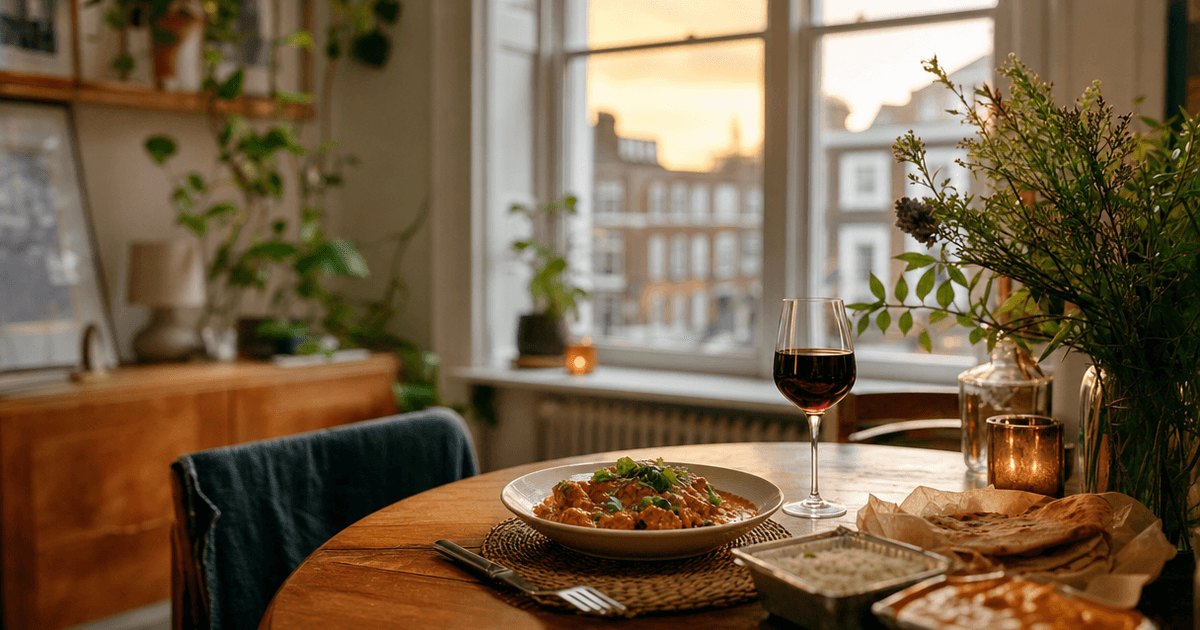
Good wine with curry isn’t the contradiction people think it is — it just runs on different rules to the ones you learned with a Sunday roast. Curry, for wine purposes, means one thing: a spiced, sauced dish where chilli, cumin, coriander, and often cream or coconut, do more work on your palate than the meat underneath. The spice is what your glass has to answer to, not the protein. That’s the whole rule, and it’s worth committing to memory: pair to the sauce, not the meat — in a curry, the sauce is the dish.
This is the takeaway-menu version of the answer, dish by dish. By the end of this you’ll know which bottle to grab for a Friday-night korma and which one to swap in when the vindaloo turns up the heat — and why your best bottle of Rioja should probably stay in the rack that night. I’ve sent customers off with a big oaked Cabernet for their “curry night” more than once, years ago, before I understood why they came back saying it just didn’t sing. It wasn’t the wine’s fault. It was mine, for not asking what was actually in the pan.
How spice actually messes with your wine
Chilli heat and the trade of Indian spices don’t just sit alongside a wine — they change how you taste it. Trade opinion on this is fairly settled: spice turns up your perception of bitterness, acidity, and alcohol burn, while turning down how much body, richness, sweetness and fruit you notice. That’s why a big, dry, high-alcohol red can taste thin and harsh next to a rogan josh, even though it tasted perfectly balanced on its own an hour earlier.
It also explains why the same wine behaves differently across one takeaway order. A Riesling that feels crisp and lean against a plain pilau can taste almost sweet and generous next to a hot phall. Nothing changed in the bottle. Everything changed in the sauce. The rule that falls out of all this is the one to shop by: the hotter the dish, the sweeter and colder the wine can afford to be.
Is curry better with red or white wine?
White wine (and rosé) generally has the easier time of it with curry, because tannin — the drying, gripping structure in most reds — reads as bitter and harsh once chilli heat is in the mix. Off-dry, fruity, low-oak whites tend to cope far better than big reds. That’s the short version; the longer one has some useful exceptions.
Tannin is the real enemy here, not colour. A young Cabernet Sauvignon or a heavily oaked red will fight a spicy dish almost every time — trade guidance on sweet and spiced curries specifically flags high-alcohol wine, highly tannic wine, and oaked wine as things worth avoiding altogether. But a light, low-tannin red — Beaujolais or Beaujolais-Villages, for instance — has a decent track record with beef or lamb curries, precisely because it doesn’t bring much tannin to the fight in the first place.
There’s also a regional pattern worth knowing: fresh, unoaked whites with a touch of natural sweetness — think Alsace, home to Pinot Blanc, Riesling, Pinot Gris and Gewürztraminer — have built a strong reputation specifically because they carry sweetness and spice of their own, rather than fighting the dish’s spice with structure. If you take one shopping shortcut from this whole page, “Alsace” is the word to remember at the counter. Our Food and wine pairing: a merchant’s complete guide to getting it right goes into why sweetness and acidity do more heavy lifting than tannin across spicy food generally, if you want the full mechanics.

What is the best thing to drink with curry?
There isn’t one best drink for curry — there’s a best drink for the dish in front of you, and the sauce matters more than the meat. As a rough guide: off-dry whites suit most curries, sparkling wine suits fried or milder dishes, light fruity reds suit richer meat curries, and a cold beer has never let anyone down with a tandoori grill.
Here’s how that breaks down by the dishes you’re actually likely to order:
| Curry style | Reach for | Steer away from |
|---|---|---|
| Korma / coconut / sweet curries | Off-dry Chenin Blanc, Alsace Pinot Gris, demi-sec Vouvray | Big tannic reds, heavily oaked wine |
| Tikka Masala | Gewürztraminer, New Zealand Sauvignon Blanc, Beaujolais Villages, sparkling wine | Fine, high-alcohol reds |
| Tandoori grills | Zinfandel, Gewürztraminer, a light Pinot Noir | Delicate, subtle whites — they’ll vanish |
| Vindaloo / very spicy-hot | Off-dry Riesling (Spätlese), Grüner Veltliner, rosé | High-alcohol or heavily tannic reds |
| Biryani | Fruity, lightly oaked Pinot Noir, or a white matched to the saffron rice | Anything too austere or bone-dry |
Beer gets an honest mention too — trade coverage repeatedly flags lager, pale ale and IPA as solid, traditional partners for curry sauce and tandoori dishes, and mulled cider turns up as a genuine match for chicken tikka masala. Assam tea has its fans with tandoori food as well. None of this is heresy; it’s just what actually sits well against the spice. And if you’re buying one bottle blind for a mixed order, make it the off-dry Riesling at Spätlese ripeness — it’s the one wine on that table that covers korma to vindaloo without embarrassment.
Serving it right: temperature and glass
Chill matters more with curry than with almost any other pairing you’ll do at home. Off-dry whites and rosé want to be properly cold — colder than you’d serve them with fish — because the chill sharpens acidity right when the chilli is dulling it. A wine that felt just-cool-enough with a salad will taste flat and warm against a hot curry within ten minutes on the table.
Sparkling wine earns its place here too, particularly with fried starters (onion bhajis, pakoras) or milder curry sauces, where the bubbles do the same refreshing job as chilled still white but with a bit more lift. If you want to go beyond Champagne for that job, cool-climate sparkling from further afield — Tasmanian sparkling wine is a good example — has that same bright acid backbone that copes well with spice, at a friendlier price. And if a demi-sec or slightly sweeter style is new territory for you, our guide to Brut, Extra Brut, Demi-Sec: what Champagne sweetness levels really taste like explains why a touch of sweetness in your fizz isn’t a compromise here — it’s the point.
Big-bowled red wine glasses are wasted on curry night, frankly. A simple white wine glass, chilled bottle, and a jug of water on the table does more for the evening than any decanter will. All of which means curry night is the cheapest good habit in wine: one properly cold bottle, chosen for the sauce, and the table’s sorted.
Which wine is best for diabetics?
I’ll be straight with you: that’s outside my lane. Health and dietary calls need a GP or pharmacist behind them, not a merchant who spends his days matching wine to dinner. Where I can actually help is on the practical side — sugar levels swing wildly from one bottle to the next, so if you’re keeping an eye on intake, look for wines explicitly labelled dry as your safest bet, and always check the label itself, since it’ll give you harder facts than I’m qualified to.
What this means for your shopping list
The good news buried in all this: good wine with curry rarely means expensive wine with curry. Trade guidance on spicy and sweet curries specifically warns off fine wine, high-alcohol bottles, heavily tannic reds and oaked styles — which is, conveniently, the expensive end of most wine lists. You’re not being asked to hold back your best bottle for curry night. You’re being asked not to bother opening it.
That frees up the budget nicely. An honest Alsace Pinot Blanc, a New Zealand Sauvignon Blanc, or a simple demi-sec Vouvray will all outperform something twice the price that was built for steak. Save the serious bottles for the nights they’re actually suited to, and let curry night be where your everyday drinking shines.
Questions customers ask us
Is red or white wine better with Indian food?
Same logic as red versus white with curry generally: white and rosé styles tend to handle chilli heat and cream-based sauces better, while big tannic reds tend to clash. Light, fruity reds like Beaujolais are the exception worth keeping in mind.
Does the same wine work across a whole shared curry order?
Rarely, and that’s fine. If you’re sharing a korma, a vindaloo and a biryani across the table, an off-dry white or a rosé is the safest single bottle to cover all three reasonably well.
Is Carmenère really a good match, as I’ve heard mentioned?
It’s had genuine trade interest — a well-documented London tasting event found real affinity between Carmenère and dishes built around cardamom and cumin. Worth trying if you can find one, though it’s a less common bottle on UK shelves than the Alsace or New Zealand options above.
What about wine with a curry sauce rather than a whole dish, like a curry-sauce chip shop tea?
The same off-dry white and Gewürztraminer logic applies — the sauce is doing the work, not the chips. Lager or pale ale is the more traditional call here, and there’s nothing wrong with sticking with it.
The merchant’s last word
I used to think curry night was a wine no-man’s-land — somewhere you just reached for beer and didn’t overthink it. I was half right about the beer, wrong about the overthinking. Once you match the glass to the sauce rather than the meat, curry night becomes one of the easiest pairings in the house, not the hardest. Fancy trying it properly this week? Browse the Italy cellar and pick something off-dry and cold for whatever’s arriving on the moped tonight.



