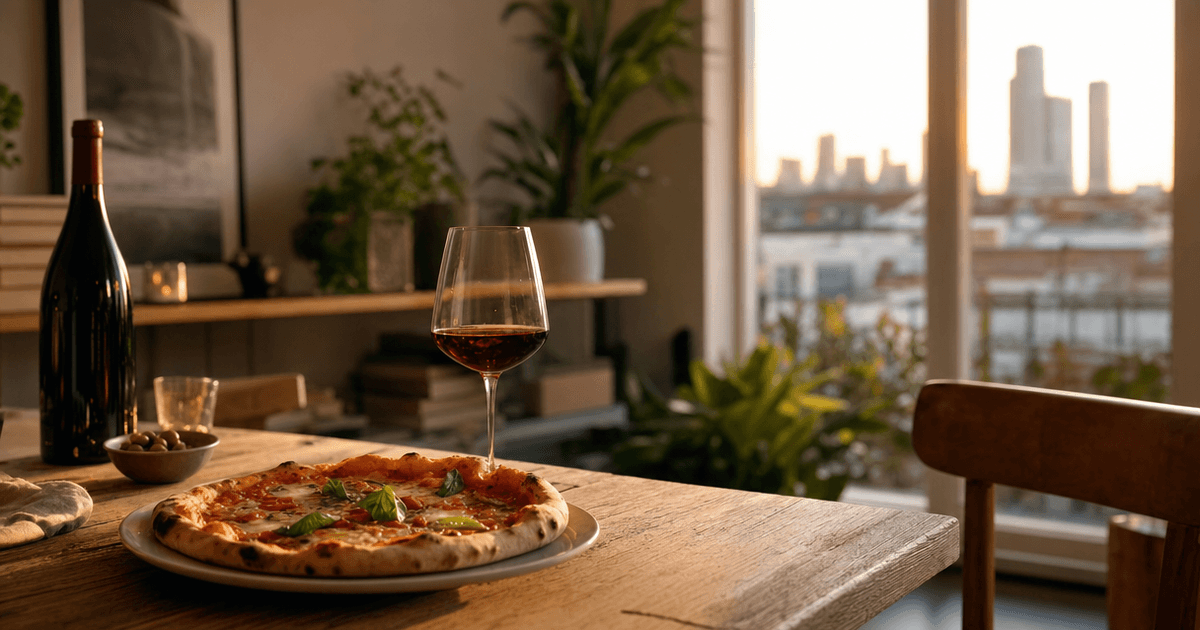
Every pairing rule you’ve heard for pizza starts with the topping. After enough Friday nights poured against margheritas and meat feasts, I’d put it differently: the crust decides, the topping adjusts. A soft, sweet delivery base and a charred, blistered wood-fired one are two different dishes wearing the same pepperoni — and the wine that flatters one can turn oddly bitter against the other. The acidity in a good tomato sauce and the fat from melted mozzarella still push back hard against anything not built to handle them, but it’s the dough that sets the terms. Below is a straightforward guide to pairing wine styles with different toppings, putting the red-or-white debate to bed properly, and dialling in the serving details so your pizza night actually works as intended.
What wine goes well with pizza?
The short version: match the acidity of the wine to the acidity of the tomato, and let the topping decide the rest. A bright, food-friendly red like Barbera or a lighter Sangiovese covers most bases; a crisp white such as Pinot Grigio or Soave takes over once you go tomato-free. Nothing exotic needed — this is weeknight drinking, not a dinner party.
Here’s where it gets useful, though, because “pizza” isn’t one dish. A four-cheese white pizza wants nothing like a pepperoni does.
| Topping | Reach for | Why it works |
|---|---|---|
| Margherita (tomato, mozzarella, basil) | Barbera, lighter Sangiovese, Pinot Grigio | High acid meets high acid; nothing fights the tomato |
| Pepperoni | Chianti, Montepulciano d’Abruzzo | Enough grip for the fat and spice without swamping it |
| White pizza / four cheese | Soave, Fiano, Prosecco | No tomato to balance, so the wine can be softer and rounder |
| Mushroom | Chianti Classico, Pinot Noir | Earthy topping, earthy wine — a classic quiet match |
| Chilli or spicy sausage | Off-dry Riesling, fruity Zinfandel | A touch of sweetness tames the heat rather than fighting it |
| Anchovy or puttanesca-style | Pinot Noir, Vernaccia | Salt-forward toppings need a wine that doesn’t add more punch |
| Peppers and onions | Cabernet Franc, Sauvignon Blanc | Herbal, green notes echo the veg instead of clashing |
If Sangiovese keeps turning up on that list, that’s not an accident — it’s doing a lot of the heavy lifting in Italian food generally, and I’ve written a longer piece on Sangiovese styles, from Tuesday pasta to cellar treasure, if you want the full picture of where it goes from simple to serious.
This is the crust rule in action: sweeter, softer bases (the kind you get from a chain delivery rather than a wood-fired oven) actually prefer a rounder red like Merlot or Argentinian Malbec over something big and tannic like Cabernet Sauvignon or Zinfandel. The bigger reds can turn oddly bitter against that sweeter dough. I learned that one the hard way, steering a customer’s regular Friday-night order towards a big, tannic red that had no business near a soft, sweet crust — it fought the pizza rather than joining it.
Do you eat pizza with red or white wine?
There’s no rule saying pizza must be red-wine territory — it’s the acid and tannin doing the heavy lifting, not the shade in the glass. A tannic red stands up to a pepperoni or sausage pie just as well as a zippy white cuts through a margherita or a tomato-based slice. The real mistake is pouring something plush, oaky and low-acid, whatever its colour, and watching it fall flat against that charred, blistered crust.
Sparkling deserves a mention here too. Trade tasting panels have flagged Champagne and other sparkling wines as surprisingly strong pizza partners — the bubbles and acidity cut straight through melted cheese in a way still wine sometimes struggles to. Rosé does something similar, especially against a spicier topping, sitting between the red and white camps rather than picking a side.
Temperature matters more than most people think. A light red like Gamay or a young Barbera actually improves with a slight chill — ten or fifteen minutes in the fridge before opening. Room temperature in July does it no favours.
And don’t discount the cheap stuff. I’ve sat through a comparison tasting with nothing but frozen supermarket pizza and a row of bottles under a tenner, and the wines that won weren’t the fanciest — they were the ones with plenty of tart fruit and a bit of minerality, standing up to that sweet, salty crust without trying to be clever about it — the base calling the shots again. Pizza doesn’t ask for your best bottle. It asks for the right one.

Do Italians drink wine with pizza?
Not as often as you’d think, if we’re honest. Wine loses that particular contest in most Italian pizzerie, where beer has quietly dominated the till for decades — a matter of cost and custom more than flavour. Order a pizza in Naples and chances are the waiter reaches for a chilled lager long before he thinks to mention the wine list.
That’s shifted lately. As pizza itself has gone more gourmet — better dough, better ingredients, longer fermentation — the old wine tradition (which actually predates the beer boom) has started creeping back. Wine lists in pizzerie are visibly improving, and it’s not unusual now to find a serious bottle alongside the beer fridge in the smarter spots.
I used to assume the opposite — that wine-with-pizza was simply how it’s always done in Italy. It isn’t, not by default. It’s a habit worth having, not a rule you’re breaking by reaching for a beer instead.
How to serve it so it earns its place
Glassware doesn’t need to be fussy — a standard white wine glass for both colours is fine, pizza is not the night for your best crystal. What matters more is not over-serving the wine: a generous pour of something with real acid will always taste sharper against a slice than the same wine sipped alongside a steak.
Herbs on the pizza change things too. A heavy hand with oregano pulls a wine towards the herbal end — Sauvignon Blanc handles that shift well, and so does a lighter Chianti. If there’s fresh chilli flake or a good glug of olive oil and garlic involved, look towards Dolcetto or Vermentino rather than anything oaky, which tends to go flat against raw garlic.
Calzone, if you’re going that way, behaves more like a rich stew than a pizza — the filling’s sealed in, so it holds heat and concentrates flavour. Lambrusco’s light fizz cuts through that nicely, and a Syrah works if there’s meat inside.
One honest note on price: you don’t need a Riserva-level Chianti for pizza night, and it’s worth knowing the difference before you spend more than you need to — I cover that properly in what Riserva actually means on an Italian label. A straightforward Chianti annata does the pizza job just as well, most weeks better, because it’s built for exactly this kind of easy drinking rather than the cellar. The same logic applies more broadly — you don’t always need the grand vin to eat well, which is the whole idea behind second wines and how to drink a great château without the grand vin price.
Questions customers ask us
Which wine is best for diabetics? That’s a medical question, and it deserves a proper answer from a GP or diabetes nurse rather than a guess from behind a wine counter. I can help with pairing and pouring; what and whether to drink sits between you and your doctor.
What about ricotta-topped or white pizzas generally? Chianti Classico still works surprisingly well here, alongside Prosecco if you want something lighter and fizzier — the creaminess of the cheese takes the edge off either.
Does olive oil and garlic change the pairing? Yes, a little — it pushes things towards Barbera, Soave or Vermentino, especially if there’s dried chilli in the mix, which those wines seem to shrug off better than an oaked white.
Is there one “correct” pizza wine? No, and I’d be suspicious of anyone who tells you there is. Toppings vary too much, bottle to bottle and pizza to pizza — the shape above will get you close every time, which matters more than being exact.
For the wider logic behind all of this — why acid meets acid, why fat needs a foil — it’s worth a look at the complete guide to food and wine pairing, which goes well beyond pizza night.
The merchant’s last word
I’ve poured plenty of wrong wines against plenty of right pizzas over the years, mine included — that lesson about big reds and sweet crusts stuck with me. The truth is pizza’s forgiving if you get the acid roughly right and don’t overthink the rest. Pick something with a bit of grip, serve it slightly cooler than you think, and let the topping do the deciding. If you’d rather I do the deciding for you, browse the Italy cellar and I’ll point you at the right bottle for Friday’s order.



