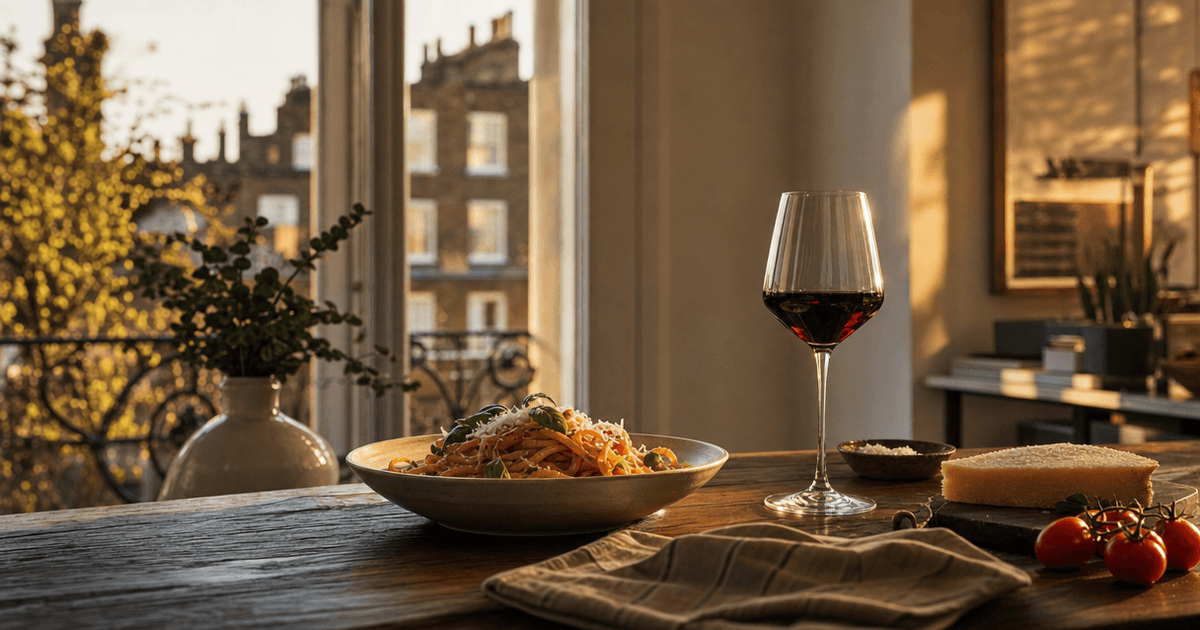
Pasta with white wine sauce is the one pairing on this blog where the bottle holds down two jobs — it’s in the pan before it’s ever in the glass. That changes how you choose: you’re not matching a wine to a finished dish so much as deciding what the dish will be built on, then drinking the evidence beside it. Here’s the plain truth of it: a white wine pasta sauce is built on a reduction — wine bubbled down in the pan, then finished with butter, cream or a ladle of starchy cooking water — and the wine’s acidity is what stops the whole thing sitting heavy on the tongue. By the end of this you’ll know which sauce style wants which glass, and why it’s the sauce, not the shape of the pasta, doing the deciding.
Can you use white wine in a pasta sauce?
Yes — and Italian cooks have been doing it for a very long time. White wine goes in early, before the cream or the tomato, and its job is to deglaze the pan and bring acidity that fat alone can’t supply. Any dry white you’d pour into a glass will do the job; the alcohol cooks off, the flavour stays — the first of the wine’s two jobs, done before anyone’s sat down.
Where people go wrong is reaching for a bottle marked specifically for cooking, the kind that’s sat at the back of a cupboard since Christmas. Don’t. A cheap, dry, unoaked white — Pinot Grigio, Vermentino, an unassuming Soave — works far better than anything sweet or heavily oaked, because you don’t want vanilla and toast fighting your garlic and clams. If you’ve got half a bottle open from last night’s dinner and you’re wondering what to do with it before it turns, this is exactly the moment — our piece on cooking with leftover wine covers what holds up in the pan and what doesn’t. And once the wine’s reduced, taste it — that little spoonful tells you more about whether the sauce is balanced than any recipe will.
What pasta is made with white wine?
Strictly speaking, none — it’s the sauce that’s made with wine, not the dough (flavoured and dyed pasta is a different rabbit hole entirely). But the question’s a fair one, and the honest answer is: vongole, scampi, and the family of baked seafood dishes finished with a wine-and-cream mornay all lean on white wine as their backbone.
Italy has over 300 recognised pasta shapes by some counts, and plenty carry regional loyalty — paccheri belongs to Campania, trofie and trenette to Liguria, pici to Tuscany. But loyalty to shape isn’t loyalty to sauce. A Ligurian trofie dressed simply in butter and a wine reduction, and a Campanian paccheri wrapped round a clam and white wine sauce, are doing completely different jobs on the palate — one wants a soft, buttery white, the other wants acid and salinity to match the shellfish. Chase the sauce first. The shape mostly decides how much sauce clings to the fork, nothing more.

How to make a creamy white wine pasta sauce?
Soften a diced shallot (or a clove of garlic, or both) gently in butter, then add a generous splash of dry white wine and let it reduce by roughly half — this is where the sauce earns its backbone, so don’t rush it. Stir in cream or crème fraîche, a good fistful of grated parmesan, and a ladle of the pasta’s starchy cooking water to loosen everything to a coating consistency, then toss the drained pasta straight through off the heat.
A few things I learned the slow way, mostly by getting them wrong on a Sunday with guests already at the table: crème fraîche splits far less readily than double cream if the pan’s too hot, so it’s the safer choice for a beginner. Lemon zest at the very end wakes the whole dish up without adding acidity you can taste as “lemon.” And the oldest trick in the book — pour a glass of the same bottle you cooked with, and drink it alongside the plate. It rarely lets you down, because a sauce built from a wine’s acidity tends to want that same acidity back in the glass: one bottle, both jobs.
Choosing your bottle: sauce by sauce
This is really where the “match the sauce, not the shape” idea earns its keep, and it’s worth reading alongside our food and wine pairing guide if you want the fuller picture beyond pasta. Trade opinion on this is fairly consistent — different sauce bases call for genuinely different bottles, even when the pasta shape underneath is identical.
| Sauce base | What’s typically in it | Reach for |
|---|---|---|
| Butter or brown butter | butter, sage, lemon | Buttery Chardonnay, Pinot Grigio, Vernaccia |
| Clam or shellfish | white wine, garlic, clams or prawns | Arneis, Soave, white Burgundy, dry Prosecco, unoaked New World Chardonnay |
| Cheese (four-cheese, cacio e pepe) | pecorino, parmesan, gorgonzola | Chianti, Barbera, Dolcetto, lighter-bodied Chardonnay, German Kabinett Riesling |
| Cream or alfredo | cream, butter, parmesan | Italian Chardonnay, Gavi, Soave, Pinot Bianco, dry Prosecco |
| Primavera (light cream, vegetables) | courgette, peas, light cream | Arneis, Chardonnay, Pinot Grigio, New World Sauvignon Blanc |
A pasta sauce with white wine that leans buttery — Alfredo being the classic example — wants a Chardonnay with a bit of buttery character itself, ideally with a touch of oak; that’s one of the rare pairings where you’re matching texture to texture rather than fighting richness with acid. Cheese sauces are the odd one out on this table, since they’re the only ones that genuinely flirt with reds like Chianti or Dolcetto — the tannin handles the fat in a way a delicate white sometimes can’t.
What about a pasta with red wine sauce?
Not every plate of pasta wants white in the glass, and it’d be daft to pretend otherwise. A tomato-and-beef ragù, or a pasta with red wine sauce built on a proper reduction, wants something with more grip than Pinot Grigio can offer — Chianti or a similar mid-weight Italian red does the job a delicate white simply can’t. If you’re standing in front of the shelf trying to work out what separates a straightforward Chianti from something labelled Chianti Classico, our piece on the black rooster difference is worth the five minutes. And if you spot “Riserva” on a label and wonder whether it’s worth the extra pound or two, what Riserva actually means will save you guessing in the shop.
Questions customers ask us
Does the wine in the sauce need to match the wine in the glass?
Not strictly, but it rarely goes wrong. If you’ve reduced a dry Soave into the pan, pouring the same bottle alongside tends to work, because the sauce and the glass share the same acid backbone.
Can I use a sweet white wine in a pasta sauce?
Better not to. Sweetness clashes with cream, cheese and garlic in a way that’s hard to correct once it’s in the pan — save the sweeter bottles for pudding, not the hob.
What if my cream sauce splits?
Usually the pan’s too hot. Take it off the heat, whisk in a spoonful of cold cream or a splash of the pasta water, and it often comes back together.
Is Prosecco ever the right pour for pasta?
Yes — particularly with clam, shellfish or primavera sauces, where its bubbles and bright acidity cut through in much the same way a still white would, just with a bit more lift.
The merchant’s last word
I’ve sold Pinot Grigio to people who really needed a Soave, and Chardonnay to people who’d have been happier with an Arneis — mostly because nobody had told them the sauce, not the pasta, was doing the choosing. Get that one idea into your head and the rest sorts itself out on a Tuesday night. Have a look through the food pairing cellar and match tonight’s pan to the glass beside it.



