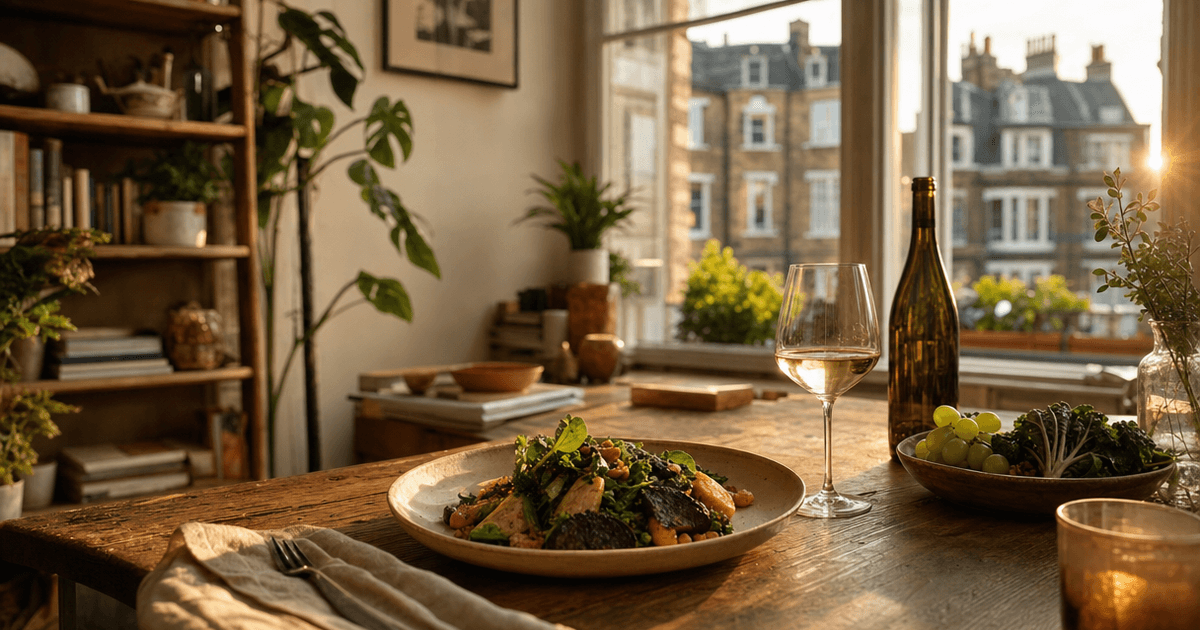
Vegan cheese and wine pairing gets treated like its own strange little category, tucked away at the back of the list next to “gluten-free” and “low-alcohol.” It isn’t a separate discipline at all — and this is the one pairing guide on this site built entirely around that idea: when dairy leaves the table, you pair by texture and technique, because the ingredient label stops helping you. The rule that runs through everything below fits on a till receipt: soft wants acid, firm wants body, pungent wants sweetness or a good beer. By the end of this you’ll know which bottle to reach for — a cashew-based cheese, a plate of grilled peppers, or a whole vegetable-led Christmas spread — and why what’s been done to the ingredient in the pan matters far more than what the ingredient is. Vegan cheese and wine pairing runs on exactly the logic that governs any cheese pairing; it just makes you notice the logic properly for the first time.
Does vegan cheese need different wine to dairy cheese?
No. The fermentation, ageing and texture of the cheese decide the wine — not whether the milk came from an animal or a cashew. A soft, spreadable plant-based cheese behaves like a young goat’s cheese and wants the same bright acid; a firm, cultured nut cheese behaves like a hard cow’s-milk wheel and wants more body in the glass.
I sold this wrong for years, if I’m honest. Vegan felt like it should mean “hearty,” so I’d push customers toward big reds without asking what the cheese actually felt like in the mouth. Big mistake with anything soft — a young chèvre-style cheese hates an oaked wine, full stop, because the oak fights the fresh lactic tang rather than framing it. The same goes for its plant-based cousin. What that fresh style wants instead is a high-acid white with no oak stamp on it: think Sancerre or a dry Loire white, the kind of wine that a rennet-free, soft French cow’s-milk cheese pairs beautifully with too — proof the logic travels across ingredient lines, not just dairy ones.
Go the other way and pick an aged, firmer nut cheese — the kind pressed and left a few weeks to develop nuttiness and a bit of funk — and you’re closer to a mature sheep’s-milk cheese in style. Those want something with more shoulder: a fruit-forward Chardonnay, a Pinot Noir, even an off-dry Riesling if there’s real richness on the plate. Pungent, washed-rind style vegan cheeses (there are some genuinely funky ones about now) behave like their strongest dairy equivalents and often do better with a good porter or dry stout than with any red at all — worth knowing before you assume wine is always the answer. So when you’re standing at the shelf: one bright Loire-style white and one soft-shouldered red will cover nearly any board you’re likely to build.
What wine goes with vegetables and vegetarian mains?
For most vegetable-forward dishes, reach for something dry, food-friendly and light on obvious oak: a dry rosé, an unoaked Chardonnay, a New Zealand Sauvignon Blanc, a lighter Grüner Veltliner, a dry Riesling, or a red with soft edges like Beaujolais or Merlot. Sparkling wine and rosé Champagne earn their place here too — the acid and bubbles do a lot of the pairing work for you.
But the dish itself narrows things down usefully — pair the technique, not the ingredient. Peas want something aromatic with a bit of weight behind the fruit — Viognier or Vouvray both do the job. Asparagus, notoriously tricky, sits well with Sauvignon Blanc’s green streak. Roasted peppers like a dry rosé; butternut squash, especially roasted until it caramelises at the edges, does well against an aged Riesling with a touch of honeyed development. Roasted garlic, oddly, is one of the few times an unoaked Chardonnay with a bit of texture actually improves rather than fights the dish. If Austrian white is your thing generally, our Grüner Veltliner: Austria’s answer to everything piece goes further into why it handles green vegetables so well.
Grilled vegetables — the char matters here — sit happily with either Merlot or Sauvignon Blanc, depending on whether you’ve dressed them heavily or kept things plain. And a beetroot dish with a plant-based goat-style cheese on top loves the same wine the goat’s-milk version would: a lighter beer, a Pinot Blanc, or Sauvignon Blanc, the beet’s earthiness needing acid more than tannin to keep it lively. Notice the pattern across all of these: it’s the roasting, pickling and charring choosing the wine, never the vegetable itself — which means one well-chosen bottle can follow you through a whole season of different dishes.

How do you build a vegan wine pairing menu for a whole meal?
Think in courses, not one clever bottle trying to do everything. A vegan wine pairing menu works best when each dish gets matched on its own texture and technique.
- Pickled or fermented starters — a pét-nat or a skin-contact orange wine, both of which have the grip to stand up to vinegar and salt.
- A spiced vegetable main (think shawarma-style celeriac or similarly bold spicing) — orange wine again, or a fuller aromatic white.
- Nut roast or a dense, savoury centrepiece — orange wine, a Southern Rhône red, or a Xinomavro-style red with enough structure to match the weight.
- A roasted vegetable platter — Chianti Classico or a Douro red, both built to handle char and root-vegetable sweetness together.
- Mezze or small plates — Pinot Noir, Mencía, or another pét-nat, kept light so nothing dominates.
- A vegan cheese course — California-style Chardonnay, an aged Riesling, or a White Rioja, following the texture logic from the section above.
One vegetable-led restaurant I know of in London leans hard into natural and orange wines for exactly this kind of spread — a dark rosé with beetroot, an orange wine with the spiced main, a pét-nat with the pickles — and it works a treat. But it’s a style choice, not a rule. If natural wine isn’t your thing, a classic Sancerre or dry Chenin Blanc does the same structural job without the funk. If you want the fuller picture on matching technique rather than ingredient across meat and veg dishes alike, our Food and wine pairing: a merchant’s complete guide to getting it right covers the underlying method in more depth. And if you’re cooking that menu for real, bring the courses to the counter — matching six dishes to three bottles is honestly the most fun a merchant gets all week.
What does a decent vegan pairing spread cost you in bottles, not cash?
Here’s the bit that surprises people: you don’t need a dozen wines open on the table. Three or four versatile styles cover almost every vegetarian or vegan meal you’ll actually cook on a Tuesday. A dry, unoaked white; a light, low-tannin red; a dry rosé or something sparkling; and one richer style in reserve for anything with real weight to it — a mushroom ragù, a lentil dish, a cheese sauce. Only that reserve bottle needs to cost more than everyday money; the first three do their best work at unremarkable prices.
That last one is the interesting case. Without meat’s fat and protein to tame tannin, a genuinely big red can feel harsh against vegetables alone. The trick — long known among sommeliers working vegetarian tables — is to build a bridge with something palate-coating: a pulse-based sauce, a purée, a cashew cheese melted through a bake. Do that and a serious Bordeaux-style red suddenly makes sense on a plant-based table. If the idea of opening something structured without the full château price appeals, our Second wines: how to drink a great château without the grand vin price piece is worth a look — it’s exactly the kind of bottle that suits a lentil ragù rather better than it suits a steak.
Questions customers ask us
What’s the best wine for a vegan cheese board? Cover your bases with one dry, high-acid white and one lighter red, then let the specific cheeses on the board pull toward whichever suits their texture best — fresh toward the white, aged and firm toward the red.
Is orange wine good with vegan food? Very often, yes, particularly with pickled, fermented or heavily spiced dishes where its grip and texture do real work. It’s not the only answer though — see our Orange wine vs rosé: what’s actually the difference? if you’re weighing the two up for a specific dish.
What wine works with a vegan Christmas dinner? Match the centrepiece: orange wine or a Southern Rhône red for nut roast, Chianti Classico or a Douro red for a roasted vegetable platter, and something aromatic and off-dry if there’s squash or root veg sweetness on the plate.
Do I need natural wine for vegan food? No — plenty of classic, conventionally made wines pair just as well. It’s a preference some vegetable-led kitchens have taken to, not a requirement of the food itself.
The merchant’s last word
I’ve watched customers stand at this counter convinced their vegan cheese board needed some special separate wine list, and every time it comes back to the same thing: taste the texture, not the label. Soft wants acid, firm wants body, funky wants sweetness or beer. Get that right and the rest sorts itself out. Come and browse the Italy cellar — tell me what’s on the board, and we’ll find the right bottle for whatever’s on your plate this week.



