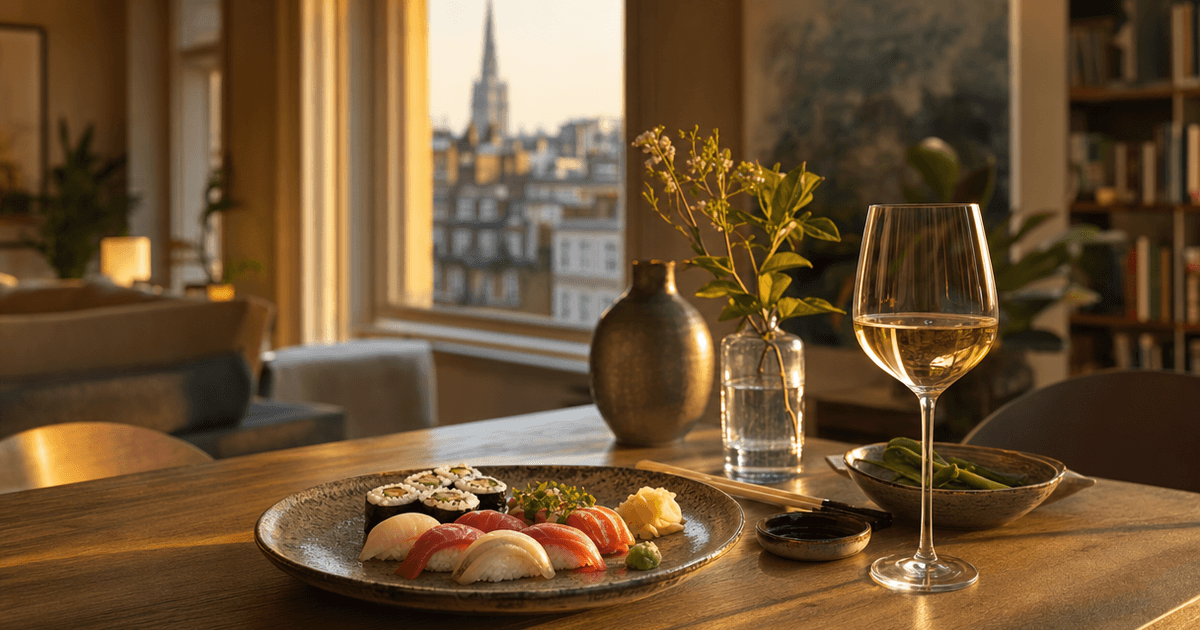
Wine with sushi is a question I get asked more than almost any other in the shop, usually by someone stood in front of the fridge holding a Sauvignon Blanc and a faint sense of doubt. Sushi is vinegared rice topped or wrapped around raw fish, shellfish, or vegetables — and that rice vinegar is doing as much work on the pairing as the fish itself, which is the bit most people miss. By the end of this you’ll know which wine styles actually hold up against wasabi and soy, when red is worth reaching for, and what to order when wine genuinely isn’t the best tool for the job.
Which wine goes best with sushi?
The best wine with sushi is dry, light-bodied, high in acid, low in alcohol, and has never seen an oak barrel. Think Muscadet from the Loire, unoaked Chablis, dry German Kabinett Riesling, or a Blanc de Blancs Champagne. These wines match the delicacy of raw fish and the sharpness of the vinegared rice without drowning either one.
Here’s the bit I got wrong for years: I used to reach for a big buttery Chardonnay because “white wine goes with fish,” full stop, no further thought required. Oak tannin and raw fish are a genuinely bad combination — the wine turns metallic, the fish turns dull. Once you drop the oak, though, Chardonnay comes back into play beautifully, especially with the fattier cuts like salmon or toro.
Sancerre earns its place here too, particularly with cleaner white fish like halibut or sea bream — its citrus and flint sit nicely alongside ponzu and yuzu dressings. If you want to go properly regional, aged Chablis from the Kimmeridgian slopes around the town itself has a saline, mineral thread that seems built for raw fish, though that’s more happy accident than ancient wisdom. For the full logic behind why acid and fat matter more than colour, our Food and wine pairing: a merchant’s complete guide to getting it right goes into that properly.
Does red or white go with sushi?
White dominates, but red isn’t banned — it depends entirely on what’s on the plate. A chilled, low-tannin red like Beaujolais or red Burgundy suits soy-glazed eel, teriyaki, or akami (lean tuna) far better than most people expect. What you want to avoid is anything big, tannic, and warm — that combination fights the vinegar in the rice and turns the fish metallic on the finish.
With Edomae-style sushi — the older Tokyo tradition, built on cured and aged fish rather than the fresh-off-the-boat style most of us eat for lunch — I’ve found fuller reds like Bordeaux, Rioja, or Brunello can work surprisingly well, because the fish itself is richer and less delicate than a plain nigiri. That’s a different meal to a light lunchtime sushi box, and it needs a different bottle.
My rule of thumb on the shop floor: if the sushi has been touched by fire, soy, or sauce (teriyaki eel, seared toro, a spicy tuna roll), a light red or an off-dry Riesling can step in. If it’s raw and unadorned, stay white, stay dry, and keep the alcohol modest — a warm 14.5% red will simply shout over delicate fish.

What is the best drink to pair with sushi?
Wine is one option, not the only one. Sake, particularly Junmai Ginjo or Daiginjo styles, is arguably the more natural partner for sushi — it was designed alongside this food, after all — and Japanese lager, green or oolong tea, and even a cucumber-and-sake cocktail all turn up repeatedly in pairing notes for good reason.
Sake’s grading system is worth understanding if you’re going that route, because different grades suit very different fish:
| Sake style | Body | Works well with |
|---|---|---|
| Nama zake (unpasteurised) | Lightest, very soft | White fish, salad |
| Ginjo | Aromatic, light | Raw or marinated fish, shrimp, squid |
| Junmai Ginjo | Medium-light | Fresh fruit, vegetables, seafood |
| Honjozo | Light, richer | Fatty tuna, salmon, tempura, oysters |
| Junmai | Medium-bodied, rich | Grilled fish, teriyaki, fatty tuna |
If you’re pouring for a table where not everyone drinks wine, a good chilled fino or manzanilla sherry is worth having in reserve too — its saline dryness does a similar job to Muscadet, and it’s a style we’ve written about at more length in Dry Sherry with dinner: Fino as a food wine.
Reading the flow of the meal
Here’s something most wine guides skip entirely, and it’s one of the most useful things I’ve picked up from people who work sushi counters for a living: sushi is meant to be eaten piece by piece, not course by course, which means your wine has to survive several very different fish in a row. Squid, halibut, and tuna in the same sitting is a genuinely hard ask for one bottle.
The trick isn’t finding a “perfect” match for every piece — it’s picking something versatile enough to work across two or three neta (toppings) at once, then letting the meal move around it. A dry, unoaked white with decent acid — Muscadet, a lighter Chardonnay, dry Riesling — tends to flex across the widest range: it won’t be the single best match for any one piece, but it won’t clash with any of them either.
If you’re at a proper counter where the chef is making each piece fresh in front of you, say up front that you’d like to pair wine with the meal — it changes how they sequence the fish, moving from lighter to richer as you go, which makes the wine’s job much easier. Roe, being rich and briny, tends to want something with bubbles — Champagne, sparkling wine, or sake all do the job; wasabi wants a touch of sweetness in the glass to soften its heat, which is where an off-dry Riesling earns its keep.
Japanese wine with Japanese food
Worth knowing, even if it never makes it onto most UK wine lists: Japan makes its own wine, and the grape to look for is Koshu. It’s a pink-skinned variety grown mostly in Yamanashi, with smaller pockets in Nagano, Hokkaido, and Yamagata, and it produces pale, low-alcohol wines — rarely much above 12% — with a natural citrus note that echoes the yuzu and sudachi used in Japanese cooking, alongside a faint salinity that almost tastes like a drop of soy has found its way into the glass.
It’s a genuinely logical partner for raw fish, not just a novelty bottle to try once. The catch is volume — Japan’s own-grape wine production is tiny compared with a major French region like Bordeaux, so it’s a rare pour rather than an everyday one, and you’re more likely to find it through a specialist shop or import list than on a supermarket shelf. If you like the idea of wine regions outside the obvious, it’s a similar spirit of curiosity to Tasmanian sparkling wine: the southern challenger to Champagne? — different climate, same instinct to look further afield. And if crisp, mineral whites are your thing generally, Chablis: the purest Chardonnay? is worth a read alongside this one.
Questions customers ask us
Which wine is best for diabetics? That’s a medical question, not a wine one, and I’d rather send you to your GP or diabetes team than guess. What I can tell you is that most of the dry, food-friendly styles covered above — Muscadet, dry Riesling, unoaked Chardonnay — are a reasonable starting point for that conversation, style-wise.
What about miso soup or wasabi specifically? Miso pairs nicely with unoaked Chardonnay, sparkling wine, or sake — its savoury depth needs something with a bit of weight. Wasabi is easier with a touch of sweetness in the glass, so off-dry Riesling or a Cava-style sparkler softens the heat rather than fighting it.
Is beer ever the better choice? Honestly, yes, sometimes — Japanese lager or a summer ale is a genuinely good, uncomplicated match for a casual sushi lunch, and nobody in the trade pretends otherwise. Save the wine for when the meal’s the main event.
The merchant’s last word
I’ll be straight with you: there’s no single bottle that nails every piece of sushi on the plate, and anyone who tells you otherwise is selling something. Pick dry, light, unoaked, and let the meal’s flow guide you from there — red, white, or sake, depending on what’s actually in front of you. If you want a bottle already chosen with this kind of pairing in mind, go and browse the Italy cellar.



