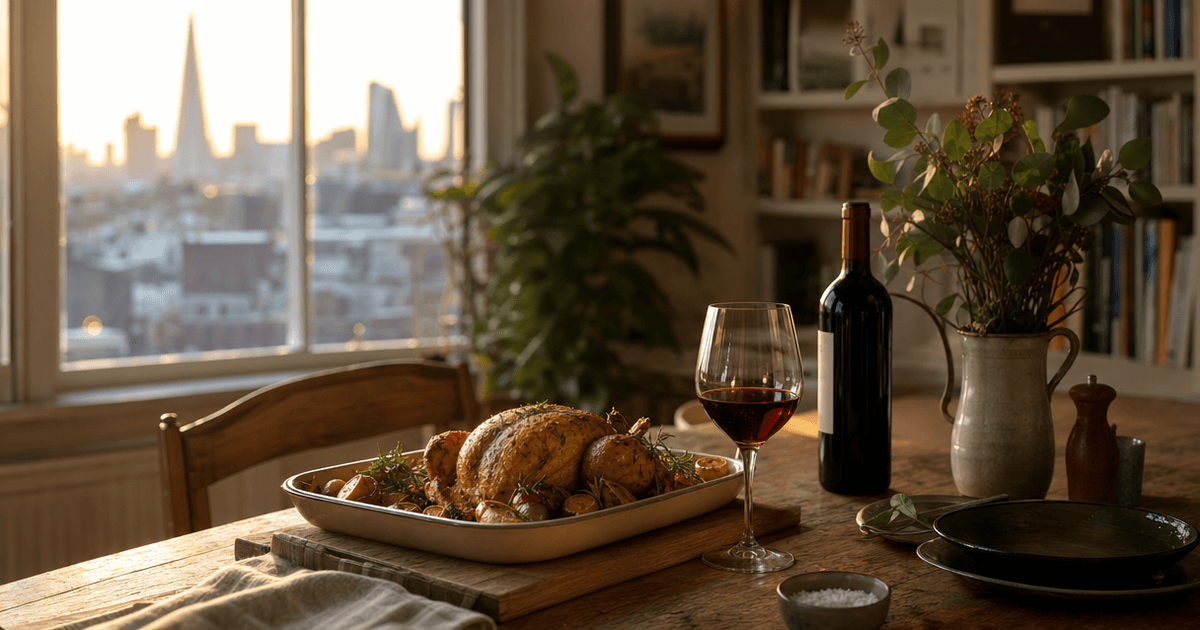
Wine pairing with roast chicken is decided by the bird itself, not by any rulebook — the crackle of the skin, the cut you favour, whatever you rubbed under it before the oven went on. Skin, thigh, seasoning: read those three and the bottle largely picks itself, which is exactly how this piece is organised. By the end of this you’ll know how to read your Sunday bird — not just its label — and pick a bottle that suits the gravy as much as the meat, whether that’s a crisp white, a proper red, or something pink with a bit of backbone.
If you want the wider thinking behind all this, our Food and wine pairing: a merchant’s complete guide to getting it right covers the groundwork. Here, we read the bird itself — joint by joint, skin-side up.
Which wine goes best with roast chicken?
For a plain roast chicken — herbs, butter, nothing fussy — I’d reach for a New World Chardonnay with light oak, or a dry Alsace Riesling. Both have enough weight to sit with the meat and enough acidity to cut through the fat rendered off crispy skin. That’s the safe, reliable, gets-you-out-of-trouble answer.
But “roast chicken” isn’t one dish — it’s a family of them, and the skin does a lot of the talking. Crispy, caramelised skin brings nuttier, richer flavours than a poached or grilled bird ever will, which is why a fuller white like white Burgundy (Puligny-Montrachet is the benchmark, though there are gentler and cheaper versions from further down the Côte de Beaune) can work beautifully. Trade opinion has also warmed to something less obvious: Barolo, from Piedmont’s Nebbiolo grape, has rose-petal and cherry aromas with a bright, cutting acidity that handles crispy skin surprisingly well — a proper counterpoint if you fancy red with your Sunday bird.
Dark meat changes things again. The thigh, or that little morsel the French call the sot-l’y-laisse, is richer and more savoury than the breast — it wants a light red with some fruit, not another crisp white doing the same job twice.
Do you serve red or white wine with chicken?
Honestly, both work — chicken is a genuine swing dish. The old rule that white always wins isn’t as fixed as it looks; trade coverage has been saying for a while that lighter reds with good acidity, Pinot Noir, Gamay, Garnacha, can sit alongside a white without anyone feeling short-changed, and some people even take them lightly chilled.
I sold this one wrong for years, always steering people towards white on autopilot. Then I watched a table of six polish off a bottle of Beaujolais with a garlic roast and ask for another. Gamay, the grape behind Beaujolais, has the fruit and lift to work with roast chicken far better than its Nouveau reputation suggests — there’s more to the story than the November release date, which our piece on Gamay: what Beaujolais Nouveau never told you about its grape goes into properly.
Rosé deserves a mention here too, and not the palest bottle on the shelf. Darker pink styles carry more tannin and structure from longer skin contact, which makes them more food-friendly than delicate, barely-there rosé — genuinely useful with a roast, not just a summer garden thing. Again, let the bird decide: a burnished, garlicky skin pulls you pink-ward far more convincingly than the season does.

What to drink with roast chicken dinner?
The bird is only half the plate. Gravy, stuffing, bread sauce, roast potatoes cooked in the fat, sprouts with bacon — a proper Sunday spread carries more weight than the chicken alone, so a rich, savoury gravy often wants more backbone than a simple roast would need on its own: Rioja Reserva, red Burgundy, or an aged Cabernet Sauvignon.
The seasoning on the bird matters as much as what’s beside it:
- Lemon and herbs — Sauvignon Blanc or a dry Muscadet, echoing that citrus lift.
- Garlic, Provençal-style (think forty cloves) — a dry rosé or a herbal dry white sits well; the garlic wants something with a bit of savoury texture, not pure fruit.
- Mustard — red Burgundy or Côtes du Rhône; the mustard’s tang needs fruit and enough structure to answer back.
- Braised in a red wine sauce (coq au vin territory) — Burgundy red, Beaujolais, or a Rhône red. The old trade rule of thumb still holds: pour whatever went into the pot.
- Braised in white wine and mustard — a dry white that keeps its character once cooked; Jura whites made from Savagnin are known for holding their flavour through the pan, which is worth knowing if you’re cooking as well as pouring.
If it’s a proper Sunday roast and you’re set on red, our guide to Which Bordeaux for the Sunday roast? Matching claret to the table is worth a look before you buy.
Choosing by how it’s cooked and dressed
| Chicken style | Reach for | Why it works |
|---|---|---|
| Plain roast, crispy skin | New World Chardonnay, light oak / dry Alsace Riesling | Balances the fat with acidity |
| Lemon and herbs | Sauvignon Blanc, dry Muscadet | Citrus meets citrus |
| Garlic, Provençal-style | Dry rosé, Vernaccia | Herbal, savoury texture |
| Dressed with mustard | Red Burgundy, Côtes du Rhône | Tang needs fruit and grip |
| Dark meat, gravy-heavy | Pinot Noir, Beaujolais | Matches savoury depth |
| Braised in red wine sauce | Red Burgundy, Beaujolais, Rhône red | Match the pot, not just the plate |
If none of that quite fits your Tuesday-night bird from the supermarket, don’t overthink it — a dry Chenin Blanc or a fruity Zinfandel are both easy, forgiving choices that rarely put a foot wrong.
What good chicken wine costs — the price shape
You don’t need to spend big here. A straightforward Muscadet or a young Beaujolais will do the everyday roast chicken job without denting anyone’s week. Step up for the Sunday version with all the trimmings — a Rioja Reserva or an aged Cabernet Sauvignon has had time in oak and bottle to soften and deepen, which suits a gravy-laden plate.
The genuine splurge sits with white or red Burgundy, or a well-made Barolo — wines with enough complexity to make a roast chicken feel like an occasion rather than a Tuesday. Worth having one such bottle in the rack for when the bird’s a proper free-range one and you’ve bothered with the bread sauce. If you want a lighter, snappier white alternative to reaching for Chardonnay every time, Aligoté: Burgundy’s other white grape, finally taken seriously is worth getting to know.
Questions customers ask us
What is the best pairing for roast chicken? There’s no single fixed answer, but a lightly oaked New World Chardonnay or dry Riesling covers most roasts. Rich gravy or dark meat can push you toward Pinot Noir or Beaujolais instead.
Does rosé work with roast chicken? Yes — darker, more structured rosé has the grip for meat and trimmings. Paler rosé suits a simple lemon roast better.
What about sherry with roast chicken? Dry amontillado, chilled, is an old-fashioned but genuinely good match, especially with gravy or bread sauce.
Can I match roast chicken with something other than wine? Sparkling cranberry or elderflower juice gives similar cutting acidity to a crisp white without needing a glass of wine at all.
The merchant’s last word
Roast chicken is the most forgiving dish in the book, which is exactly why people worry about getting it wrong. You won’t, not badly, not with any of the styles above. Read the skin, read the gravy, and pour what suits your Sunday rather than what the label tells you to. If you’d rather I did the deciding for once, browse the Italy cellar and I’ll point you to the right shelf.



