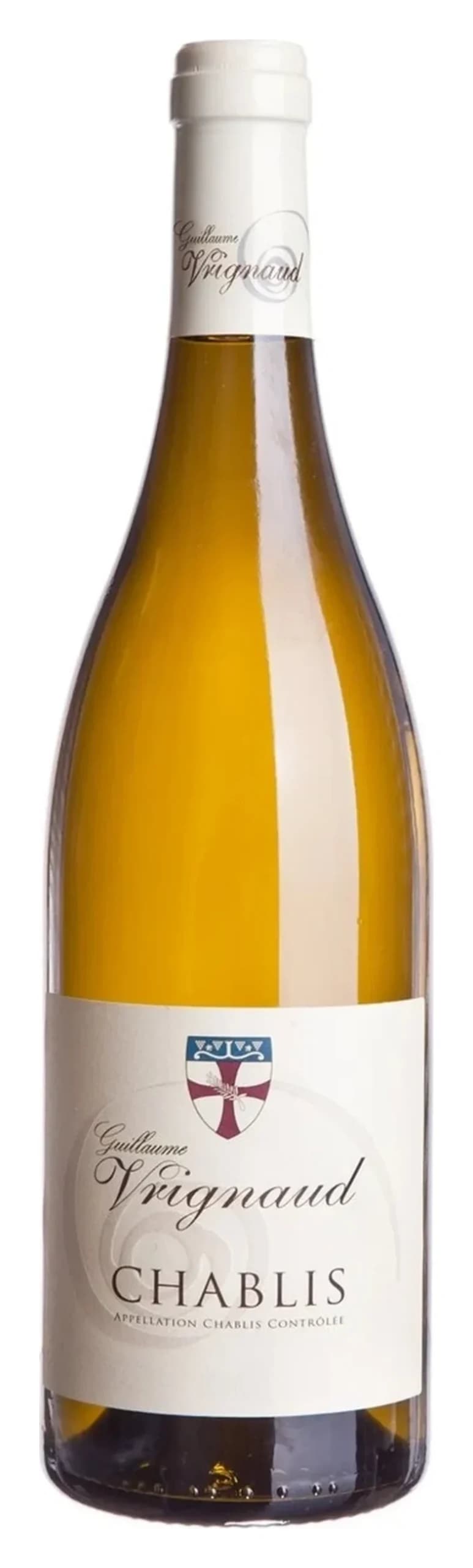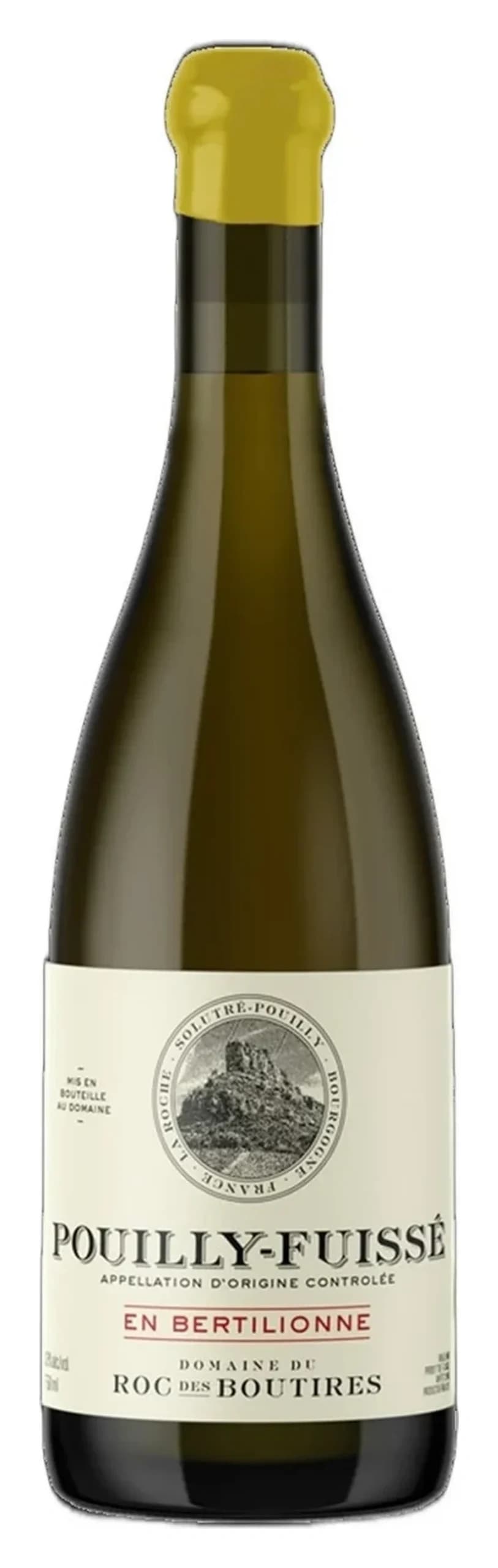
Pouilly-Fuissé is the white Burgundy whose character you can read off a cliff face — two of them, in fact. The great limestone crags of Solutré and Vergisson stand over the vines, and where a grower’s parcels sit in relation to those rocks splits the appellation into two distinct personalities in the glass. That split, not the price tag, is the useful thing to know before you buy. It’s a dry white wine appellation in the Mâconnais, the southern end of Burgundy, made entirely from Chardonnay grown on limestone. By the end of this you’ll know how to read a Pouilly-Fuissé label, roughly what you’re paying for at each price point, and which bottle to pull off the shelf when the recipe calls for butter, cream or a decent piece of fish.
What kind of wine is Pouilly-Fuissé?
Pouilly-Fuissé is a dry white wine grown across four communes — Fuissé, Solutré-Pouilly, Vergisson and Chaintré — and it’s restricted entirely to Chardonnay. It runs fuller-bodied than most white Burgundy from further north, with wines from the amphitheatre around Fuissé and Pouilly the richest, and those grown higher up under the crags of Solutré and Vergisson coming out fresher and more mineral.
Those crags aren’t just scenery. The Rock of Solutré and its neighbour at Vergisson mark the end of the same limestone plateau that runs the whole length of Burgundy (bar Beaujolais), and the vines tucked into the sun traps beneath them ripen properly even in a middling year. There’s a nice bit of local folklore about Stone Age hunters driving animals off the top of the cliffs, supposedly enriching the soil below — I can’t vouch for the science, but it’s the kind of story that makes a vineyard walk worth doing.
Since 2020, the best single sites within the appellation — 22 of them — have carried premier cru status, which is new enough that plenty of drinkers haven’t caught up with it yet. If you want the shape of Burgundy’s whole village-to-grand-cru pecking order, the long version is in Burgundy, decoded: villages, crus and why it costs what it costs.
Buying takeaway: want the richer style, ask for something from Fuissé or Pouilly on the label; want lift and stoniness instead, look for Vergisson or Solutré.
Is Pouilly-Fuissé the same as Chardonnay?
Pouilly-Fuissé is 100% Chardonnay — full stop, no blending allowed. But not all Chardonnay is Pouilly-Fuissé. It’s one particular, tightly-drawn expression of the grape, grown on limestone in a warmer pocket of Burgundy than the Côte d’Or, and shaped by rules on yield and site that a generic bottle labelled simply “Chardonnay” isn’t bound by.
Here’s a detail I like: there’s an actual village called Chardonnay a short drive from Mâcon, and it’s genuinely debated whether the grape took its name from the place, or the other way round. I used to trot this out as a bit of trivia; then I found out how many customers assumed “Chardonnay” was a style rather than a grape at all, oaky and buttery by definition. It isn’t — oak is a choice, not a birthright, and I wrote a whole piece unpicking that confusion: Oak in Chardonnay: what ‘oaked’ really tastes like.
In the Mâconnais, most everyday wine — basic Mâcon and Mâcon-Villages — is fermented in stainless steel or lined concrete and bottled early, so it stays bright and unoaked. Pouilly-Fuissé, especially from ambitious growers, more often sees some barrel time, though rarely with the heavy hand you’d get from a warm-climate New World bottle. If Chardonnay isn’t the only white grape on your Burgundy radar, it’s worth getting to know its quieter cousin too — see Aligoté: Burgundy’s other white grape, finally taken seriously.
Buying takeaway: a label that just says “Chardonnay” from California or Australia will usually mean riper fruit and more oak; a label that says Pouilly-Fuissé means limestone and the restraint written into the rules.
What’s the price range for Pouilly-Fuissé?
On our shelves, entry-level named-village Mâcon starts around £9, with straightforward Pouilly-Fuissé and Saint-Véran running up from there into the £20s and £30s, and premier cru sites — newer and scarcer — sitting higher again. Basic Mâcon-Villages, by contrast, can be found for a fraction of that.
Here’s roughly how the ladder sits:
| Appellation | Style | Typical price shape |
|---|---|---|
| Mâcon / Mâcon-Villages | Easy, unoaked, early-drinking | Budget-friendly |
| Named-village Mâcon (e.g. Lugny, Verzé) | A step up in character | Mid, still gentle |
| Saint-Véran | Similar richness to Pouilly-Fuissé | Noticeably less than Pouilly-Fuissé |
| Pouilly-Fuissé | Fuller, structured, built to hold | The region’s ceiling |
| Pouilly-Fuissé premier cru | Single-site, riper, more oak influence | The top of that ceiling |
Why does Pouilly-Fuissé sit where it does? Partly because the appellation is small — under 800 hectares across all four communes — and partly because as Côte d’Or whites from Meursault and Puligny have got eye-wateringly expensive, both drinkers and money have moved south looking for the same limestone backbone at a saner price. That demand has pushed Pouilly-Fuissé prices up over the last decade, even though it remains the more affordable route into serious white Burgundy rather than the cheapest thing on the shelf. The two-rock split earns its keep here too: the commune name on the label tells you the style before the price tells you the ambition. I’ve written more on hunting down genuine value in the region here: Affordable Burgundy: does it exist? An honest answer.
Buying takeaway: cooking a Tuesday supper, buy Mâcon-Villages; hosting a proper Sunday lunch, trade up to Pouilly-Fuissé and don’t feel you need the premier cru to be impressed.
Is Pouilly-Fuissé good?
Yes — and it’s got better. My honest read, watching this over the last few vintages, is that quality across the Mâconnais has been closing in on the Côte d’Or, driven by growers (some with Côte d’Or pedigree themselves) taking the region more seriously than the co-operative-driven decades before it. It’s not uniform — there’s still plenty of forgettable bulk wine wearing a Mâcon label — but the good end is genuinely good.
On the table, Pouilly-Fuissé is built for richer food: think roast chicken, salmon or scallops in a cream sauce, baked ham, or a hard sheep’s cheese like Pecorino. Fresh goat’s cheese is the classic regional match, which makes sense — Charolais, the local goat’s cheese, comes from more or less the same patch of countryside. I’d steer you away from anything too delicate or too spicy; this wine has enough weight to want food with a bit of backbone too.
Buying takeaway: if the dish has butter, cream or a decent hunk of protein in it, Pouilly-Fuissé is the wine to build the evening around, not an afterthought pour.
Questions customers ask us
Isn’t Pouilly-Fuissé the same as Pouilly-Fumé? No, and it’s an easy mix-up. Pouilly-Fumé is a Sauvignon Blanc wine from the Loire, nowhere near Burgundy; Pouilly-Fuissé is Chardonnay from the Mâconnais. Different grape, different region, similar name — that’s really the whole story.
Does Pouilly-Fuissé age well? The premier cru sites, recognised only since 2020, are built to hold a few years in bottle. Everyday village-level bottles are happiest drunk within a couple of years of the vintage, while they’re still fresh.
What’s Saint-Véran, and should I try it instead? It’s a neighbouring Mâconnais appellation making a similar style of Chardonnay, usually for less money. A sensible move if you want the Pouilly-Fuissé character without quite the Pouilly-Fuissé bill.
Is Mâcon-Villages worth buying at all? Very much so — it’s honest, food-friendly Chardonnay at an everyday price, and a good one is genuinely one of the most reliable bottles on a shop shelf.
The merchant’s last word
I sold Mâconnais for years as the “cheap seats” of Burgundy, and undersold it in the process. It isn’t a compromise — it’s its own thing, with its own hierarchy from easy Mâcon-Villages right up to premier cru Pouilly-Fuissé, and its own two personalities standing under those two rocks. Have a look through what we’ve got in, pick your rock — or your amphitheatre — and find your level: browse the burgundy cellar.