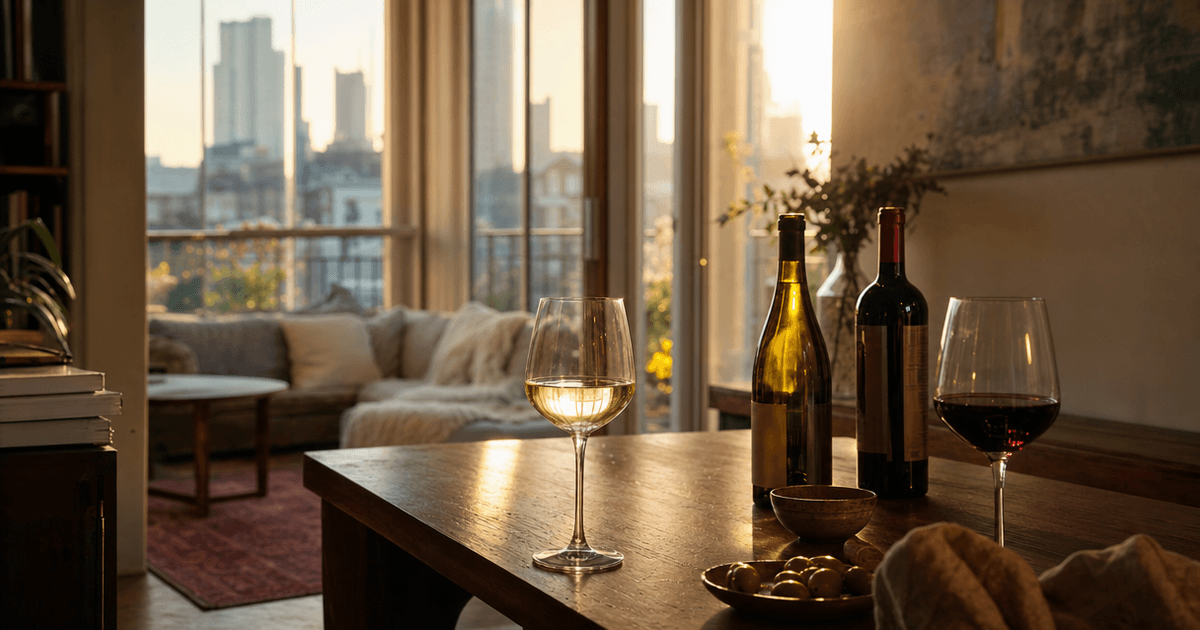
Red vs white winemaking comes down to one decision, made in the first hour at the crusher: press now, or press later. That’s the entire fork in the road. Press the grapes straight away and ferment the juice alone — skins kept well out of the tank — and you’re making white wine. Ferment the whole crushed mass — skins, pulp, sometimes stems — together first and press afterwards, and you’re making red. Everything else people treat as mysterious — colour, tannin, how a wine ages, what you should actually be pouring it into on a Tuesday night — sits downstream of that one timing call, and by the end of this you’ll know exactly how. For the fuller basics, our pillar guide to wine is a good companion to this one.
What sells more, red or white wine?
There’s no scoreboard I’d trust, and anyone quoting you an exact split is guessing. From behind the counter, though: white has been closing the gap on red for years at the everyday end, while red still wins when people are buying for a dinner party or something to lay down. Rosé and orange wine nibble at both from the sides, especially once the weather turns.
Walk into any big high-street wine shop on a warm Friday and the trolleys tell their own story — cases of Provençal-style rosé and crisp Loire whites stacked by the door in June, replaced by Rioja and claret-shaped reds come November. Trade writers have also been noting a taste shift within each colour itself: paler, brisker whites and darker, more saturated reds than a generation back. That’s not really about sales volume. It’s about what “red” and “white” are even expected to look like now, which changes what people reach for.
How red and white winemaking actually differ
The mechanics matter more than the marketing here, so let’s get into them properly — press-now versus press-later is the bit worth understanding once, because it explains the rest of the article.
White winemaking presses first, ferments second. Grapes arrive, get crushed and de-stemmed (or occasionally pressed as whole bunches, gently, to avoid any skin contact at all), and the juice is run off the skins before fermentation even starts. Fermentation then happens cool, often between 15 and 20°C, to protect the fruit character. Malolactic conversion — the softening of sharp malic acid into rounder lactic acid — is a deliberate choice for whites, not a given.
Red winemaking flips the order. The crushed mass of skins, pulp and juice ferments together first, and pressing happens afterwards, once the winemaker has extracted the colour, tannin and flavour they want from the skins. This contact period is called maceration, and it’s the whole reason red wine is red — those anthocyanin pigments live in the skins, not the juice, which is why red and white grapes actually start from a near-identical, barely-tinted juice. Malolactic conversion happens as standard in most reds. Reds also tolerate more oxygen exposure through the process, which is part of why barrel ageing turns up far more often on the red side.
| Step | White winemaking | Red winemaking |
|---|---|---|
| Crushing/pressing order | Pressed before fermentation | Crushed, fermented on skins, pressed after |
| Fermentation temperature | Cooler, roughly 15–20°C | Warmer, more oxygen tolerated |
| Malolactic conversion | Optional, winemaker’s call | Standard practice |
| Colour source | Skins avoided entirely | Skins macerated with the juice |
| Ageing vessel | Mostly steel; oak for richer styles | Barrel or cask more common |
One curiosity worth knowing: you can ferment white grapes on their skins too, on purpose. It’s a small but growing style called skin-fermented or “orange” wine, and it borrows red winemaking’s logic while starting from pale grapes. If that’s caught your eye, our piece on orange wine vs rosé untangles it properly. Sparkling wine sits at the other extreme — Champagne is often made from black grapes pressed so gently and quickly that no colour transfers at all, which is worth a read in our guide to how Champagne is actually made.

When should you have red wine vs white wine?
Let temperature and the weight of the food lead, not the label colour. A chilled, bright white suits a warm evening or something light on the plate; a red with more grip and structure suits richer, warmer cooking, especially anything with fat or char on it. That’s the honest rule of thumb, not a law carved in stone.
I sold this the wrong way round for years, if I’m honest — always steering people to red “because it’s a proper dinner” even when the dish was a delicate fish stew that wanted a crisp white instead. The better question isn’t red-or-white, it’s weight-and-temperature: is the dish light or rich, and is the day hot or cold? Answer those two and the colour mostly sorts itself out. A lightly chilled, low-tannin red on a summer terrace breaks the “rule” happily too — don’t let anyone tell you it can’t be done.
What is nicer, red or white wine?
Genuinely down to you, and I mean that — but the honest divide between them is texture, not just flavour. Reds carry tannin and weight because they’ve fermented on their skins — the press-later decision at work again; whites are usually cleaner and lighter on the palate precisely because that skin contact never happens.
Tannin is the compound doing most of the work in that mouth-drying, gripping sensation you get from a big Cabernet or Nebbiolo, and it comes almost entirely from skins, seeds and the odd stem fragment sitting in the must during red winemaking. Whites do carry some tannin too, just far less of it, since they’re deliberately kept away from that contact. If you want the full story on what tannin actually is and why it dries your mouth out, that’s its own piece worth ten minutes. My own bias, for what it’s worth: I lean red in winter, white the second the sun properly shows up. Neither is the “right” answer — that’s the whole point of having both in the shop.
Is white wine better for you than red wine?
We don’t deal in health claims here, and I’d be wary of any merchant who does. The honest answer is that “better for you” isn’t really a question winemaking can settle — the real, provable difference between red and white is in production: skin contact, tannin, colour, ageing style. Nothing about that production process tells you which is the healthier pour, and it’s not our place to suggest otherwise.
What we will say: enjoy either one in the glass, not the bottle, and let taste and occasion do the deciding rather than anything you’ve read about polyphenols on the internet.
Questions customers ask us
Does rosé count as red or white winemaking? Neither, really — rosé uses black grapes but with only brief skin contact, just enough to tint the juice pink before it’s pressed off, sitting somewhere between the two methods.
Why do some white wines still have noticeable tannin? A handful of styles, particularly skin-fermented or barrel-aged whites, pick up more tannin than the average bottle because of extra skin or wood contact — still nowhere near typical red levels.
Can red grapes make white wine? Yes — so long as the juice is separated from the skins fast and gently, which is exactly how many Champagne-style sparkling wines get their pale colour from black grapes.
Does colour tell you much about quality? Not really. Colour depends on grape variety, vintage, winemaking choices and age far more than on how good the wine is — competition judges score it, but it’s rarely why anyone actually falls for a bottle.
The merchant’s last word
I’ve watched customers agonise over red-or-white like it’s a personality test. It isn’t — it’s one pressing decision that happens to shape everything you taste after. Know the mechanics, trust your own palate, and let the occasion pick the colour rather than the other way round. If you fancy trying both sides properly this week, browse the Red cellar and see where you land.



