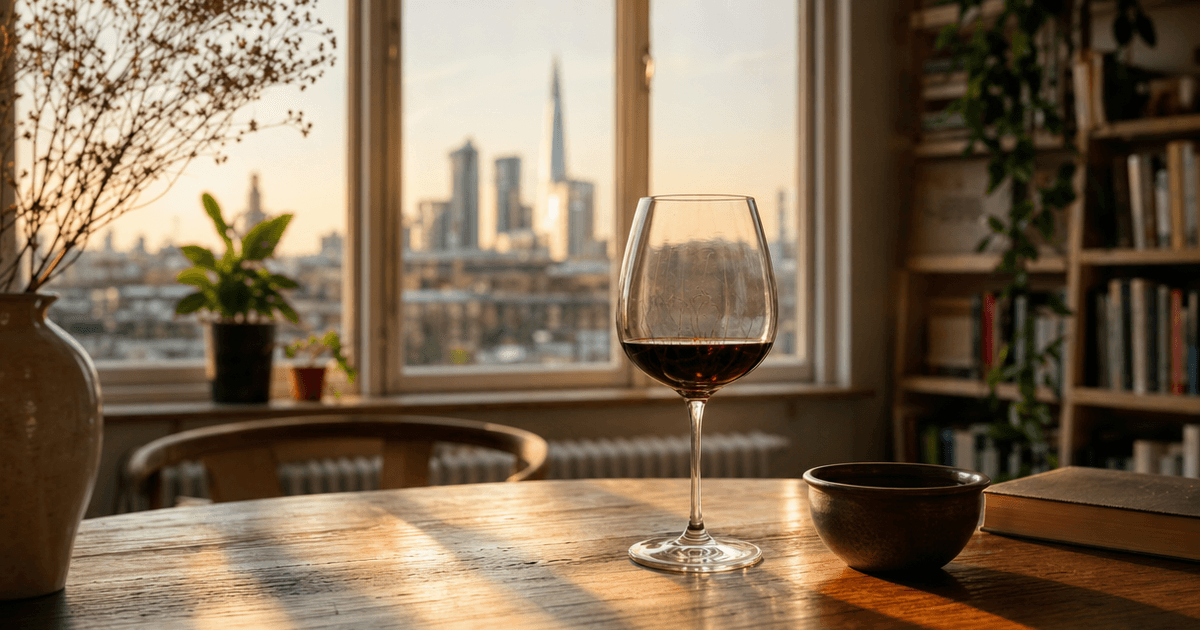
Swirl, tilt, stare — then the question comes across the counter: what do wine legs actually mean? Legs — some call them tears — are simply the streaks of wine that run back down the inside of the glass once you’ve swirled it. They’re caused by alcohol evaporating off the thin film on the glass faster than the water in the wine does. That’s the whole mechanism, and here’s this article’s honest promise: legs are the one piece of glass theatre that tells you almost nothing about quality. By the end of this you’ll know exactly what your glass is telling you when it does that, what it isn’t — and what to look at instead.
What do legs mean in reference to wine?
Legs form when you swirl a glass and a thin film of wine clings to the sides. As the alcohol in that film evaporates quicker than the water, the remaining liquid’s surface tension changes, pulling itself into droplets that thicken, arch, and eventually slide back down to the pool below.
A British physicist called James Thomson first wrote about this back in 1855, calling it “tears of strong wine” and linking it to surface tension — decent detective work that, frustratingly, got overlooked for decades. Wine scientists now call the mechanism the Gibbs-Marangoni effect, which is a mouthful for something you can watch happen in ten seconds with any glass on your kitchen table. Some tasters call the pattern “cathedral arches,” which I’ll admit is a nicer phrase than “tears.”
Worth knowing: it’s not exclusive to wine. Swirl a whisky or a cognac and you’ll see the same thing, because it’s the alcohol doing the work, not anything unique to grapes. Traditional tasting manuals actually now call “legs” a bit of an old-fashioned term — it’s stuck around in conversation far more than it has in serious tasting notes. Old-fashioned or not, it’s a lovely bit of theatre; just don’t let it anywhere near your buying decisions until you’ve read the next section.
Is wine good if it has legs?
No, not by itself. Legs correlate loosely with alcohol, and alcohol correlates loosely with body — but that’s two loose links in a chain, and either one can snap. I’ve poured plenty of humble, straightforward wines that show dramatic tears simply because they’re 14.5% and warm-climate, and plenty of genuinely fine wines that barely show a thing.
The clearest myth-buster here: some of the best German wines run at only 7 or 8% alcohol and still throw obvious, generous tears. Meanwhile a big, warm-climate red — say, one of the bolder reds coming out of Washington State’s desert vineyards, where daytime heat and cool nights push ripeness and alcohol both up — will usually show heavier, slower legs almost as a rule. That’s a genuine correlation with alcohol. It just isn’t a quality signal.
Contrast that with something like Etna Rosso, grown on Sicily’s volcano at real altitude — often lighter and more elegant despite the heat of the island, because the vineyard sites sit high and cool. Its legs won’t be dramatic. Its quality has nothing to do with that. I sold wine for years half-believing the old line about legs meaning quality myself, before I actually sat down and thought about why a 7%-alcohol Mosel Kabinett can out-tear a clumsy 13.5% blend. It can’t, on flavour. It absolutely can, on the glass.
The rule to keep: legs read alcohol, not quality — a glass tells you how strong a wine is long before it tells you how good it is. And if it’s richness you’re actually after, say so at the counter: “full-bodied” gets you to the right shelf faster than “good legs” ever will.

Does more legs in wine mean more sugar?
Sugar does have a role, but a supporting one — alcohol is the stronger driver of what you’re seeing. Trade figures suggest roughly a 1% rise in alcohol strength has a bigger effect on a wine’s thickness than a 10g/l rise in residual sugar does. So legs correlate a bit with sweetness, but far more with strength.
Where it gets genuinely dramatic is when both stack up together. A sweet, botrytised dessert wine — the kind made in Sauternes or the German and Austrian Beerenauslese styles — combines high sugar with often-high alcohol, and that combination produces the slowest, thickest, most theatrical tears you’ll see in a glass. It’s not one factor; it’s both leaning the same way at once.
One popular myth worth burying properly: glycerol. It’s often credited with giving wine “legs” and a silky feel, and glycerol genuinely does taste faintly sweet and oily. But the science doesn’t support the connection to tears — glycerol sits at around 4–6g/l in most wines (up to 10g/l in botrytised ones), and you’d need something like 28g/l before it noticeably changed viscosity at all. It’s nowhere close. Blame the alcohol, not the glycerol.
| Factor | Effect on legs | Tells you about quality? |
|---|---|---|
| Alcohol strength | Strongest driver — higher ABV, slower/thicker tears | No |
| Residual sugar | Modest effect on its own | No |
| Sweet + strong together | Most dramatic tears of all | No |
| Glass shape / temperature | Changes how visible tears are | No — affects display, not the wine |
Fancy seeing the extremes at home? Stand a botrytised Sauternes-style dessert wine next to a light, low-alcohol German Riesling — the two ends of the show in one sitting, and both worth drinking for far better reasons than the dripping.
Getting a proper look at them
If you actually want to watch this happen properly (and there’s no shame in it — it’s a nice bit of kitchen-table physics), a clean glass matters more than people think. Any film of detergent or dust changes how the wine wets the glass, so a spotless bowl helps. A brandy balloon of cognac shows it beautifully too, if wine’s not on the table.
Swirl gently, let it settle, and watch the rim. Temperature and even the room’s humidity change how fast the alcohol evaporates, so a wine that shows barely anything on a cold night might show more once it’s warmed a touch in your hand. Glass shape plays a part too — a proper tulip-shaped bowl, tapered at the rim, tends to show tears more clearly than a straight-sided tumbler, mostly because it holds and directs that film of wine better. If you want the full picture on which glasses genuinely change what you taste and which don’t, I’ve laid it out in our guide to glassware that matters.
What actually tells you something about the wine
Here’s what I’d watch instead, if you want real signal. Tilt the glass against something white — a napkin does the job — and look at the rim colour: purplish edges mean a young red, brick or tawny tones mean it’s carrying some age. That tells you more about a wine’s stage of life than any tear ever will.
Then taste it. Body, or “weight,” comes through as a felt resistance in the mouth — that’s texture and mouthfeel doing their job, built from tannins, alcohol and a wine’s natural acidity working together, not from what dripped down the glass a minute ago. And length matters more than either: how long the flavour genuinely lingers after you swallow is one of the better honest markers of a well-made wine. None of that needs a swirl-and-stare.
Those three checks — rim colour, weight in the mouth, length of finish — cost nothing and outperform the prettiest tears every time. If you’re still building your basic vocabulary for all this, our beginner’s guide to wine is a good next stop.
Questions customers ask us
Are wine legs the same as spritz? No — spritz is the fine bubbling or fizz you sometimes see along the bottom and sides of a glass, usually in wines bottled early with a touch of dissolved CO2 still in them. It’s unrelated to tears and, on a still wine, of no real significance either way.
Do other drinks show legs too? Yes — whisky, rum, cognac, anything with a decent alcohol content will show the same streaking when you swirl it. It’s a simple evaporation effect, not something special to wine.
Can I mistake bottle deposit for tears? Not really — bottle deposit is a lacquer-like film that forms inside the bottle itself over time, not the glass you’re drinking from, and it doesn’t affect the wine’s quality. Tears happen live, in your glass, after a swirl.
Does a wine’s texture change with age? Yes, though not through legs — ageing shifts colour (golds deepen in whites, reds fade and eventually brown) and can soften texture, but that’s a separate story from anything you’ll see dripping down the bowl.
The merchant’s last word
Honestly, I like a good set of tears in a glass — there’s something satisfying about watching them arch and fall, and I’ll never tell you to stop looking. Just don’t let them do your thinking for you. Smell it, taste it, see how long it lingers — that’s where the real answer lives. If you fancy putting some of this into practice, browse the Red cellar and pick a bottle to swirl tonight — something bold and warm-climate if you want the show, something light and northern if you’d rather catch the myth red-handed.



