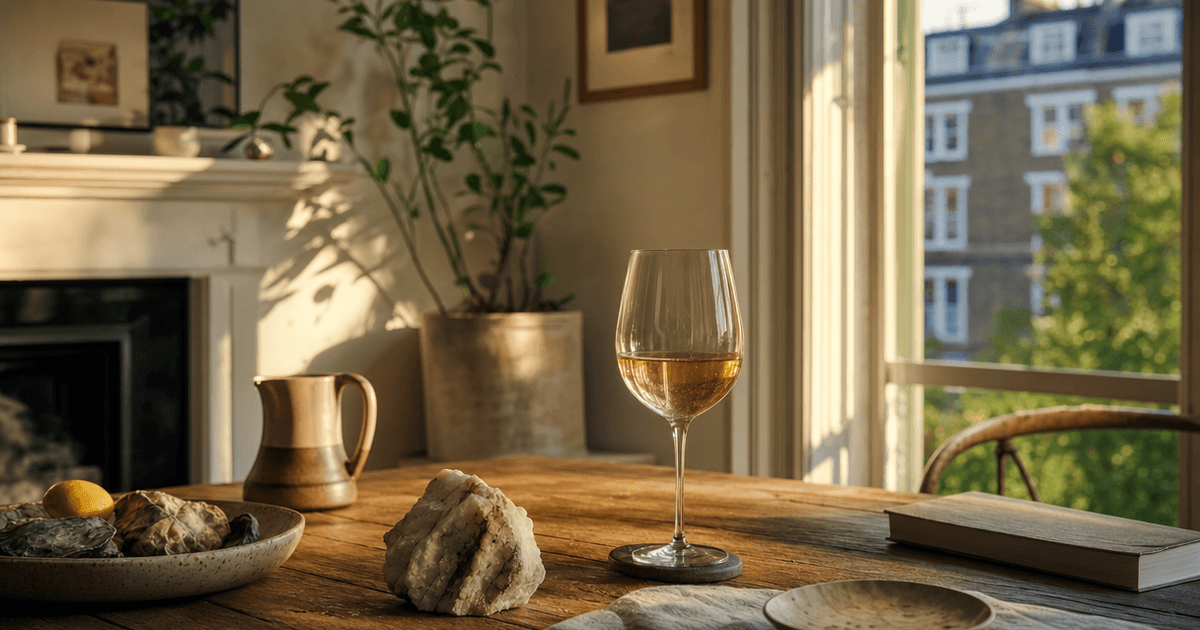
Minerality in wine is the word tasters reach for when a white wine tastes of something that isn’t fruit, wood or flowers — a chalky, flinty, wet-stone thing sitting underneath everything else. In plain terms, it’s a tasting term for stony, saline or smoky sensations found mostly (not only) in cool-climate whites; it is not, whatever the back label implies, proof you’re tasting crushed rock. By the end of this you’ll know what the term is really describing, how to spot it in the glass, which bottles reliably show it, and where the romance runs ahead of the science.
What does minerality mean for wine?
Minerality means stony, chalky or flinty character in a wine’s aroma, flavour, or texture — an imprecise but genuinely useful term that became fashionable in wine writing in the early 2000s, though words like flinty and chalky had described wines such as Chablis and Sancerre for decades before that. Nobody fully agrees on the cause.
Here’s where I used to get it wrong on the shop floor: I’d tell customers minerality came straight from the soil, like the wine had somehow absorbed the vineyard’s rock. It’s a nice story. It’s just not quite true. Vines take up mineral nutrients — potassium, calcium and the rest — dissolved in soil water, and most of a vine’s actual nutrition comes from organic matter in the soil, not from rock itself. Nitrogen, phosphorus and sulphur, three of the big ones, are barely present in rock at all.
There’s also a chain problem. Geological minerals in rock have to weather down, dissolve, get taken up by roots, survive fermentation yeast doing its own thing with the must — by the time you’re smelling the glass, one geologist has put total minerals at around 0.2% of the wine, calling them “last in all the things that give wine its flavour.” Trade research backs this up from the other direction too: excellent wines come off acidic, neutral and alkaline soils alike, with little to suggest wine quality tracks a specific soil chemistry.
So what is it, then? Easier to say what it’s not — not fruity, not vegetal, not animal. What’s left after you subtract those is the territory minerality occupies.
Can you smell minerality in wine?
Sometimes, yes — but more often it’s what you feel on the palate than what hits your nose. Trade coverage on this is split: some tasters find it mainly aromatic, most find it shows up as texture and grip alongside high acid. One widely used flavour-wheel framework has no slot for it at all, because there’s no single compound behind “mineral” as a catch-all.
There is one genuine exception worth knowing. Researchers have traced a specific sulphur compound to the smoky, gunflint-like aroma found in certain wines — a real, measurable thing, not just a metaphor. But that’s one narrow slice of what people mean by minerality, not the whole picture.
The more interesting explanation for why you smell it might be you, not the wine. Researchers studying the term have pointed to “tasting by association” — you learn Chablis is meant to be flinty, Mosel is meant to taste of wet slate, and your brain does some of the work for you. Lick an actual piece of flint or slate and there’s not much flavour there at all; flint, specifically, is tasteless and odourless. If you want the fuller picture of how acid, not stone, drives a lot of what reads as “mineral” freshness, our guide on acidity in wine is the natural next stop.

Which white wine has minerality?
Chablis and Sancerre are the two names that come up most, followed by Mosel and Rheingau Riesling, and Austrian whites from Wachau and Kremstal. It isn’t only a white-wine thing either — Priorat reds from slate (llicorella) soils and Mencía from Ribeira Sacra and Bierzo carry a similar stony character on the palate.
| Wine / Region | Grape | Soil association | Character |
|---|---|---|---|
| Chablis | Chardonnay | Kimmeridgian limestone/chalk | Chalky, oyster-shell edge |
| Sancerre, Pouilly-sur-Loire | Sauvignon Blanc | Flint (silex) | Smoky, wet-stone |
| Mosel, Rheingau | Riesling | Slate | Wet slate, saline |
| Wachau, Kremstal | Grüner Veltliner, Riesling | Gneiss, loess | Stony, peppery |
| Priorat | Garnacha, Cariñena | Slate (llicorella) | Dark, mineral-edged red |
Champagne’s chalk deserves its own mention — calcareous soils there sit alongside Burgundy and Barolo, and the caves cut into that limestone are still used for storage today. Chalk gives a specific textural thing: a dry, finely grained feel some tasters call “chalky” as its own category within minerality, distinct from flint’s smokiness.
Worth a look too: Greek whites, particularly Assyrtiko off volcanic Santorini soils, are increasingly cited in trade circles for a similar saline, stony edge — we cover that in our Greek wine guide. And Chablis gets a full chapter to itself in our dedicated guide, if that’s the direction you’re leaning.
What does flinty minerality mean in wine?
Flinty minerality describes a smoky, struck-match character, most associated with wines grown on actual flint-bearing soils — Sancerre, Pouilly-sur-Loire, parts of Champagne, some English vineyards. Flint is an ultra-fine silica rock, often found alongside chalk, formed originally from ancient sea-floor algae hardening over time.
The odd part: flint itself is tasteless and odourless. What it does do in the vineyard is practical — it improves drainage and, being inert, restricts how much nutrient the vine can pull up, which some growers believe concentrates flavour elsewhere. The “flinty” tasting term is metaphorical, likely a nod to how flint breaks into sharp, glassy edges, or to the smell of two pieces struck together.
Where the science gets more concrete: that gunflint-smoke note some tasters pick up isn’t purely imagined. It’s been tied to a specific compound formed during fermentation, present in certain wines regardless of whether the vineyard has flint in the ground at all. So a wine can taste “flinty” without a single flint pebble anywhere near the vine — which rather undercuts the tidy soil-to-glass story, but there it is.
Choosing and serving a mineral wine
If you’re picking a bottle for that stony character, grape and region together do more work than any single word on the label. Chardonnay off Kimmeridgian limestone, Sauvignon Blanc off flint, Riesling off slate — pick the pairing, not just the buzzword.
Serve these on the cooler side; a chilled glass holds the acid and texture together, and that’s largely what you’re tasting as “mineral” anyway. On the table, dried spices and coriander are a trade-recommended match for earthy, flinty, minerally styles — think a Thai-leaning green curry alongside a crisp Sancerre, or a spiced fish dish with a chalky Chablis.
One caution, kindly meant: mineral wines have picked up a romantic halo in the trade — “elegant,” “pure,” “artisan,” implying they’re a cut above fruitier, more commercial styles. That’s marketing doing some of the talking. Taste blind if you can, trust the acid and the finish over the story on the label, and you’ll make a better call than most of us managed for years. If you want the fuller foundations before you go shopping, our pillar guide to wine basics is worth ten minutes.
Questions customers ask us
Does minerality mean a wine is better quality? No — it’s a style marker, not a quality one. Excellent wines exist with plenty of mineral character and without it; don’t let the word alone push your decision.
Is minerality just acidity by another name? They’re closely linked but not identical. High acid wines often read as more “mineral” because the sharpness draws attention to texture, but acidity and stony flavour are separate things happening together.
Can red wine have minerality? Yes — Priorat and some Mencía from northern Spain are the trade’s go-to examples, both grown on slate.
Does soil type directly control the taste? Only indirectly, through drainage and vine stress, not by lending the wine its own flavour — the mineral nutrients a vine absorbs don’t map neatly onto what you taste in the glass.
The merchant’s last word
I’ve poured a lot of “mineral” wines across a lot of counters, and the honest answer is: nobody’s fully cracked what it is, me included. What I do know is which bottles show it reliably, and that’s worth more than any theory. Fancy chasing some wet stone and chalk dust for yourself? Browse the Red cellar and I’ll point you towards the right glass.



