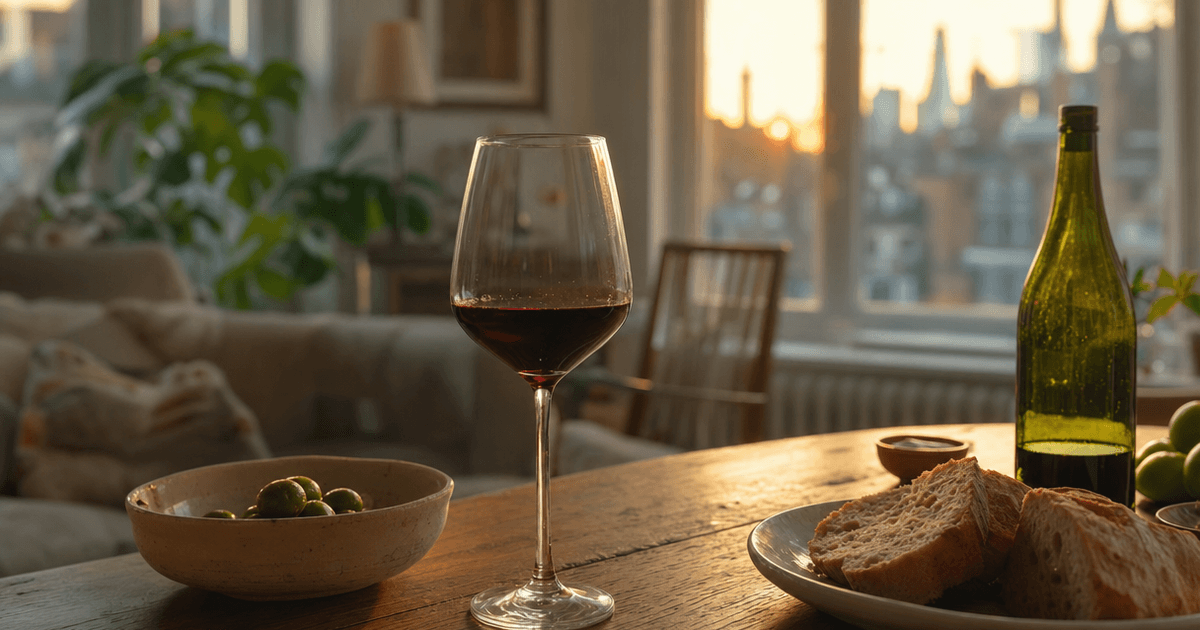
Txakoli wine is the taste of a Basque pintxos bar before you’ve even ordered the anchovies — bracing, faintly fizzy, poured from somewhere near the barman’s shoulder rather than politely at the table. It’s a light, high-acid white from Spain’s Basque coast, made mostly from the Hondarrabi Zuri grape and drunk within a year or so of the harvest. By the end of this you’ll know what’s actually in the glass, whether it leans dry or sweet, and which of the three Basque regions to reach for depending on what’s on the plate.
What is a Txakoli wine?
Txakoli (say cha-ko-lee) is a light, white style from Spain’s Basque Country, made mainly from the Hondarrabi Zuri grape and released young. The name comes from the Basque etxekoa, roughly “home-made” — this was farmhouse wine long before anyone thought to export it. It isn’t one grape or one place; it’s three small appellations strung along the Bay of Biscay, all making crisp, coastal whites meant for the table, not the cellar.
I used to file it under “holiday drink you can’t get at home” — the sort of thing you have standing up in San Sebastián and then forget about back in Bristol. That’s changed. Trade coverage over the past decade has tracked a real recovery: regional plantings grew from around 14 hectares in the 1980s to roughly 400 hectares by the late 2010s. That’s a genuine revival, not just marketing.
It’s worth knowing why it nearly vanished. A century ago vineyards ran from Bayonne down to Bilbao — well over 1,000 hectares by some estimates. Phylloxera tore through, and by the late twentieth century Álava had fewer than five hectares left standing. What survives now is deliberately high-trained, partly to keep the bunches clear of a genuinely wet climate: annual rainfall around 1,500–1,600mm, which makes downy mildew a constant worry and organic canopy management less a fashion than a necessity.
The grape mix is narrower than people assume. Hondarrabi Zuri, together with its close relative Hondarrabi Zuri Zerratia (better known outside Spain as Petit Courbu), makes up around 85% of everything planted. Small amounts of Folle Blanche (locally Mune Mahatsa), Riesling, Gros Manseng and Petit Manseng fill in the gaps. About 2% of production is red, from Hondarribi Beltza — worth knowing if you spot one, since it’s genuinely uncommon.
Is Txakoli wine dry or sweet?
Txakoli is dry — the classic style is bone dry, high in acid, low in alcohol, with a small natural prickle on the tongue. That holds true across all three Basque appellations. Sweet versions do exist, made in tiny volumes from Petit Manseng, but they’re a curiosity you might spot on a specialist list rather than the bottle you’ll find at the corner shop.
The fizz itself isn’t added. It’s carbon dioxide from fermentation, trapped under a layer of inert gas rather than pumped in, which is why it reads as a whisper rather than a shout — nothing like Cava or Prosecco. Some producers now bottle a genuine traditional-method sparkling version (labelled Apardunak under rules brought in during 2021), which is a different, more deliberate fizz entirely.
Style also splits by region in a way that matters more than sweetness ever will. The classic Getaria style is bright, green, almost herbal — cut grass and lemon pith. Move west to Bizkaia or inland to Álava and you’ll find producers working the lees deliberately, building texture and roundness that trade writers have compared to good Albariño from Galicia. There’s also a newer official category, Txakoli Bereziak, for wines aged at least five months in barrel and on lees — proof this is a style still finding its ambitious edge, not a museum piece.
How to choose: the three DOs
All three Basque DOs sit on the Atlantic side of the country, but they don’t taste the same. Here’s the shape of it:
| DO | Roughly where | Style | Main grapes |
|---|---|---|---|
| Getariako Txakolina | Coast west of San Sebastián | Lightest, spritziest, most herbal — the classic style | Hondarrabi Zuri (~95%), plus small amounts of Gros Manseng, Riesling, Chardonnay, Petit Courbu |
| Bizkaiko Txakolina | Around Bilbao and Bakio | Richer, fuller, more lees contact | Hondarrabi Zuri, Folle Blanche |
| Arabako Txakolina | Inland, Álava province | Similar to Bizkaia in style; smallest of the three DOs | Hondarrabi Zuri, Gros Manseng |
If you want the wine most people picture when they hear the word Txakoli — pale, prickly, poured from height — go Getaria. If you want something with a bit more weight to sit alongside a proper Tuesday fish supper, look to Bizkaia or Álava instead. Recent regulation puts Getaria at roughly 433 hectares, Bizkaia at 428, and Álava at around 100 — so Getaria and Bizkaia are near enough neck and neck, with Álava the minnow.
How to serve Txakoli
Serve it cold — proper fridge-cold, not just cellar-cool — and don’t be precious about the glass. In the Basque Country it’s traditionally poured from a height into a flat-bottomed tumbler, partly showmanship, partly to rough up that gentle spritz before it hits the table. If that feels like overkill in your kitchen, a decent white wine glass does the job; for the exact temperature range, our wine serving temperatures cheat-sheet will save you the guesswork.
Where it earns its keep is on the plate. Think anchovies (especially marinated ones), bacalao, oysters, crab, grilled sardines, shellfish, sushi, even Thai food — anything with salt, acidity or a squeeze of vinegar. Garlic and pil pil sauce, the classic Basque emulsion for salt cod, are practically designed for it. If that sounds familiar, it’s the same instinct behind our piece on Picpoul de Pinet, the seafood white that lip-stings — different coast, same job: acid doing the heavy lifting alongside fish.
What it costs, and finding it in the UK
Txakoli is still a specialist pour in the UK rather than a supermarket staple, though that’s shifting as more importers bring small parcels over each spring. Because it’s meant to be drunk young, look for the current or most recent vintage on the label — this isn’t a wine anyone’s asking you to lay down.
One honest quirk worth knowing before you order online: bottle shapes are all over the place. Some producers use green glass, some brown; plenty still bottle in a German Riesling-style flute out of old habit, while the more ambitious estates have switched to Burgundy-shaped bottles to signal serious intent. None of it tells you much about what’s inside — it’s a region still settling on how to present itself, and I’d call that a growing pain rather than a red flag.
If you’re shopping for the real thing, your safest bet is a merchant who lists the DO clearly on the product page — Getaria, Bizkaia or Álava — rather than just “Txakoli” as a catch-all. For a wider sense of what else the country does well beyond Rioja, our guide to Rioja and beyond: Spain for people who love flavour is worth a browse alongside it.
Questions customers ask us
How do you pronounce Txakoli? Cha-ko-lee, with the stress on the middle syllable. Don’t worry about getting it perfect — most merchants (me included) will know what you mean from the first syllable.
Is Txakoli always white? No — about 2% of production is a light red from Hondarribi Beltza, and there are small amounts of rosé and traditional-method sparkling too, though white remains what most people mean by the name.
Does it age well? Not really, and that’s fine. It’s built for drinking within a year or two of release, when the acidity and spritz are freshest — treat it like a Tuesday-night bottle, not a birthday-in-ten-years one.
Is it similar to Vinho Verde? There’s a family resemblance — both are Atlantic-influenced, low in alcohol, and lightly spritzy — though the grapes, coastline and history are entirely separate.
The merchant’s last word
I’ve sold this to people expecting something like Prosecco, and to people expecting still Albariño — it’s neither, and that’s rather the point. It’s a proper coastal white with a job to do: sit next to seafood and get out of the way of the conversation. Chill it hard, don’t overthink the glass, and go easy with the bottle. If that’s sold you on it, go browse the spain cellar.



