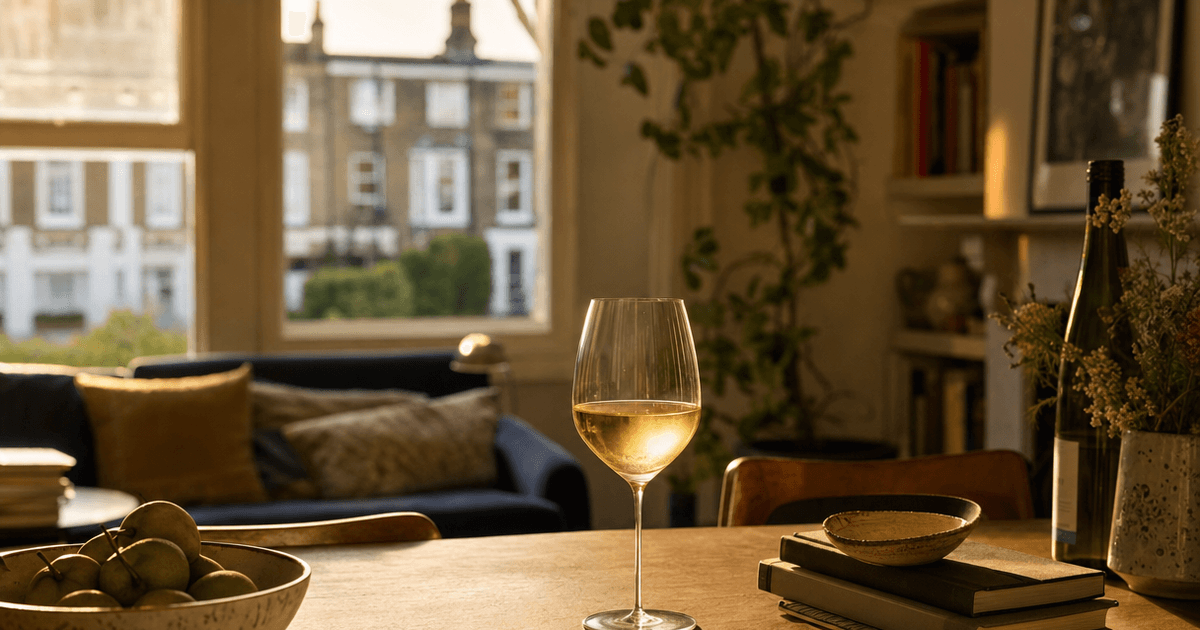
Is Riesling sweet? Sometimes — but here’s the stranger truth: even when it is, your tongue isn’t always told. Riesling’s acidity runs so high it talks over the sugar, which makes this the one grape where sweetness is better read off the bottle than guessed from the first sip. The variety can be made bone dry, gently off-dry, or unctuously sweet — the same hillside in the Mosel can produce all three in one vintage — and that ever-present acidity is why even a sweet Riesling rarely tastes heavy or sickly the way a lower-acid grape might. By the end of this you’ll know how to read a Riesling label with some confidence, so you land on dry for the Tuesday fish supper, off-dry for the curry, or properly sweet for something poured after pudding — on purpose, not by accident.
Is Riesling wine a sweet wine?
No, not as a rule. Riesling spans the full range from bone-dry to lusciously sweet, and nothing about the grape forces it one way. What’s constant is a thread of high acidity that runs through every style, which is why a sweeter Riesling can still taste fresh and lifted rather than flabby.
That acidity is doing more work than people give it credit for. It’s what lets Riesling ripen fully — building real sugar, sometimes helped along by botrytis, the noble rot that concentrates flavour in grapes left late on the vine — without the wine tasting flat or heavy. It’s also why Riesling ages so well; those honeyed, toasty, even faintly petrol-like notes that turn up in an older bottle are a Riesling signature, not a fault, and the acid is the scaffolding that lets the wine get there in the first place. If you want the fuller story of why acid matters this much, I’ve written about it separately in Acidity in wine: the backbone nobody talks about.
Fruit character shifts with ripeness too — green apple and lime in a cooler, earlier-picked style, moving towards peach and even tropical notes as ripeness climbs, with white flowers or honeysuckle often on the nose regardless. None of that tells you sweetness on its own. For that, you need the label.
Reading a Riesling label without needing a translation dictionary
German Riesling labels look intimidating, I know — I spent my first couple of years in this trade quietly guessing. Here’s the shape of it. The words trocken, halbtrocken, lieblich and süss tell you the residual sugar band, broadly:
| German term | Meaning | Residual sugar |
|---|---|---|
| Trocken | Dry | Up to 4g/l (or 9g/l where acidity is close behind) |
| Halbtrocken | Off-dry | 4–12g/l |
| Lieblich | Medium/medium-sweet | 12–45g/l |
| Süss | Sweet | Above 45g/l |
There’s a catch worth knowing, and it’s the same one from the top of the page: these bands measure sugar, not how the wine actually tastes on your tongue. A high-acid Riesling with a given amount of residual sugar will taste noticeably drier than a lower-acid grape carrying the same sugar — the acid masks it. So halbtrocken often reads as fairly dry in the glass, which is partly why some producers have quietly dropped the word from labels, wary of it sounding sweeter than it is.
Kabinett, Spätlese, Auslese and the sweeter Prädikat levels above them describe ripeness at harvest, in ascending order, not finished sweetness on their own — though in practice Kabinett tends to be the lightest and often the driest of the group, while Auslese and above usually land properly sweet. One trade shortcut in the same read-the-bottle spirit: check the ABV. A Mosel Riesling stopped early to keep its sweetness often sits at 8–9% alcohol; one fermented right out to dryness is more often 12% or above. It’s not foolproof, but it’s a faster read than the small print. For more on decoding a label generally, see How to buy wine like a merchant: labels, ratings and value.
Is Riesling sweeter than Pinot Grigio?
Usually, yes — but mostly because of what each grape is typically asked to do, not because Riesling is inherently sweeter. Most Pinot Grigio sold in the UK is made deliberately dry, crisp and neutral. Riesling, by contrast, is made across the whole spectrum, so on average you’re more likely to meet sugar in a Riesling than in a Pinot Grigio.
Put two bone-dry bottles side by side, though, and that gap closes fast. A dry Alsace Riesling and a dry Friulian Pinot Grigio can sit at near-identical sugar levels. What actually separates them is acidity and aromatic volume — Riesling carries more citrus and floral lift, and its acid is sharper, which can trick the palate into reading it as drier still than it technically is. That’s the trap Decanter’s own wine writers have flagged: dryness gets read as a sign of quality or sophistication, when really it’s the acid doing the talking, not the sugar count.
Which is sweeter, Chardonnay or Riesling?
Chardonnay is almost always vinified dry, wherever it’s grown and whatever the price point. Riesling is the variable one — so an average bottle of Riesling may well carry more residual sugar than an average Chardonnay, but that’s a shelf-level pattern, not a rule baked into either grape.
There’s a nice bit of family history buried here too: DNA work in Austria found Riesling shares a parent-offspring link with gouais blanc, which is also a parent of Chardonnay. Cousins, in effect. But they behave completely differently in the glass and in the cellar. Chardonnay tends to take on oak and winemaking style willingly — it’s a variety happy to be shaped. Riesling resists that; it’s “no friend of barriques,” as the trade puts it, and shows its vineyard site with a clarity that’s closer to how Cabernet Sauvignon behaves than how Chardonnay does. If that idea of a grape’s own character interests you, it’s the whole subject of The Grape Guide: how a merchant reads a wine by its grape. Riesling also tends to sit lower in alcohol than Chardonnay across the board, which changes the whole weight of the wine at the table, quite apart from sugar.
Is Riesling a good beginner wine?
Yes, with one condition: start with the right style, not the driest, most austere one on the shelf. A light Kabinett, or an easy off-dry bottle from the Finger Lakes or South Australia, is a far gentler introduction than a bone-dry Mosel or a steely Wachau Riesling, which even seasoned drinkers find demanding.
Low alcohol helps here too — some German Kabinett wines sit as low as 7% ABV, genuinely light in the glass. And the food range is enormous: Riesling runs happily alongside Thai and other spicy dishes, roast chicken, trout, scallops, even richer things like foie gras or pork belly if there’s a touch of sweetness in the glass to meet them. For the full logic of why sugar and spice get on so well, have a look at Food and wine pairing: a merchant’s complete guide to getting it right. Don’t feel you have to chase the bone-dry Clare Valley style on day one — a fruit-forward, slightly off-dry New World Riesling is a perfectly good place to start, and honestly a wiser one.
Questions customers ask us
Is Riesling always German? No — Germany is its heartland and still its largest home, but Alsace, Austria’s Wachau, Australia’s Clare and Eden Valleys, New York’s Finger Lakes and parts of New Zealand all make serious Riesling, in styles running from dry to sweet.
Does Riesling age well? Very well, arguably better than most white grapes — its acidity is the preservative, and older bottles develop honeyed, toasty, sometimes petrol-like notes that are considered a mark of good ageing, not a fault.
Why does Riesling have a bad reputation with some drinkers? Largely down to cheap, sweetened Riesling-adjacent wines sold decades ago under similar-sounding names — the real grape, made properly, bears little resemblance to those bottles.
Is Riesling ever made sparkling? Yes, and skin-contact versions exist too — its range runs wider than most drinkers assume, well beyond the still, dry-to-sweet spectrum most people picture.
The merchant’s last word
I used to sell Riesling apologetically, as though I owed the customer an explanation before they’d trust me. I don’t do that any more — it’s one of the most honest grapes I stock, it just asks you to read the label properly first. Pick your sweetness on purpose, match it to what’s on the plate, and it rarely lets you down. Go and browse the grape variety cellar and see what I mean.



