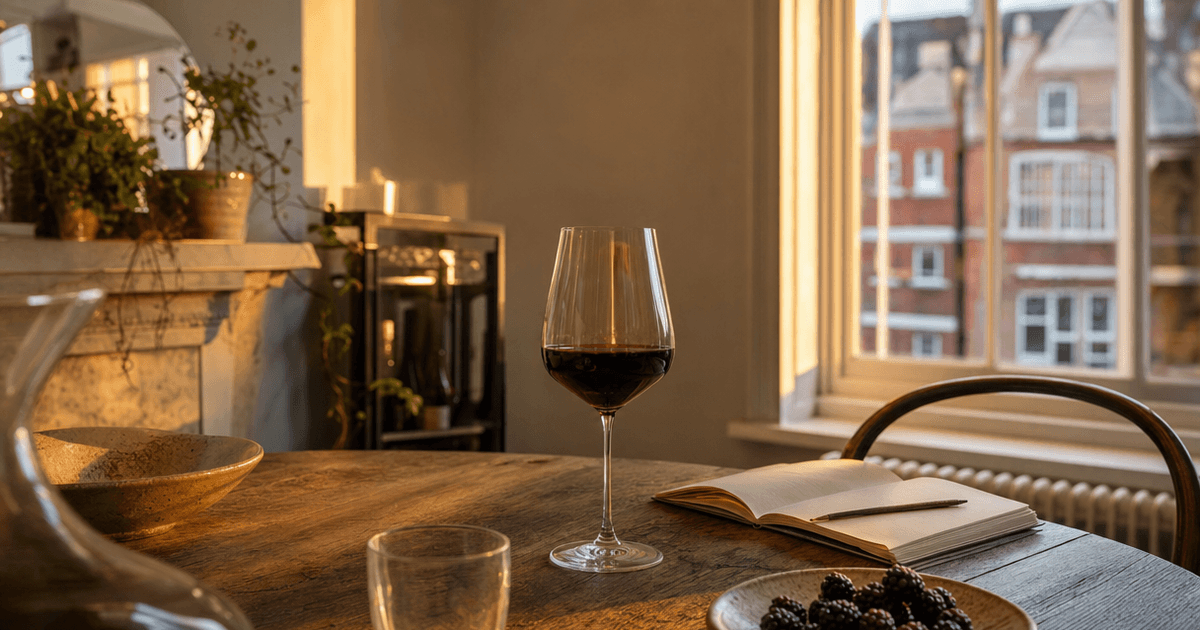
How to taste wine properly is the odd question out in this whole series: every other one has an answer I can hand over the counter, but this one is a skill you practise — which is exactly why people fear looking daft doing it in front of others, usually right after buying a decent bottle. Tasting wine, done properly, is just paying attention on purpose — eyes, nose and mouth, in a set order, so you notice more than you would gulping it down at the sink. A quick check takes seconds; a full, considered assessment can run to half an hour, and knowing which of the two the moment calls for is half the skill. By the end of this you’ll have a method you can actually use — at the table, in this shop, or stood at your own kitchen counter — without any of the swirling-and-spitting theatre putting you off.
What are the 5 S’s of wine tasting?
The 5 S’s — Sight, Swirl, Smell, Sip, Savour — are shorthand for the order most tasters work through a glass: look at it, get air into it, smell it, taste it, then notice how long it lingers. It isn’t sacred procedure. It’s just a sequence that stops you rushing straight to the sip and missing half of what the wine’s doing.
- Look. Angle the glass over a plain white background and check two things: how clear it is, and how deep the colour runs. Don’t assume a cloudy wine is faulty — plenty of natural or unfiltered bottles carry harmless sediment and taste perfectly fine. What’s more telling is what happens after a swirl: any fizz suggests trapped carbon dioxide, and the slow trails sliding back down the glass (often called legs) can point to alcohol strength. I’ve unpacked what that really means — and what it doesn’t — in our piece on wine legs, a quick read if you’ve ever wondered whether “good legs” is just a myth.
- Swirl. If you’re not confident lifting the glass, practise circling it flat on the table first. Once you do raise it, the movement should come from your shoulder rather than a quick wrist-flick. It’s not for show — swirling introduces oxygen and coaxes the aromatic molecules up and out of the liquid, which is really the whole purpose of the step.
- Sniff. Take one smell before you swirl, to catch the quieter, more fragile aromas, then another afterwards, once the wine’s opened up — the two readings rarely match. This is where most of the real information lives; your nose is doing far more heavy lifting than your palate ever will.
- Taste. Draw in a decent mouthful, roughly a dessertspoon’s worth, and let it move across your whole mouth rather than sitting still. Sweetness registers almost instantly at the tip of the tongue, acidity along the sides, while bitterness lags — sometimes up to fifteen seconds — and settles at the back. The drying, grippy feeling you get from red wine is a separate mechanism entirely, tannin at work, which I explain more fully in our tannin explainer.
- Reflect. Whether you swallow or spit, notice the aftertaste: how long it lingers, and whether the whole experience feels coherent or disjointed. A finish that vanishes in a couple of seconds tells a very different story to one still unfolding half a minute on.
How long it actually takes — and why nobody tastes like a professional at dinner
Here’s the bit that trips people up: professional tasting technique and dinner-table tasting aren’t the same activity, and trying to do the first while doing the second is where all the awkward theatre creeps in.
A full, considered assessment of one wine — written notes, watching how the aroma develops, judging the finish properly — can take fifteen minutes or more. That’s why serious comparative tastings usually cap things at five or six wines; any more and fatigue and odour adaptation start distorting what you’re actually perceiving. If the goal is just weeding out faulty bottles rather than ranking anything, a taster can get through twenty, even fifty, wines in a sitting, because the bar is simply “is this sound,” not “is this brilliant.”
None of that is how you’d taste a bottle on a Tuesday. At the table, most of your attention should be going to the meal and the company anyway — that’s not a lesser way of doing it, it’s the right one for the setting. Save the full five-step process for the wines you actually want to think about: something new, something you’re deciding whether to buy a case of, something you want to understand rather than just enjoy.

Which wine is best for diabetics?
I get asked this more than you’d think, and I want to be straight with you: it’s a medical question, and I’m not the person to answer it. Please put it to your GP or pharmacist, who can look at your situation properly — that’s not me passing the buck, it’s me not wanting to guess at something that actually matters to you.
What I can do is arm you with the vocabulary so that conversation goes better. Wines sit on a spectrum from bone dry to sweet, and that’s about residual sugar left after fermentation — nothing to do with quality, just style. A crisp Muscadet and a late-harvest sweet wine from Sauternes couldn’t be further apart on that scale, and everything in between exists too: off-dry Chenin Blanc from Vouvray, medium-sweet Riesling from the Mosel, fully dry reds from Bordeaux or the Rhône. Sweetness is also the sensation your tongue detects fastest, right at the tip, so it’s rarely subtle once it’s there. Dryness and acidity often get confused with each other, which is worth untangling — our piece on acidity covers that backbone properly if you want to go a level deeper. Ask your pharmacist the sugar question; ask me the style question.
Tasting at the table vs tasting to judge
These are genuinely different exercises, and knowing which one you’re doing saves you from performing a ritual that doesn’t fit the moment.
Tasting with food is meant to be simple and short — most of your attention, rightly, is on the meal and the people you’re with. Critical tasting, the kind done by buyers and judges, is the opposite: strict quiet, no competing smells in the room, sometimes even black glasses so colour can’t bias the palate before the nose and mouth get a say. Professionals do this because appearance alone can quietly steer your expectations of flavour before you’ve even lifted the glass.
You very rarely need the second version. If you’re working out whether to reorder a case, do the full five steps properly, ideally with a plain background and nothing distracting nearby. If you’re having a lasagne on a Wednesday, relax — the food is the point, and the wine’s job is to sit alongside it, not steal the room.
Your palate isn’t wrong — it’s just untrained
This is the bit that puts people off tasting altogether, and it’s worth saying plainly: there’s no objectively right answer for what you like. Personal taste in wine is genuinely subjective, shaped by your own sensitivities, and that’s not a failing — it’s just how taste works.
Even the language used to describe wine is an imperfect tool — a tasting note is one person’s brain filtering an overwhelming amount of sensory information into a handful of words, not a precise measurement. Mood, tiredness, what you ate an hour ago — all of it changes what you perceive in the glass, professional palate or not. So if a Sauvignon Blanc doesn’t smell like gooseberries to you, or a Gewürztraminer doesn’t shout lychee, you haven’t failed a test. You’re noticing something true to your own senses, which is the entire point of doing this yourself rather than parroting a label.
If you want the wider groundwork — what actually shapes how a wine tastes before it reaches your glass — our general wine guide covers that ground properly; that’s the half you can look up. This piece has stuck to the half you have to practise: the tasting itself.
Questions customers ask us
Does the size of the pour matter? A little — professional samples run to roughly a small measure, enough to swirl properly without wasting wine, and consistency between glasses matters more than the exact amount when you’re comparing wines side by side.
Why does the same wine taste different on day two? Air continues working on an open bottle, softening some elements and fading others — it’s genuinely a different sensory experience, not your palate playing tricks.
Should I smell before or after swirling? Both, and they tell you different things — smelling first catches the lightest, most delicate aromas; smelling again after swirling shows you what’s been coaxed out by the extra air.
Is there a “correct” glass shape? Tulip-shaped glasses that curve inward help concentrate aroma at the rim, and flutes suit sparkling wine for the visual of the bubbles — but no shape has been shown to transform a specific grape’s character. Consistency across your glasses does more for a fair comparison than the shape itself.
The merchant’s last word
I’ve sold wine long enough to know most people don’t need the ritual — they need permission to trust what’s actually in their own glass. Like any skill, this one grows with unglamorous repetition: learn the shape of it, use it when a wine deserves the attention, and skip it happily the rest of the time. If you fancy something worth doing the full five steps on this week, browse the Red cellar and pick something you haven’t tried before.



