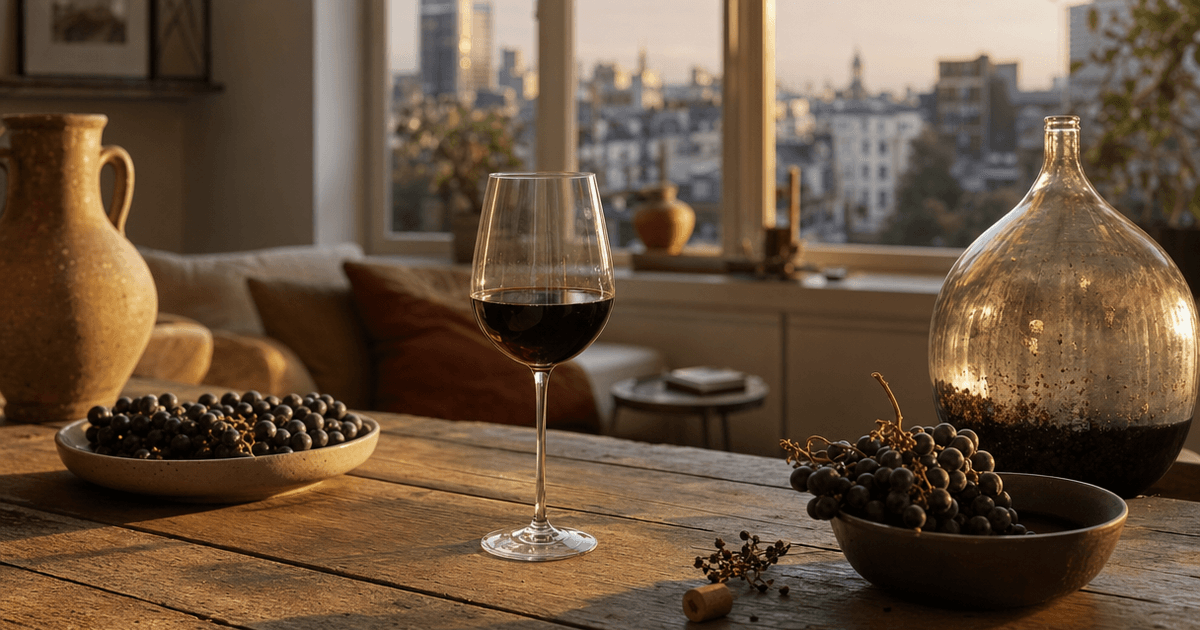
How is wine made? At the root of it, wine is just grape juice that yeast has turned into alcohol — fermented grape juice, full stop: yeast meets sugar, alcohol and carbon dioxide come out the other side. But here’s the merchant’s way to read the process, and the reason I walk customers through it at all: every step layered on top of that one chemical fact — the crushing, the choice of oak or steel, the months of patience in a cool cellar in Rioja or a stainless tank in the Loire — is a decision somebody paid for, and those decisions are what a shelf price is actually made of. By the end of this you’ll know what actually happens at each stage, why it changes what lands in your glass, and what each choice quietly adds to what you pay.
If you want the fuller tour of wine basics before we get into the weeds, our pillar guide is built for exactly that.
How is wine made step by step?
Step by step, it runs: harvest, crush, ferment, press (for white wine this happens before fermentation, for red it’s usually after), then élevage — the ageing, racking and clarifying that happens before bottling. Red wines ferment sitting on their skins, which is where the colour and tannin come from; white wines are typically pressed off the skins first, so you lose that grip. Every producer varies the timing, but that’s the shape of it.
Here’s the fuller sequence, more or less as it happens in a working cellar:
- Harvest. Hand-picked into small crates (common across much of Italy and Burgundy, and gentler on the fruit) or machine-harvested into larger bins, which is faster and cheaper but bruises the grapes more on the way in.
- Reception and sorting. Leaves, unripe bunches and the odd spider get pulled out before anything touches a press.
- Crushing and destemming. The skins split, the juice starts running, and — for red wine — this is where the grape’s flavour compounds begin to migrate into the must.
- Fermentation. Yeast converts sugar to alcohol, typically over five to ten days or more for reds in temperature-controlled tanks (Bordeaux reds often peak around 30°C, though many cellars are pulling that lower now for gentler extraction).
- Pressing. Whites go to press before fermentation; reds are pressed afterwards, once the skins have given up what they’re going to give.
- Élevage. Racking, clarifying, sometimes malolactic conversion, sometimes oak — this is where a producer’s philosophy shows, and where the most expensive ingredient of all gets spent: time.
- Bottling. Filtered or not, fined or not — another set of small choices that add up to style.
It’s worth saying: winemaking only became a proper science in the late 19th century, once Louis Pasteur worked out what yeast and bacteria were actually doing. Before that, cellars were running on inherited instinct — which, to be fair, got them remarkably far.
How is wine made alcoholic?
Wine gets its alcohol from yeast eating sugar. That’s it — no shortcuts, no additives required. Yeast cells land in the sugary grape juice, and as they feed, they produce ethanol and carbon dioxide as by-products. It happens naturally the moment yeast meets sugar; a producer’s real job is steering that process, not causing it.
Climate decides a lot of the groundwork before the yeast even gets involved. In a cool spot like the Mosel, grapes ripen slowly and hang onto plenty of acidity, and because sugar accumulation is slow too, the finished wine tends to sit lighter in alcohol. Somewhere hot — Central Valley Chile, say, or the Riverland in Australia — sugars build fast, and you end up with wines carrying more weight and less bite. Where a producer feels the grapes haven’t got quite enough natural sugar, some regions permit chaptalization (adding a little sugar before fermentation to lift potential alcohol) — legal in parts of France, banned in warmer places where it’s rarely needed anyway.
Most cellars now use cultured yeast strains bred for reliability, though a growing number of producers — often those working organically or biodynamically — ferment with whatever wild yeast turns up on the grape skins. Wilder, less predictable, sometimes more interesting. Malolactic conversion often follows alcoholic fermentation, softening sharp malic acid into rounder lactic acid — that’s why most reds taste smoother than the raw must ever did.

How is rosé wine made — and where it splits from red
This is where people often assume rosé is just red and white blended together (it’s mostly not, in Europe at least — that’s actually restricted). Real rosé gets its colour one of two ways: either the juice sits briefly on red grape skins before being drawn off — the saignée method — or red grapes are pressed gently and directly, picking up only a blush of colour on the way through. Short skin contact, pale colour, done.
It’s the inverse cousin of a technique we’ve written about before: Blanc de Noirs takes black grapes and presses them so fast and gently that almost no colour transfers at all, giving you a white wine from red fruit. Rosé is the same grapes, same instinct, just dialled to let a little colour through instead of none.
What separates an £8 bottle from a £30 one
This is where the steps above turn into pounds. Hand-harvesting into small crates protects the fruit — less crushing in transit, less oxidation, less risk from stray spoilage yeasts — but it’s slow and needs people, so it costs more. Machine harvesting is faster and cheaper, and modern harvesters can even sort and add sulphur dioxide in the field now, but the fruit takes more of a battering getting to the winery.
Then there’s the fruit itself. Some producers grow every grape they use; others buy in, and the price of bought fruit swings hard depending on variety and vintage. A winery chasing a low price point might blend something workaday — Airén, Ugni Blanc, Colombard — with a splash of something more expensive like Chardonnay, just to hit a shelf price. Neither approach is dishonest. They’re just different jobs being done for different budgets.
Ageing adds another layer of cost and time. Spain has actual legal categories — crianza, reserva, gran reserva — dictating minimum time in barrel and bottle before release, which is worth understanding if you’re choosing a Rioja Gran Reserva versus a younger crianza, or want the mechanics behind how Spain’s ageing law actually works. More time in oak and bottle before release means more storage space tied up, more capital sitting still — and that always shows up in the price.
Questions customers ask us
Does wine help lower LDL? That’s a medical question, and it’s genuinely not mine to answer from behind a wine counter — ask your GP or a dietitian. I can tell you plenty about how a wine’s made; I can’t tell you what it does inside your arteries, and I’d rather say that plainly than guess.
Which wine is best for diabetics? Same answer, different question — that one belongs with a GP or diabetes nurse, not a merchant. Come to me for grape, region and style, and take the health side to someone qualified for it.
Is machine-harvested wine automatically worse? Not automatically — plenty of good, honest everyday wine is machine-picked, and modern harvesters have got a lot gentler. It matters more for delicate, high-value fruit destined for long ageing, where bruising and oxidation really show.
Does oak “make” the wine, or just flavour it? Just flavour and texture, mostly — a bit of vanilla, a bit of spice, softer tannin through slow oxygen exchange. The wine underneath is still built entirely from grape, yeast and time; oak is dressing, not substance.
The merchant’s last word
I’ve poured a lot of wine across this counter over the years, and the question I get asked most isn’t “is this good” — it’s “why does this cost what it costs.” Now you’ve got the honest answer: harvest method, fruit cost, and how much patience went into the cellar before bottling. Come and put that to the test — browse the Red cellar and see what a bit of extra patience actually tastes like.



