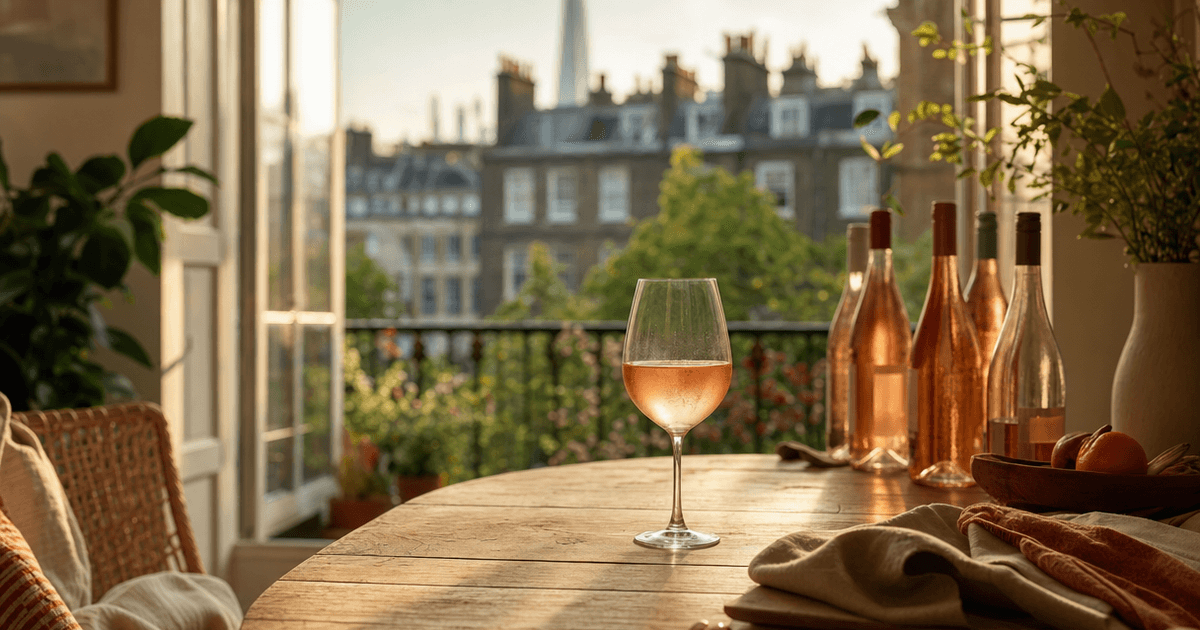
Best summer rosé wines is really a stocking question, not a tasting one — because summer rosé is rarely bought one glass at a time. It’s bought for a table of people: some arriving thirsty, some staying for food, some who’d secretly rather have bubbles. So this isn’t a hunt for one perfect bottle; it’s the method I use to stock a shelf, shrunk down to a shortlist you can carry into any shop. By the end of this, you’ll know how to build that list for a summer table — and which questions to ask instead of just squinting at the label.
What are the top 5 rosé wines?
There isn’t a fixed top five — vintages change, shelves change, and what your local shop stocks in June won’t be what it stocks in August. What doesn’t change is the shape of the category. Learn these five shapes and you can pick well anywhere, any summer.
| Shape | Typical colour | Where it’s from | Best for |
|---|---|---|---|
| Pale, bone-dry | Salmon to onion-skin | Provence, southern Rhône | Aperitif, canapés, hot days |
| Fruitier, softer | Deeper pink | Loire Valley (Anjou, Touraine) | Picnics, cold chicken, salads |
| Rosado | Pink to light ruby | Rioja, Navarra, other Spanish regions | Tapas, paella, grilled meats |
| Sparkling rosé | Pale pink, fine bead | Traditional-method regions, Prosecco-style | Toasts, brunch, anything fried |
| Off-dry, fruit-forward | Bright pink | California, and increasingly Rioja and southern France | Guests new to dry wine, spiced food |
Provence still leads the pale, dry end of the trade, and France overall remains the biggest rosé producer worldwide, with the Loire close behind Provence and the Languedoc for reputation. But the last few vintages of trade tasting have turned up sharp, fresh rosé from Rioja and some genuinely interesting Carignan-based pink from California — the category’s stopped being a Provence monopoly, even if Provence still sets the pale-and-dry template everyone else measures against.
If Spanish rosado is new territory for you, it’s worth its own look — I’ve written more on that style in Spanish rosado: the pink wine Provence doesn’t want you to find, because it deserves more than a footnote here.
What is the best supermarket rosé wine?
There’s no single best bottle sitting on a supermarket shelf waiting to be crowned — bottlings shift year to year and shop to shop. What you can trust is a method: check the colour through the glass (pale usually signals dry, though a darker rosé doesn’t always mean sweet — that’s a common and forgivable mix-up), read the region, and treat £8-£12 as the sweet spot for reliability.
Below that price, rosé tends to taste fairly interchangeable — red fruit, a touch of watermelon, not much else going on, which is fine for a big jug at a barbecue but won’t hold much interest sipped on its own. Spend a little more and you start getting texture, a savoury edge, sometimes a herby note that lifts it off the page. That jump in quality tends to show up around the low-to-mid teens in pounds, not because expensive automatically means better, but because that’s roughly where producers stop cutting corners on fruit selection.
One shelf trick worth knowing: clear glass bottles are common in rosé specifically because producers want you to see the colour before you buy. It’s a deliberate part of how the wine is sold, not an accident of packaging.

How to build your summer party shortlist
Don’t buy five different rosés hoping one lands — buy three, chosen for contrast, and let guests migrate between them. It’s how a merchant stocks a small shelf, scaled to a garden table: cover the corners of the category and let people find their own middle. One pale and bone-dry (Provence-shaped), one rounder and fruitier (Loire-shaped or a New World off-dry), and — if the weather’s playing along — one sparkling rosé for the first hour, when people are still arriving and want something with a bit of fizz in hand.
Rosé earns its keep with food far more than red or white manage at a garden table. It sits happily with grilled fish, pork off the barbecue, cured meats and olives, paella, hummus and flatbreads, even fried food, which is a rarer trick for a red. Melon and prosciutto is close to a classic pairing for a reason — the wine’s freshness cuts straight through the salt and sweetness.
For a proper sit-down affair rather than a stand-around one, my Hosting without stress: planning wine for a dinner party piece goes into pacing and quantity in more depth — worth a look if you’re catering for more than eight or ten.
Serving it right
Chill rosé harder than you’d chill a similarly styled white — but not so hard it goes numb and flavourless. Twenty minutes in an ice bucket with water added (ice alone doesn’t do the job properly) gets you there faster than the fridge door ever will.
Glassware matters less than people fear. A standard white wine glass is fine; you don’t need anything specialist. What matters more is timing — pour rosé too far ahead and it warms in the glass within minutes on a hot afternoon, losing the freshness that’s the whole point of drinking it.
For bigger gatherings, a magnum does something a table of single bottles can’t — it stays colder for longer once opened, and it’s one ice bucket instead of four warming bottles scattered across a table. If you’re planning for a crowd, Do bottle sizes change the wine? Halves, magnums and why size matters covers exactly when that’s worth doing and when it isn’t.
What it costs in shape
Budget rosé (broadly under £8) tends toward simple red fruit and watermelon, made to be poured cold and drunk fast — there’s a place for it, especially in a jug at a big outdoor do, but don’t expect complexity. The £10-£18 band is where most of the interesting Provence, Loire and Spanish bottles sit, and it’s where most of my own summer buying happens. Above £20-£25, you’re generally paying for single-vineyard fruit, sometimes barrel ageing, and a wine built to be thought about rather than just enjoyed in passing — recent trade tastings under £25 turned up genuinely serious pink from Tuscany, Santorini and southern France worth that step up.
If you want the fuller picture — how rosé is actually made, why colour and sweetness aren’t the same thing, what “Vin Gris” means versus standard rosé — that’s the job of my longer piece, Rosé, seriously: a merchant’s guide beyond the pink.
Questions customers ask us
Is rosé the same as blush wine? Not quite. “Blush” was the softer, often sweeter end of pink wine that had its moment decades back; modern dry rosé from Provence, the Loire or Spain is a sharper, more food-friendly style built for the table, not the fridge door of a 1980s kitchen.
Does rosé need to be very cold? Colder than most white wine, yes, but not fridge-numb — over-chilling flattens the fruit. A short, proper chill just before pouring does more good than an afternoon buried in ice.
What’s the difference between dry and off-dry rosé? Dry rosé has no perceptible sugar left after fermentation; off-dry carries a touch, which suits spicier food or guests newer to wine. Colour is a rough (not reliable) guide — pale usually means dry, but not always.
Someone asked me about the best rosé perfumes for summer once — wrong shop, but a fair mix-up. If that’s what brought you here, I can only help with the drinking kind. For that, a pale Provence-style or a Loire rosé chilled properly will do more for a summer evening than any bottle from a chemist ever could.
The merchant’s last word
I’ve sold enough rosé over enough Julys to know the mistake people make: buying one bottle and hoping. Buy the shape, not the label — pale and dry for the aperitif hour, something rounder for the food, fizz if the sun’s really out. Get that right and the party sorts itself out. If you’d like a hand narrowing it down, browse the rose wine cellar and I’ll talk you through what’s drinking well right now.



