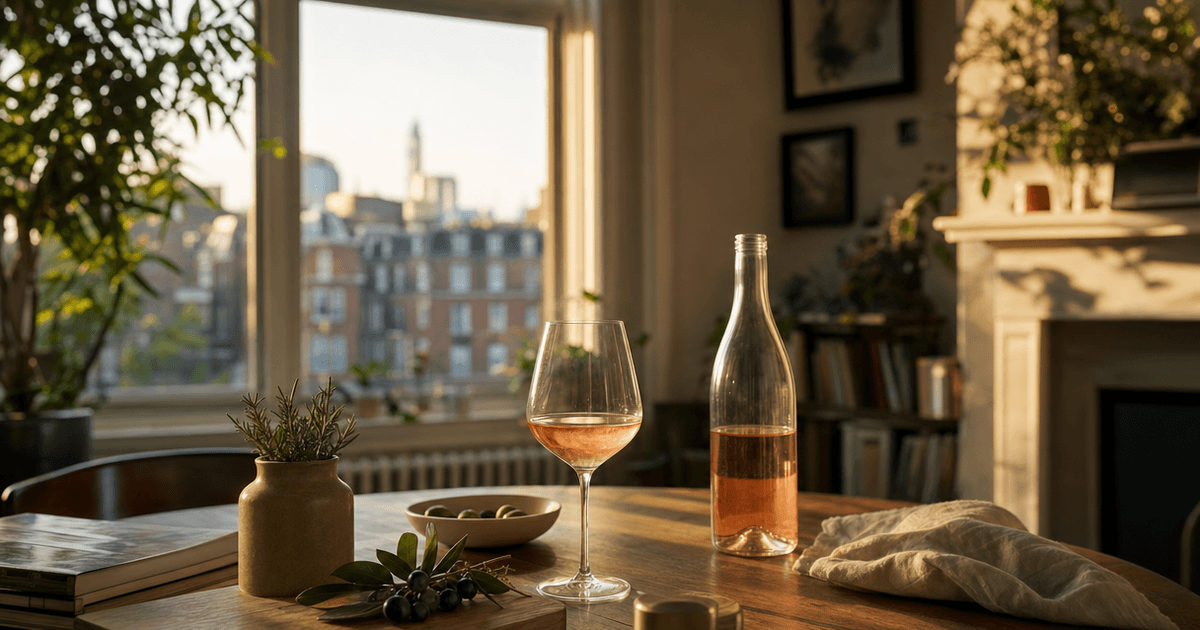
Bandol rosé wine is what you get when a red-wine appellation turns its hand to pink: rosé made by people whose benchmark is a Mourvèdre red built for decades in the cellar, and it shows in the glass. It’s a dry pink from a small appellation on the Var coast, built mainly around the Mourvèdre grape rather than the pale Grenache-and-Cinsault blends most of Provence leans on — deeper in colour, weightier in the glass, and, unusually for pink wine, able to hold its shape for a few years in the cellar. That red-wine backbone is the whole story here, and it’s why the trade rates it. By the end of this you’ll know how to spot a proper bottle, what makes it worth the extra few pounds, and when a standard Côtes de Provence rosé will do the job just as well.
What is a Bandol rosé wine?
Bandol rosé is a dry pink wine made under strict rules: it must contain between 20 and 95% Mourvèdre, with the balance usually filled by Grenache and Cinsault. That range matters — a Bandol rosé built on 70% Mourvèdre tastes like a different wine to one sitting at 25%, and the label rarely tells you which.
The appellation takes its name from the old port of Bandol, which once shipped these wines out across the world (the town itself is now more resort than working harbour). The vineyards sit well inland, on steep, south-facing terraces the locals call restanques, sheltered from the mistral by the Sainte-Baume hills. Soils are rocky — limestone and clay, low in fertility, which is exactly the kind of stress Mourvèdre likes.
The appellation was formalised in 1941, one of the first in France, driven by growers who wanted the region’s red wines recognised as something more serious than everyday Provençal pink. Rosé was always made alongside it, but for most of Bandol’s history the red was the point. That’s flipped: rosé now leaves the region in far greater volume than red or white, something recent trade estimates put at around three-quarters of everything bottled here.
What wine is Bandol famous for?
Bandol’s reputation was built on its reds — deep, structured, Mourvèdre-dominant wines that need patience and reward it. Reds must contain 50–95% Mourvèdre and spend a minimum of 18 months in oak before release, and the best can age for decades rather than years. Rosé, meanwhile, is the wine that actually pays the bills, accounting for the vast majority of what the appellation produces each vintage.
That split shows up in how the wines are judged, too. A 2024 trade panel tasting 77 Bandol wines across all three colours found reds took the lion’s share of the top scores, even though rosé made up the largest single group tasted. It’s a slightly odd position for an appellation to be in — famous for the wine it makes least of.
The red, when you find one, is worth understanding even if rosé is what brought you here. Expect dark fruit — blackberry, damson — moving with age towards truffle, leather and the dried herbs of the local garrigue: thyme, rosemary, bay. Firm tannins, high alcohol, built for the long game rather than a Tuesday supper.

How to choose a Bandol rosé
Because the Mourvèdre percentage swings so widely within the rules, two Bandol rosés can taste like different wines entirely. As a rough guide when you’re comparing bottles:
| Style | Typical colour | Grape base | Best drunk |
|---|---|---|---|
| Standard Provence rosé | Very pale pink | Grenache & Cinsault led | Within a year or two, well chilled |
| Bandol rosé | Deeper pink, sometimes salmon-orange | Mourvèdre led (20–95%) | Fine young, better with a year or two of bottle age |
| Bandol red | Deep ruby | Mourvèdre led (50–95%), oak-aged | 7–8 years minimum, often 20+ |
If a merchant or back label mentions the Mourvèdre percentage, that’s worth paying attention to — higher generally means more structure, more ageing potential, and a wine that wants food rather than a sun lounger. One long-established Bandol estate, whose rosé dates back to the 1830s, is often cited by wine writers as the reference point for the style: fuller fruit (apricot, grapefruit, red berries), a mineral, almost stony edge, and enough grip to hold across a whole meal rather than just the first glass. Trade coverage notes that particular bottling’s price climbing every vintage — a sign of demand outpacing what a small, terraced appellation can actually grow.
Getting it on the table
This isn’t a fridge-door rosé. Serve it a notch warmer than your everyday Provence pink — ten minutes out of the fridge before pouring does the job — and it opens up properly.
Food-wise, Bandol rosé was built for the coast it comes from: think anchovies, brandade, grilled tuna, roasted peppers, seafood, tapas. Provençal aïoli — that garlicky, olive-oil-heavy dish everyone in the region seems to have an opinion on — is the pairing the appellation’s own wines were designed around, whichever colour you’re pouring. The red wants heavier work: grilled or roasted lamb, game, barbecued meat, the kind of dish that can stand up to real tannin.
Is Bandol rosé good?
Yes, on the evidence of recent trade tastings — a 2024 panel of 77 Bandol wines returned zero scores below “commended,” with the majority landing in “recommended” or higher and four hitting “outstanding.” That’s a consistent showing across red, rosé and white, though the reds still edge ahead for critical acclaim.
What that consistency doesn’t tell you is how the styles differ bottle to bottle. Reference books have long called Bandol the most serious wine-producing corner of Provence, and that reputation was earned by the reds decades before rosé caught up in either volume or attention. What’s changed is that producers now bring their red-wine habits to the pink — some ageing it briefly before release, aiming for real structure rather than a pale, forgettable summer pink. Vineyard land here has also been shrinking for years, squeezed by coastal property development and tourism (trade sources differ on exact figures, but the direction is the same everywhere you look), which keeps supply tight and, generally, quality pressure high.
If you’ve mostly drunk pale Côtes de Provence rosé and assumed that’s what all Provençal pink tastes like, Bandol is the wine that corrects that assumption. It won’t replace your poolside bottle. It’s not meant to.
Questions customers ask us
Is Bandol good wine? Yes — it’s regarded as Provence’s most serious wine-producing appellation, red especially, though quality still varies producer to producer. Buying from a merchant who tastes before they stock is the shortcut past that variation.
What other grapes go into Bandol rosé besides Mourvèdre? Mainly Grenache and Cinsault, in whatever proportion the producer decides within the 20–95% Mourvèdre rule. Some producers lean heavily on Mourvèdre for structure; others keep it lighter and more aromatic.
Does Bandol rosé age well? Better than most pink wine, yes — the acidity and tannic grip from the Mourvèdre give it a couple of years of upside that a standard Provence rosé simply doesn’t have. It’s not built for a decade in the cellar, but a year or two won’t hurt it.
How is Bandol different from the rest of Provence? Provence overall makes rosé mostly from pale Grenache and Cinsault; Bandol builds its wines, red and rosé alike, around Mourvèdre grown on sheltered, terraced, south-facing slopes. That single grape shift changes the whole character of what ends up in your glass.
For more on how pink wine varies by grape, region and style, our Rosé, seriously: a merchant’s guide beyond the pink covers the bigger picture. If you want to see how Spain does structured pink differently, Spanish rosado: the pink wine Provence doesn’t want you to find is worth a read, and for the legal side of ageing rules elsewhere, How does Spain’s wine ageing law actually work? fills in that comparison.
The merchant’s last word
I sold Bandol rosé for years as “posh Provence” and left it there — lazy, and it undersells what’s actually going on in the glass. It’s a red-wine region’s idea of pink — built differently, from vines that fight for their spot on the hillside every year. If you’ve only ever had the pale, poolside style, this is the one that’ll make you sit up and ask what you’ve been missing. Go on, browse the rosé wine cellar and find out for yourself.



