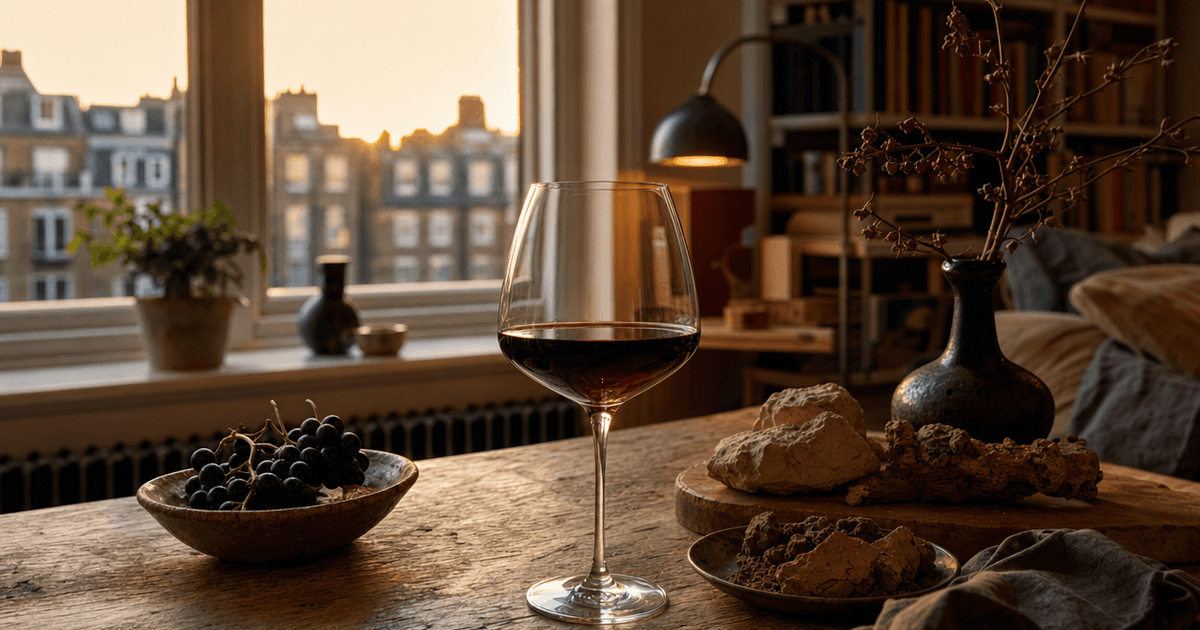
Spain’s great red rivalry is really an argument about altitude. Ribera del Duero is the wine that turned up at the party years after Rioja and quietly won over half the room — and it did it by taking the same grape somewhere higher and colder. It’s a Spanish appellation making red wine almost entirely from Tempranillo — here called Tinto Fino or Tinta del País — grown along a high, cold stretch of the River Duero in Castilla y León. (Some estates fold in a little Cabernet Sauvignon, Merlot or Malbec, but the backbone is always that one grape.)
By the end of this you’ll know what genuinely separates a bottle of Ribera del Duero from the Rioja sitting next to it on the shelf — mostly height, cold and nerve — and which one to reach for depending on what’s in the pan tonight and how long you’re willing to wait for the other.
What kind of wine is Ribera del Duero?
Ribera del Duero is a red wine built on Tempranillo, farmed at real altitude in the upper Duero valley. It tends to be darker and denser than Rioja, with more black fruit and firmer tannin, and less of the vanilla-and-dill sweetness that long ageing in American oak gives a classic Rioja. It arrives with its elbows out rather than easing in gently.
Soil is more of a story here than in most Spanish regions. The ground shifts hugely from one corner of the appellation to the next — chalky, limestone-rich patches in the east that could pass for Jerez, heavier clay taking over as the land flattens towards the west. A good share of the vineyard is still old bush vine, though the flatter west allows trained rows and machine picking. Much of what’s in the ground today is fairly young: a lot of it went in during a planting boom through the 1990s. Before any of that, this was Roman country — there’s a theatre at Clunia, and the Vaccei people were working these river terraces long before anyone had written the word Tempranillo down.
Where is the Ribera del Duero region?
The region sits in Castilla y León, north-central Spain, east of Valladolid and running along the upper Duero valley — the same river that becomes the Douro once it crosses into Portugal. It only earned DO status in 1982, starting from a handful of wineries; today there are several hundred, spread across an area roughly a third the size of Rioja.
Altitude is the real story, not latitude. Vineyards climb to genuine height, the growing season runs short, and frost is a risk either side of summer — this is not the sun-baked Spain of postcards. That marginal climate is exactly why the wines can swing from thin in a poor year to properly concentrated in a good one; vintage matters more here than in most of Spain’s warmer regions. One historic property in the western part of the appellation had been making wine there since the 1800s, long before the DO existed, and for the best part of a century was more or less the only serious name in the valley. If you want the wider map of what’s happening in Spanish wine beyond these two regions, our pillar guide to Spain is worth a read.
Is Ribera del Duero better than Rioja?
Neither is “better” — they’re two different answers built from the same grape, argued out at two different heights. Ribera tends darker, richer and more structured, made almost entirely from Tempranillo. Rioja is traditionally a blend — Tempranillo with Graciano, Mazuelo or Garnacha — usually aged longer and arriving softer, with that familiar vanilla-oak signature. Which one wins on your table depends on what’s cooking and how patient you’re feeling.
| Ribera del Duero | Rioja | |
|---|---|---|
| Main grape | Tempranillo (Tinto Fino), near-solo | Tempranillo, usually blended |
| Typical style | Darker, denser, firmer tannin | Softer, more aged, vanilla-oak |
| Vineyard area | Smaller | Roughly three times the size |
| Ageing categories | Crianza, Reserva, Gran Reserva (Crianza most common) | Same categories, older tradition |
| Domestic reputation | Loved for its power, especially oak-driven styles | Long-standing calling card since the 1970s |
It’s the same argument we make about Barolo vs Barbaresco: same grape, different souls — same grape, two soils, two temperaments, neither one wrong. And if you enjoyed how the Left Bank vs Right Bank split defines Bordeaux, you’ll recognise the same tension here, just played out with Tempranillo instead of Cabernet and Merlot.
The two regions have also borrowed from each other, not always smoothly. There’s been at least one attempt at growing Tinto Fino in Rioja’s soils and Rioja’s own Tempranillo in Ribera’s, just to watch what terroir does on its own. Early results read like a work in progress; only with time did the wines settle comfortably into themselves. It’s a decent reminder that terroir isn’t decoration — move a grape a hundred miles, change the soil and the altitude, and you get a genuinely different wine, not a relabelled one.
There’s history behind the rivalry too. Rioja was Spain’s calling card by the late 1970s, winning over drinkers outside Spain with well-aged, vanilla-scented reds. By the late 1990s, Ribera’s darker, richer style started challenging that dominance, and it pushed a good number of Rioja producers toward riper, richer wines released with less age — splitting the region into modernist and traditionalist camps. More recently a third strand has emerged, favouring site over oak, earlier release, fresher wines, alongside a swing back toward single-variety Garnacha in some corners of Rioja. Worth knowing too: English critics have historically been cooler on Ribera’s fruitier, oakier mass-market style than Spanish drinkers themselves, who genuinely love it — the “Roble” category in particular sells hard on home turf.
Reading the label: Crianza, Reserva, Gran Reserva
Both regions use the same ageing ladder, telling you roughly how long a wine spent in oak and bottle before release — but the rungs sit differently up here. Crianza is the entry point and by far the most common category for wines from Ribera del Duero; Gran Reserva is genuinely rare and reserved for the best vintages. A growing share of everyday Ribera del Duero wine now carries no ageing category at all, made for drinking sooner rather than later — part of a wider move among quality-focused producers toward less time on skins and less new oak, chasing freshness over sheer weight.
What a bottle of Ribera del Duero costs you, in shape
Trade coverage is consistent on one point: Ribera isn’t cheap. Quality generally runs good to outstanding, but the price sits mid to super-premium rather than everyday-Tuesday territory, and the region has a strong domestic following plus real demand from markets like the US for that powerful, fruit-and-oak style. Rioja, by contrast, spans a far wider price ladder — from simple, inexpensive bottles up to fine old Reservas — partly a legacy of its DOCa classification having to satisfy everyone from small growers to large commercial brands at once. Neither shape is wrong; they’re just different shelves to shop from.
Questions customers ask us
Is Ribera del Duero a good wine? Generally, yes — trade opinion rates the region good to outstanding, though quality varies more than in some appellations, which is exactly why picking a merchant who’s tasted the bottle matters.
Does Ribera del Duero need decanting or ageing? Older-style Crianza and Reserva bottlings often benefit from an hour in a decanter; the newer, fresher, less-oaked wines coming through the region are built to drink sooner and don’t need the wait.
Which is more affordable, Ribera del Duero or Rioja? Rioja generally offers a wider spread, from everyday bottles to fine old vintages. Ribera sits mid to super-premium as a rule — you’ll rarely find a genuine bargain-basement bottle wearing that name.
The merchant’s last word
I sold Ribera del Duero as “Spain’s answer to Rioja” for years, which does it no favours — it isn’t answering anything, it’s its own wine, from its own harsh, high, brilliant bit of land. Try one alongside a Rioja from the same year and taste the argument for yourself. Come and browse the spain cellar — I’ll point you to the right bottle for what’s on your table tonight.



