Bandol is the bottle I reach for when someone tells me they’ve had enough of thin, forgettable Provençal pink and want something with a backbone. It’s a small appellation on the Mediterranean coast between Marseille and Toulon, built almost entirely around one grape — Mourvèdre, grown on steep, south-facing terraces above the sea. The old growers’ line about Mourvèdre is that it wants its head in the sun and its feet in the sea, and Bandol is one of the very few places in France that can honour both halves of the bargain. By the end of this you’ll know whether a Bandol red, rosé or white suits your table, and roughly what it costs to find out properly.
Is Bandol a good wine?
Yes — and trade opinion has said so consistently. Independent tastings of Provence reds tend to place Bandol’s best examples well above the regional norm for structure and ageing potential. It isn’t a wine built for instant charm, and it doesn’t try to be.
That seriousness has a date attached to it. In 1985, Bandol’s growers rewrote their own rulebook: minimum Mourvèdre in red wine rose from 20% to 50%, yields were capped at 40 hectolitres per hectare, and vines had to reach seven years old before their fruit could go into the wine at all. A generation of winemakers has spent the decades since refining what that stricter framework makes possible, and collectors have noticed — small-production Bandol has been drawing more interest from buyers hunting for something off the well-trodden Bordeaux-Burgundy path.
Buying takeaway: that 1985 rulebook quietly does your vetting for you — anything labelled Bandol rouge already had to clear the half-Mourvèdre bar, from vines at least seven years old, so even the appellation’s modest names start from a solid baseline.
What kind of wine is Bandol?
Bandol is a Mourvèdre-led red, rosé or, occasionally, white from one tightly drawn stretch of Provençal coast. Red Bandol must be 50-95% Mourvèdre and spend a minimum of 18 months ageing in oak before release. Rosé can carry anywhere from 20-95% Mourvèdre. The red is what the appellation’s reputation stands on; the rosé is what pays the bills.
| Style | Mourvèdre share | Character | Typical pairing |
|---|---|---|---|
| Red | 50–95% (18 months+ oak) | dark fruit, garrigue herbs, firm tannin | roast lamb, wild boar, roasted vegetables |
| Rosé | 20–95% | fuller and more structured than most Provence pink | anchovies, tapas, grilled fish |
| White | minor role, other varieties | light, dry, genuinely rare | bouillabaisse, lobster |
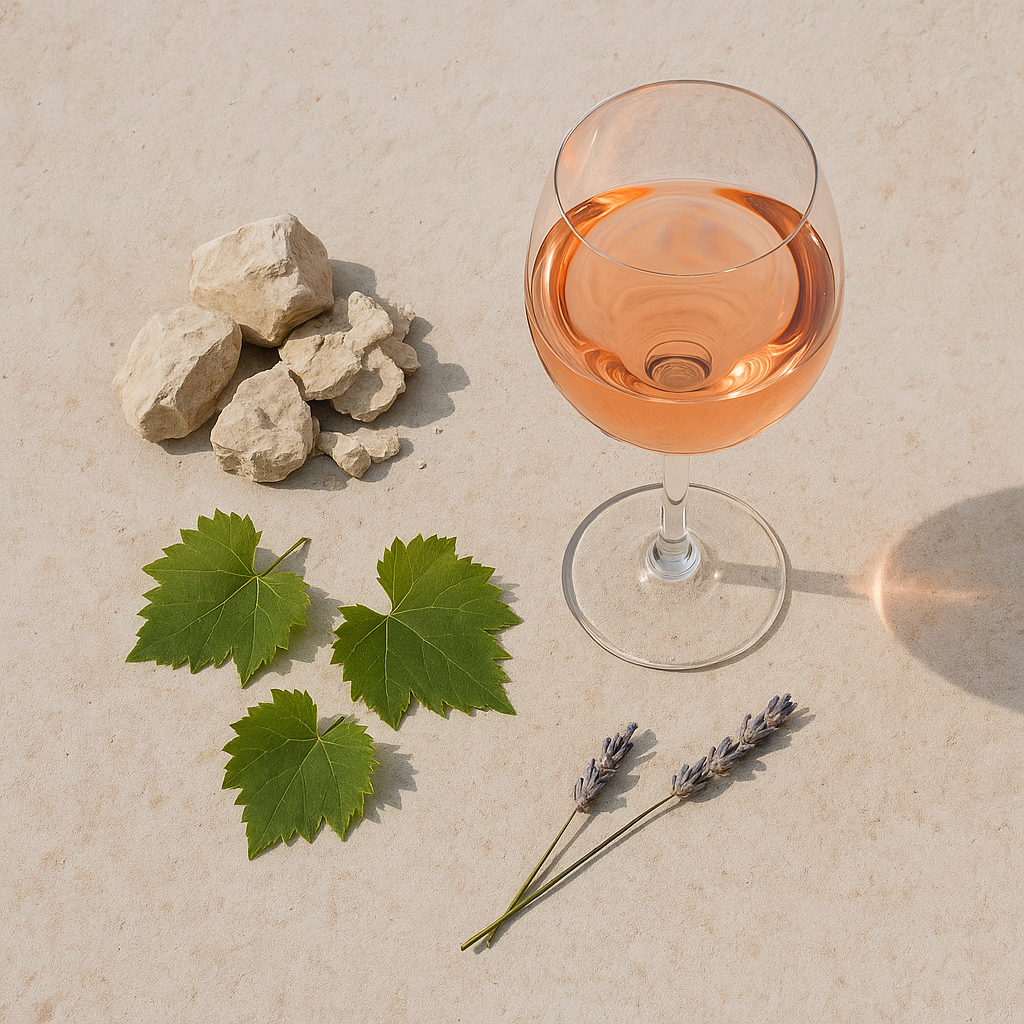
Rosé now accounts for the large majority of production by volume, whatever the reputation was built on. The soils don’t make any of it easy: rocky limestone and clay, low fertility, terraced by hand on slopes locally called restanques, which is slow, expensive work compared to flat vineyard land elsewhere.
Buying takeaway: here’s the rule worth memorising — no colour named on a Bandol label almost always means rosé; if you want the cellar wine, ask for “Bandol rouge” by name.
What is Bandol famous for?
Bandol is famous for ripening Mourvèdre better than almost anywhere else in France — a notoriously late, stubborn grape that needs real warmth right through to harvest (the head-in-the-sun half of the growers’ bargain). It’s also known for reds that ask you to wait: seven or eight years before they properly open, with the best holding for two decades or beyond.
The appellation takes its name from the old port town from which the wine was once shipped worldwide; the town itself is now mostly a Mediterranean resort with little to detain a wine tourist, which surprises people who assume the name means a cellar-crawl destination. It gained AOP status in 1941, making it one of France’s earlier protected appellations. The vineyards sit on an amphitheatre of terraces facing the sea, sheltered from the Mistral by the Sainte-Baume hills — warmth the grape finds almost nowhere else in France bar the southern Rhône.
Land under vine has shrunk under pressure from coastal development; trade figures for total hectarage vary depending on the year and how the count is drawn, which tells you the pressure on this land is real rather than theoretical. If Provence’s wider patchwork of appellations interests you beyond Bandol, our guide to the Rhône and the French South maps the whole coast, Bandol included.
Buying takeaway: with land under vine shrinking, this is not a wine getting more plentiful — one more argument for buying to cellar rather than waiting for it to come to you.
How to choose a bottle
Once you know red is the style with the cellar in mind, the real choice is age. A Bandol red released at the legal minimum — 18 months in oak — is still young by this appellation’s own standards. Ageing happens in large old oak vessels called foudres, a slow, static process quite different from the fractional blending you’ll find in a sherry solera system, if you enjoy seeing how different regions handle time (see how the solera system blends time itself).
For rosé, the opposite logic applies: buy the youngest vintage you can find. It’s built for freshness, not the cellar.
If you already love Châteauneuf-du-Pape, that’s your shortcut in: Bandol is the coastal cousin — same Mediterranean warmth, more Mourvèdre grip — and usually at gentler money, as the cost section below sets out.
Buying takeaway: for a first Bandol red, look for five years’ age minimum. For rosé, check the vintage on the back label and pick the newest one on the shelf.
Serving and pairing
Bandol red wants food with weight: roast lamb, wild boar, venison, roasted vegetables, even a good pizza or a plate of pasta with a rich meat sauce. It’s a full-bodied wine and shows its best against fat and char, not against something delicate.
Bandol rosé belongs at the saltier end of the Provençal table — anchovies, brandade, tapas, roasted peppers, grilled tuna. The rare white is bouillabaisse and lobster territory, best drunk where it’s made — more on tracking one down in the questions below.
Buying takeaway: roast a shoulder of lamb with rosemary and garlic, open a five-year-old Bandol red, and the appellation makes its own case — that dinner is the cheapest wine education I sell.
What it costs, and what that buys you
Bandol has never been cheap in the way some of Provence’s rosé-flooded neighbours are, and recent buying interest for small-production bottles has pushed the ceiling higher still. That said, the appellation is often compared to Châteauneuf-du-Pape for its quintessentially Mediterranean character, and it generally sits below Châteauneuf on price for a wine of comparable ambition.
If the well-known names have crept beyond your budget, the logic that works for grander Bordeaux applies here too: there’s usually a younger-vine or village-level bottling nearby doing something related for less — the same idea behind second wines from great Bordeaux châteaux.
Buying takeaway: treat a ready-aged Bandol red as a considered but not extravagant buy — and if that stretches too far, a younger vintage laid down yourself gets you there for less.
Questions customers ask us
Does Bandol red need decanting? Given the firm tannin structure typical of Mourvèdre, yes — an hour in a decanter, or longer for a younger bottle, helps it show properly rather than closed and tight.
Is Bandol rosé the same as the pink wine I drank on holiday in Provence? Possibly, though Bandol rosé is generally fuller-bodied than most Provençal pink because of the higher Mourvèdre content permitted — worth checking the label if you loved something lighter.
Why does Bandol taste different from other Provence reds? Because Mourvèdre dominates it, giving dark fruit, herbal garrigue notes, and firm tannin, where most Provence reds lean on Grenache and Cinsaut and taste softer, lighter, and drink younger.
Is there a white Bandol worth seeking out? There is, but production is tiny and mostly stays local — if you spot one, it’s a light, dry curiosity best matched to grilled fish rather than a wine to build a cellar around.
The merchant’s last word
I’ve sold this wine to people expecting Provence’s usual pale, easy pink, and watched them blink at how serious the red actually is. That’s the appeal — it’s the one corner of the coast that never chased fashion. We keep it filed alongside its southern neighbours; if you want to see where it sits next to the rest, browse the Rhône cellar.